Why Ramaphosa won’t be able to deliver the three urgent fixes South Africa needs:

The competition for the top six leadership positions in South Africa’s governing party, the African National Congress (ANC), was no carefully choreographed script such as the one-candidate-per-election of Chinese Communist Party congresses. It was a rip-roaring, full-throated democratic contestation – as raucous as US primary elections. Even more so, with delegates’ repeated singing and dancing.
This point bears emphasising. As recently as 2016, one hardline ANC critic published a book-length argument that ANC political practice and culture is shaped by an exile culture of avoiding or rigging elections. The ANC’s 2017 national elective conference proves him wrong.
At a cost of tens of millions of rand to host 4 776 delegates – and 1 200 accredited journalists – for a five day conference, the ANC achieved the closest possible thing to internal democracy. By contrast, the UK Prime Minister has, on occasion, been chosen by less than four hundred MPs in a party parliamentary caucus.
This refutes those who predicted “the end of the ANC”.
In the end Cyril Ramaphosa won the tightly contested race. He was the favourite candidate of that rarest of all alliances – business, labour and the South African Communist Party. His election was preceded by high expectations that, if elected, he would displace Zuma as state president before his term ends in 2019; stop corruption in loss making state owned enterprises; and make credible appointments to replace discredited ones in state institutions.
On the one hand, Ramaphosa’s narrow victory over Nkosazana Dlamini-Zuma means that there will be no breakaway from the ANC, unlike the Economic Freedom Front and COPE after previous pivotal moments in the party.
On the other, Ramaphosa wins a poisoned chalice, raising big question marks over whether he will be able to deliver on the three big expectations.
Poisoned chalice
Ramaphosa faces a number of constraints. The biggest one is the composition of the other four men and a woman who constitute the ANC’s “top six”. The team effectively runs the organisation.
The election results for the top six were a neck-and-neck mix of the two rival slates behind Ramaphosa and Dlamini-Zuma. Winning candidates were separated from their rivals by only a few hundred votes.
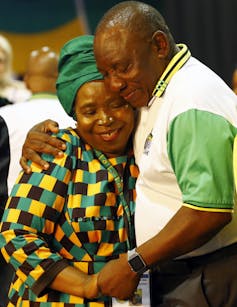
The rest of the team that will work with Ramaphosa are: David Mabuza as deputy president, Gwede Mantashe as national chairman, Ace Magashule as secretary-general, Paul Mashatile as treasurer-general and Jessie Duarte remains deputy secretary-general.
It makes for strange bedfellows given that Mabuza, Magashule and Duarte are widely viewed as Jacob Zuma supporters. This means that Ramaphosa won’t be as free to act as he might want to.
For example, it’s unlikely that a majority of the six would back a motion to ask Zuma to retire as state president before the end of his term of office in 2019.
It also remains to be seen to what extent this mixed slate leadership will support action against the Guptas, Zuma’s friends at the heart of state capture allegations, and tenderpreneurs – business people who get rich through government tenders, usually using dubious means – and the whole system of patronage and clientelism that has gotten out of hand.
The make-up of the team that Ramaphosa will lead might also baulk at pressing the ANC led Parliament to take decisive action against the decline in the country’s large state owned enterprises such as South African Airways and power utility Eskom.
Implications for the opposition
The best results from a partisan viewpoint for the Democratic Alliance (DA) and Economic Freedom Fighters (EFF) would be had Dlamini-Zuma won. This would have alienated more ANC voters in the 2019 elections.
Ramaphosa’s victory means the DA has no option but to knuckle down to the hard slog of building branches in townships, ensuring a rising proportion of black people are represented as members, and promoting a rising proportion of black representatives in its parliamentary and provincial legislature caucuses.
Anticipating a Ramaphosa win, DA leader Mmusi Maimane set the tone for his party’s 2019 campaign in a recent round of full page newspaper ads with the message: whoever wins at the ANC conference is irrelevant – only a DA government can turn the country around. For DA election canvassers, every month that Zuma continues in office as state president is the gift that keeps on giving.
But whether Ramaphosa can tempt disillusioned, abstaining ANC voters back to the polls remains a moot point. Will the DA now win the Gauteng Province in the 2019 elections? Will the ANC retain its shrinking Northern Cape Provincial majority? Can the DA get an absolute majority, or at least hold onto its three metro prize catches of Johannesburg, Tshwane, and Nelson Mandela Bay during the 2021 municipal elections?
All these questions are now part of the roller coaster ride that is normal in functioning democracies.
The EFF will probably continue its taunting of Ramaphosa as “buffalo man”, – a reference to the fact that he bought a buffalo cow and her calf for nearly R20 million rand – but the party seems to have hit its ceiling of attracting alienated ANC voters. It will struggle to build its share of the vote any higher.
This ANC elective conference marks the start of a watershed for the party, which will continue until the end of Zuma’s term as president of the country in 2019.

Keith Gottschalk is an ANC member, but writes this in his professional capacity as a political scientist.
Source: The Conversation – Articles (AFRICA)
Read more on The Conversation.
Join the fun: Add Your event | Submit a Press Release | Add your listing.


