Why some rebel groups force kids to fight: it depends on how they are funded:
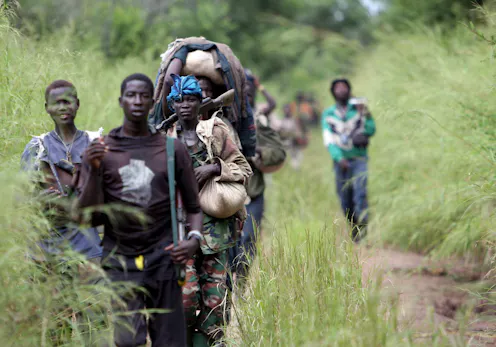
To sustain their operations, armed groups must have a steady supply of recruits. These serve to fill their fighting ranks and to replace those lost to injury, death, or desertion.
Most rebel groups around the world rely initially on volunteers but resort to some form of forced recruitment when they can no longer attract enough voluntary recruits. This strategy is particularly prevalent among rebel groups that recruit children. But the extent of forcible recruitment of children differs across rebel groups and conflicts and often evolves over the course of a conflict.
The topic of child soldiering has garnered significant attention in academic research. But few studies have considered why rebel organisations resort to the forcible recruitment of children. In cases when research has been done, a prevalent assumption has been that coercive recruitment is a “cheap alternative” to voluntary recruitment and a strategy that “rebel groups will choose to employ … if given the opportunity”.
But is this really the case? In our recent work we tried to understand why some rebel groups forcibly recruit large numbers of children while others don’t. To explain this variation, we examined a factor that’s often overlooked: the influence of a rebel group’s funding. Specifically, we looked at whether rebels profited from natural resources.
To explore the relationship between rebels’ funding sources and forcible recruitment, we looked at more than 150 rebel groups operating around the globe, from South America through Africa to Southeast Asia. We collected information on the level of forcible recruitment of children by these groups. For source data, we relied primarily on independent reports from organisations including Child Soldiers International, the International Labour Organisation, Human Rights Watch, and various independent news and academic outlets.
We made a clear distinction between the broader use of child soldiers, a significant portion of whom volunteer to join armed groups, and those forced into fighting for rebel armies.
The role of resources
Why would natural resource funding influence a rebel group’s forced recruitment of children? We offer several plausible explanations. First, we argue that rebel groups that do not profit from natural resources are often more dependent on civilian support to sustain their operations. Lacking a steady funding stream, these groups tend to rely more on local people to contribute money and supplies (like food and water) to their rebellions. Not surprisingly, such groups generally refrain from abusing civilians in order to maintain this support.
In contrast, we suggest that when groups successfully profit from natural resources, they become less dependent on the local population. As a result, they tend to be less accountable to local communities and suffer fewer costs for abusing civilians. A group that illustrates this point is the Lord’s Resistance Army in northern Uganda. It started to forcibly recruit many children only after solidifying its economic security.
Second, previous research has shown that resource-rich rebel groups are more likely to attract a higher proportion of “opportunistic” recruits who are primarily motivated by a desire for personal benefit. In seeking to maximise their own personal gains, they may be reluctant to share group assets with other members. We contend that in such instances, children become prime targets as they can easily be excluded from the equitable division of assets.
Third, rebels that profit from natural resources generally want to sustain and even increase revenues. But they may need additional labour to do so. Coercive recruitment strategies can help them do this. This is particularly true in situations where the natural resources being exploited don’t require skills or equipment. Children can be especially useful in the exploitation of lootable resources, which generally are easier and cheaper to exploit and have low barriers to access. They include commodities such as alluvial diamonds, gems, and drugs like cannabis or coca.
What we found
We combined our new data on the level of forcible child recruitment by rebel groups with information on whether these groups profited from natural resources. The Rebel Contraband Dataset provides yearly information on rebels’ exploitation of over 20 natural resources ranging from charcoal and diamonds to timber and oil.
Analysing data across a global sample of rebel groups active between 1990 and 2012, our analysis showed that the probability of forced child recruitment increased by 41% when a group profited from natural resources as compared to groups that didn’t.
We also found robust evidence for the linkage between forcible recruitment of children and the exploitation of lootable natural resources. Rebel groups exploiting lootable resources were 27% more likely to forcibly recruit children than groups with only non-lootable or no natural resource funding.
The case of the Revolutionary United Front in Sierra Leone offers an illustrative example. The group forcibly recruited children to mine and smuggle diamonds in addition to fighting. Another example is the rebel group M23 in the Democratic Republic of Congo. It forcibly recruited children to aid in the exploitation of valuable minerals including gold.
Digging deeper
Overall, our findings underscore the importance of identifying rebel revenue streams in efforts to predict which groups will engage in the forcible recruitment of children. Given that resource-exploiting rebels are significantly more likely to forcibly recruit children, policymakers seeking to mitigate child soldiering may want to focus first on those groups.
The international community can also continue to make it more challenging for rebels to profit from the commodities they exploit, particularly those for which they may need children. An example is the Kimberley Process, a certification scheme that regulates the rough diamond trade in an effort to stop the flow of conflict diamonds. Initiatives like this have helped inhibit the flow of conflict diamonds and curtail rebels’ demand for labourers, including children.

This material is based in part on work by Beth Elise Whitaker and colleagues that was supported by the US Army Research Office through the Minerva Initiative under grant number W911NF-13-0332.
Christopher Michael Faulkner has received funding from the Minerva Research Initiative and the United States Institute of Peace. The views expressed in this article are the authors’ and should not be attributed to the US Institute of Peace, which does not advocate specific policy.
Roos van der Haer does not work for, consult, own shares in or receive funding from any company or organization that would benefit from this article, and has disclosed no relevant affiliations beyond their academic appointment.
Source: The Conversation – Articles (AFRICA)
Read more on The Conversation.
Join the fun: Add Your event | Submit a Press Release | Add your listing.


