Why studying African birds’ varied migration patterns is so important:
Bird migration comes in many flavours – and, as with ice cream, “vanilla” is the one people are most familiar with.
This is the process of flying from the northern hemisphere to the southern hemisphere, leaving the northern autumn and entering the southern spring; then making the return journey from autumn to spring. That sounds like a lifestyle to be envied: perpetual summer. But it’s not easily achieved. Birds must make the trip of thousands of kilometres using their energy and muscles; they have to deal with headwinds and storms.
Each year on the second weekend of May scientists, conservationists and bird lovers mark World Migratory Bird Day. In 2018, there’s a change to the calendar: the event will be marked twice, now also on the second Saturday in October. The organisers hope this will draw attention to migratory bird habits beyond the more studied and better resourced northern hemisphere.
This is an important step in recognising that there are hundreds of variations on the basic “flavour” of migration. Judging from attendance at international conferences, about three-quarters of ornithologists live and do research in the areas which were under the ice sheets of Europe and North America tens of thousands of years ago. So birds’ search for perpetual summer is what’s been most intensely studied.
Our knowledge of migration between Europe and Africa, and between North and South America, then, is good – but nowhere near complete. In an era of global climate change and development, scientists have realised that this knowledge is not static. It’s dynamic, and constantly shifting. The weak link in understanding vanilla migration is a knowledge of where each species spends the non-breeding season at the southern end of migration.
Vanilla migrants
Most bird species have been around for a long time, and have been through many ice ages. The most recent, known as the Pleistocene Epoch, ended around 12 000 years ago.
At the worst of this epoch – about 20 000 years ago – most of Europe north of about Spain and Italy was so cold and miserable that it was uninhabitable by birds throughout the year. Then gradually Europe’s climate became better for birds, but only in spring and summer.
It was precisely this strong seasonality which made the new territory so attractive. For most bird species, breeding occurs when there is a spike in food abundance. In the new territory, the thaw in spring was accompanied by a burst in plant growth. This was quickly followed by an abundance of caterpillars and other insects to feed on the plants, and to provide a reliable source of food for nestlings.
So as the permanent ice sheets across Europe and elsewhere retreated, the areas left behind became attractive breeding places. Once they’d bred, birds would escape to warmer places further south. The pattern that is recognised so well today was established.
But what about other forms of bird migration?
Different patterns
There are many species that migrate within the continent of Africa, appropriately known as “intra-African migrants”.
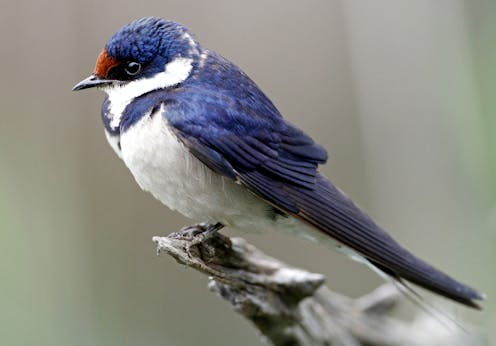
For instance, there are species which breed in South Africa in the southern summer and then head north, to elsewhere on the continent, in winter. Most swallows are in this category, notably the white-throated swallow. They leave in March-April, and are away until August-September. My fellow bird researchers and I think they migrate to countries farther north like Angola and Zambia.
Some birds fall into a second category: they are partial migrants. For example, about 80% of the Cattle Egrets in South Africa’s Gauteng province leave for warmer countries to the north each December and January. But there are always at least some Cattle Egrets throughout the province during winter. Partial migration is challenging even to recognise, because the species is continuously present throughout the year – and even harder to study.
Then there’s altitudinal migration. This is the idea that birds move downhill in winter to warmer places where there is more food. South Africa is one of the best places in the world to study altitudinal migration.
Tanya Scott, who recently completed her MSc with the Animal Demography Unit which I head at the University of Cape Town, was the first to comprehensively examine all the province’s bird species to identify altitudinal migrants. She searched for patterns that would help provide explanations for why some species undertake altitudinal migration, and others don’t. She found none. A week after her MSc was submitted, the first ever global review of altitudinal migration was published – and reached the same conclusions.
Altitudinal migration is a big puzzle. Vanilla migration is easy; all the birds do it. But developing an understanding of why some birds of a species migrate downhill after breeding and the birds in the neighbouring territory do not, is key to understanding how migration in a population starts.
There are many hypotheses about how long-distance migration started in species in which every individual migrates. These ideas can only be tested in the context of partial migration.
Understanding migration for conservation
The populations of many long-distance bird migrants are getting smaller. It is obvious that researchers can only develop effective conservation strategies for these species if we understand their spatial needs throughout their annual cycle.
And many partial migrants are categorised as being “threatened” with extinction. Understanding the where, the when and the how of their movements is key to their protection. Mountains are particularly impacted by climate change, and a study of altitudinal migrants might well reveal that a disproportionate number of them are threatened.

Les Underhill receives research funding from the National Research Foundation in Pretoria and the JRS Biodiversity Foundation in Seattle.
Source: The Conversation – Articles (AFRICA)
Read more on The Conversation.
Join the fun: Add Your event | Submit a Press Release | Add your listing.


