Why tackling sexual violence is key to South Africa’s decolonisation project:
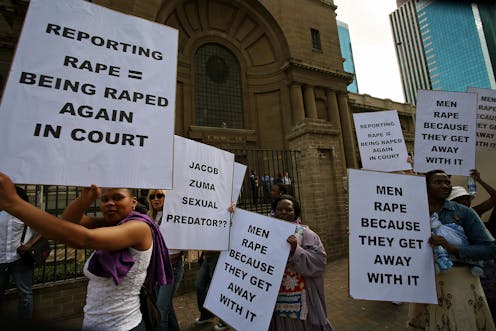
Horrific incidences of rape, sexual assault and sexual harassment are so common in South Africa that it has been dubbed the “rape capital of the world”. Yet these issues have been curiously neglected in the country’s politics.
In South African political discourse, transforming race relations is prioritised over the transformation of gender relations. Race and gender are regarded as two separate projects, and improving race relations in the aftermath of apartheid and colonialism is presented as more pressing than tackling gender issues.
But, as South African feminist scholar Shireen Hassim argues, the country is bedevilled by a kind of race discourse which silences and displaces feminist attempts to discuss the workings of gender power politics. At the same time, she argues, political power is gendered and masculinised in ways that remain unacknowledged.
Many feminist scholars have shown that gender is deeply intertwined with the colonial project’s racism. Their research suggests that neither the logic nor the effects of racism within colonial and post-colonial contexts can be properly grasped without clearly understanding the gender dimension.
In a recently published paper a colleague and I focused particularly on the work of three such scholars: Nigeria’s Oyèrónké Oyĕwùmí, a sociologist; Argentinian philosopher Maria Lugones; and South African feminist scholar Pumla Dineo Gqola.
They argue in different ways that the sexual exploitation and objectification of black women by colonial powers and the demonisation of black male sexuality as bestial were central to the colonial project. Read together, their work shows that these constructions of black sexuality where not merely a historical aberration or mistake. They were key to the workings of colonial power. And that logic persists in the postcolony.
Sex and the colonial project
The Western distinction between masculine and feminine, Lugones writes, served as a mark of civilisation for colonisers. Becoming “civilised” meant internalising this distinction, its concomitant norms and values.
The gender configurations and societal structures of the colonised did not conform to western gender norms. In terms of colonial logic this served as “evidence” of the colonised people’s bestiality and inferiority. It meant they needed to be “saved” by western conquest.
In her book The Invention of Women Oyĕwùmí detailed how the British colonial administration in Yorùbáland, Nigeria, posited men’s superiority over woman. Administrators reduced and homogenised women into an identifiable, clearly demarcated and predetermined legal, social and biological category. This was defined by their anatomy and meant they were always subordinated to men.
The colonisers introduced the category “woman”. This undermined the fact that females in precolonial Yorùbá society had multiple identities that were neither gendered nor linked to their female anatomy. These could include farmer, hunter, mother, cook, warrior, ruler – “all in one body”. Oyĕwùmí writes that the creation of (Yorùbá) “woman” as a category was one of the colonial state’s very first “accomplishments” in Yorùbáland.
So Lugones’ and Oyĕwùmí’s work shows in different and complementary ways that the process of “civilising the native” was not only a racial one. It was also deeply gendered. The striking implication is that issues of sexuality in a post-colonial society like South Africa cannot be separated from race and culture, and vice versa.
Lasting consequences
In line with these arguments, I contend that South Africa’s sexual violence problem can also be framed as a central part of the colonial legacy. Addressing this crisis, then, should be understood as a top priority for any serious decolonisation agenda.
One of Gqola’s arguments is particularly relevant here. She explains that black male sexuality is demonised through the colonial gaze as bestial and predatory. Black female sexuality is structured as its counterpart. Black women are always already raped and therefore paradoxically “unrapeable” both in law and in social understanding.
In other words, in the colony the sexuality of the colonised people was constructed so that nothing which was done to a black woman would be classified as rape. There were two reasons for this. Firstly, black women were portrayed as being so primitively sexual that no sexual advances were unwelcome. And, because black men were demonised as “natural rapists”, this meant black women were always already raped, by black men.
This legacy endures in South Africa. Today rape is normalised. It’s not taken seriously by society and it is left mostly unpunished by the criminal justice system.
Decolonisation and addressing sexual violence
Scholars like Lugones, Oyĕwùmí and Gqola teach us that the colonial logic of sub-human sexual categorisation permeates and thoroughly infuses the ongoing colonial production of racial hierarchies.
The decolonisation of South African society requires sexual violence to be recognised and approached as a key aspect of the colony. It must be viewed as a problem that sits at the heart of colonial denigration, exploitation and abjection of the racialised body.

Azille Coetzee receives funding from the SARChi Chair in Gender Politics, Stellenbosch University.
Source: The Conversation – Articles (AFRICA)
Read more on The Conversation.
Join the fun: Add Your event | Submit a Press Release | Add your listing.


