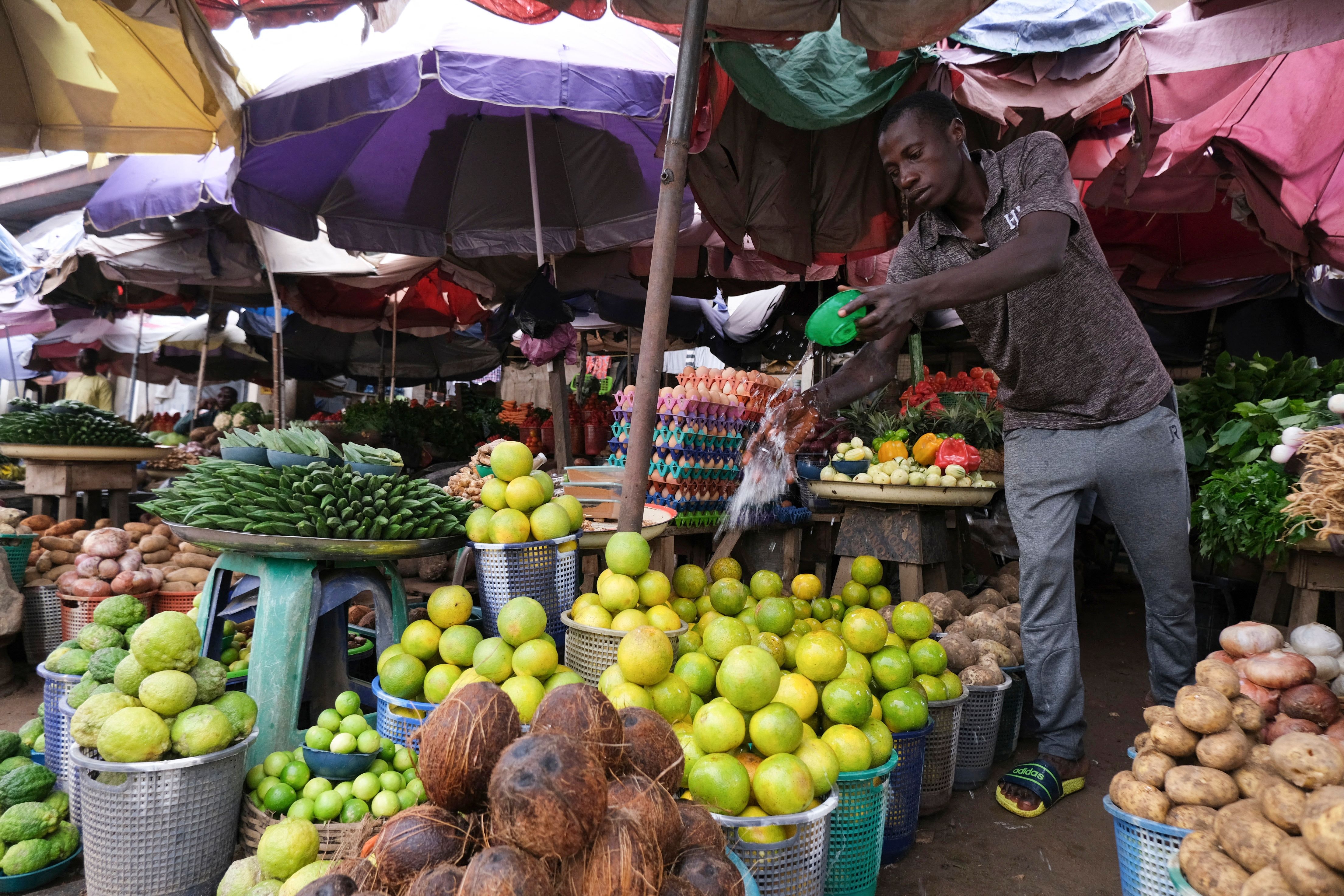
Nigeria has had a series of policies directed towards improving food supply at affordable prices. Policies have kept coming since the 1960s, including the National Accelerated Food Production Programme of 1972 and the most recent – the National Agricultural Technology and Innovation Policy of 2021 to 2025.
Essentially, these policies aimed at improving food production, through land reform, mass literacy, affordable funding, subsidised farm inputs, research, mechanisation, linkages and extension services.
Yet food prices have continued to rise.
I have previously written about food price inflation in recent times, arguing that the COVID pandemic was not solely responsible. Other drivers included the dearth of capital, technology, infrastructural facilities and insurgency.
These factors still feature prominently as drivers of food inflation in Nigeria. They show that policies aimed at tackling food inflation have failed.
Well out of the COVID lockdown, Nigeria’s consumer price index has persistently increased. Between September 2020 and January 2021, there was an 8.13% increase, and a further rise of 8.07% by July 2021. By January 2022, the composite food index rose by 17.13% year on year, in spite of government efforts to stabilise food prices.
An example is the rice pyramid initiative by the federal government. In a bid to improve the local supply of rice and suppress prices, the government, through the Central Bank’s Anchor Borrower’s fund, supported local rice farmers to double their production capacity between 2015 and 2021. The output of that programme was stacked in pyramids displayed to the public in January 2022. Two months after this display of rice, the price of the staple food rose by 15%.
This is further evidence of some disconnection between policy and results.
The reason policies haven’t worked is that they lack substance and are not implemented appropriately. The danger is that food inflation will continue if these problems are not attended to.
The government needs to be more inclusive in formulating policies. From the start, it should involve those who will implement these policies.
2022 food prices
The price of a 50kg bag of rice rose by 17.58% from March 2021 to March 2022. A 100kg bag of beans became 5% more expensive in the same period. Tomatoes went up by 11.93% for a 60kg basket and onions by 5.27%.
Most Nigerians can’t afford meat, a source of protein. The price of boneless beef rose 24.4%, frozen chicken prices 14.3%, and titus fish (mackerel) a whopping 34.5%.
Perhaps the most jarring are the 45.5% increase in the price of eggs and the 44.4% increase in the price of bread. The price of milk has increased by 50% and noodles by 24%.
Fruits are no longer within the reach of lower earners, as essential as they are for a balanced diet. Price increases have ranged from 50% to 100%.
The cost of transport, which is a key service required for food supply, increased by 283% between January 2017 and December 2021. This was without an official fuel pump price increase.
What’s going wrong
Obviously, the rate at which food prices have risen shows that they do not reflect the expected outcomes of government policies aimed at tackling the cost of food.
My previous research highlighted some of the reasons, including inadequate financing, technological know-how and banditry.
A further factor is errors of policy. As I have found in my research that focused on the agribusiness value chain in sub-Saharan Africa, increased technology and land usage have not improved output. This indicated the possibility that digital technology introduced into the agriculture value chain was not being accessed by those who really needed them or would have used the technology.
Firstly, policy makers often lack the deep and intensive preliminary groundwork they need. Policies therefore lack substance. Policy formulation requires deeper work, broader scope, workability testing and the inclusion of those who will eventually implement the policy. These elements are often missing in the various policies Nigeria has designed to tackle rising food prices.
Secondly, policies are usually implemented in a way that is detached from the formulation process. This often flows from the fact that those who must implement the policy are not carried along in its formulation. Since they were not part of the formulation, what they require in implementation is often not taken into consideration. The policies become unworkable and unimplementable.
Another factor in food price inflation is Nigeria’s rate of population growth. Policies often fail to take adequate account of this. In 2022, the population growth rate is expected to be 2.53%.
Read more: Nigeria’s 2022 census is overdue but preparation is in doubt
This explains the need to import enormous quantities to meet demand. For example, 52% of the rice demand was met from imports in 2018. For wheat, 99.7% of total demand is sourced from imports. About 70% of dairy products demand is imported.
This is why price volatility in the global commodity market directly affects domestic food prices in Nigeria. For instance, Russia’s war on Ukraine could destabilise international trade and the commodity market and this would have direct implications for food prices in Nigeria.
Read more: How Russia-Ukraine conflict could influence Africa’s food supplies
Though policies have acknowledged the need to produce more, the supply of food has not improved. One reason is these deficiencies in formulation and implementation of policy.
How to get ahead
The government needs to be more inclusive by incorporating its officials at state and local government levels as well as smallholder farmers and other key players in the agricultural value chain in the formulation of policies that they would later be expected to implement.
This improves understanding, enhances commitment and optimises the policy progress monitoring.
The country needs to import less food and produce more, sustainably.
Nigeria can achieve sufficient food supply at reasonable prices. It only requires policies that focus on relevant issues, and their sound execution.


