Why traditional healers could have a role to play in fighting HIV:
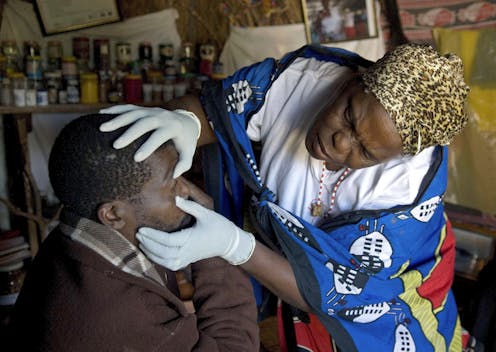
Many cultures and societies throughout the world turn to traditional healers to find out why they are ill and to seek treatment. In many settings, including sub-Saharan Africa, traditional healers are often called on to provide cures for various ailments.
Seeking help from traditional healers can have a detrimental effect on a patient because it can delay them getting the care or treatment they need from health facilities. This is a particularly pertinent challenge when it comes to treating HIV because getting access to treatment as early as possible after being diagnosed has been shown to be very important. In addition, studies have shown that traditional medicine can affect the efficacy of antiretroviral treatment.
We were keen to understand how people living with HIV in rural communities in South Africa consulted traditional healers, and how this affected whether or not they sought treatment from local clinics. Our study, done in rural northeastern South Africa, has an HIV prevalence of 19.4% among adults. This is one of the highest figures in the world.
We found that some traditional healers continued to treat HIV-positive people for HIV and their associated opportunistic infections. But it also showed that they referred their patients for HIV testing at public health facilities. This suggests that they saw the value of HIV testing.
The study, undertaken in an area where the South African government’s health facilities offer free antiretroviral treatment, raises important questions about the role that traditional healers play in providing health care. It shows that working with traditional healers could lead to health care that integrates both approaches. Studies from other developing countries has shown that this can have benefits.
One, or both
People seek care from traditional healers for different reasons. Often they are able to access the traditional healer more easily than health professionals. Medication shortages at clinics and hospitals also play a role. For others there are greater cultural similarities between the traditional healers’ explanation of their condition and their own understanding.
Research shows that people felt they were treated better by traditional healers than carers in the public health system.
Traditional healers and health professionals often treat patients concurrently. Patients choose to use one or the other – or both. This results in a “ping-pong” effect of patients moving between traditional healers and health care facilities.
There are dangers in this – using traditional medicine and ART concurrently have been shown to have negative effects in some instances.
Examples of integration
There have been attempts to incorporate traditional healers into health care systems. A number of projects and studies have been done in several African countries including Cameroon and Mozambique to integrate traditional healers with health professionals.
These projects have had mixed results. Traditional healers are a heterogeneous population: not all healers will make effective partners with clinicians and nurses in the health care system. Some healers fear losing income, others do not believe nurses and clinicians can cure all ailments and a history of distrust has damaged relationships between healers and clinicians.
But engaging healers has resulted in several successful partnerships. These have included:
-
Increasing traditional healer’s knowledge of diseases and conditions,
-
Reducing the delay of patients getting care from health facilities for time-sensitive conditions
-
Improving the relationship between healers and health professionals.
In Mozambique, ongoing research with traditional healers has resulted in the development of a referral-back-referral system. Traditional healers refer patients to a clinic to be tested for HIV and other common ailments. The patients then return to the traditional healer with a clear referral of the clinic’s findings.
Our research shows similar results. About 85% of traditional healers referred their patients for HIV testing at public health facilities before initiating traditional care. And traditional healers used a patient’s CD4 count as a threshold to determine whether further traditional treatment should be offered.
Keep the ball rolling
Great progress has been made in managing the HIV/AIDS pandemic. Key to this success has been ensuring people are tested and then introduced to drug regimens as soon as possible.
While the push for a functional cure and more effective treatment and treatment delivery systems are important, so too is understanding and mitigating barriers to existing care. Keeping a cautious, yet open mind to the complementary role that traditional healers can play could help further reduce – and support the ultimate end of – the HIV/AIDS pandemic.

Ryan Wagner is a Research Fellow with the MRC/Wits Rural Public Health and Health Transitions Research Unit (Agincourt). The Unit has received funding from the Wellcome Trust (UK), the National Institutes of Health (US) the Medical Research Council (UK), the University of the Witwatersrand and the Medical Research Council (South Africa).
Carolyn Audet is currently receiving funding from the National Institute for Mental Health in the United States of America. She has previously received funding from ViiV HealthCare (UK) and the Centers for Disease Control and Prevention (US).
Source: The Conversation – Articles (AFRICA)
Read more on The Conversation.
Join the fun: Add Your event | Submit a Press Release | Add your listing.


