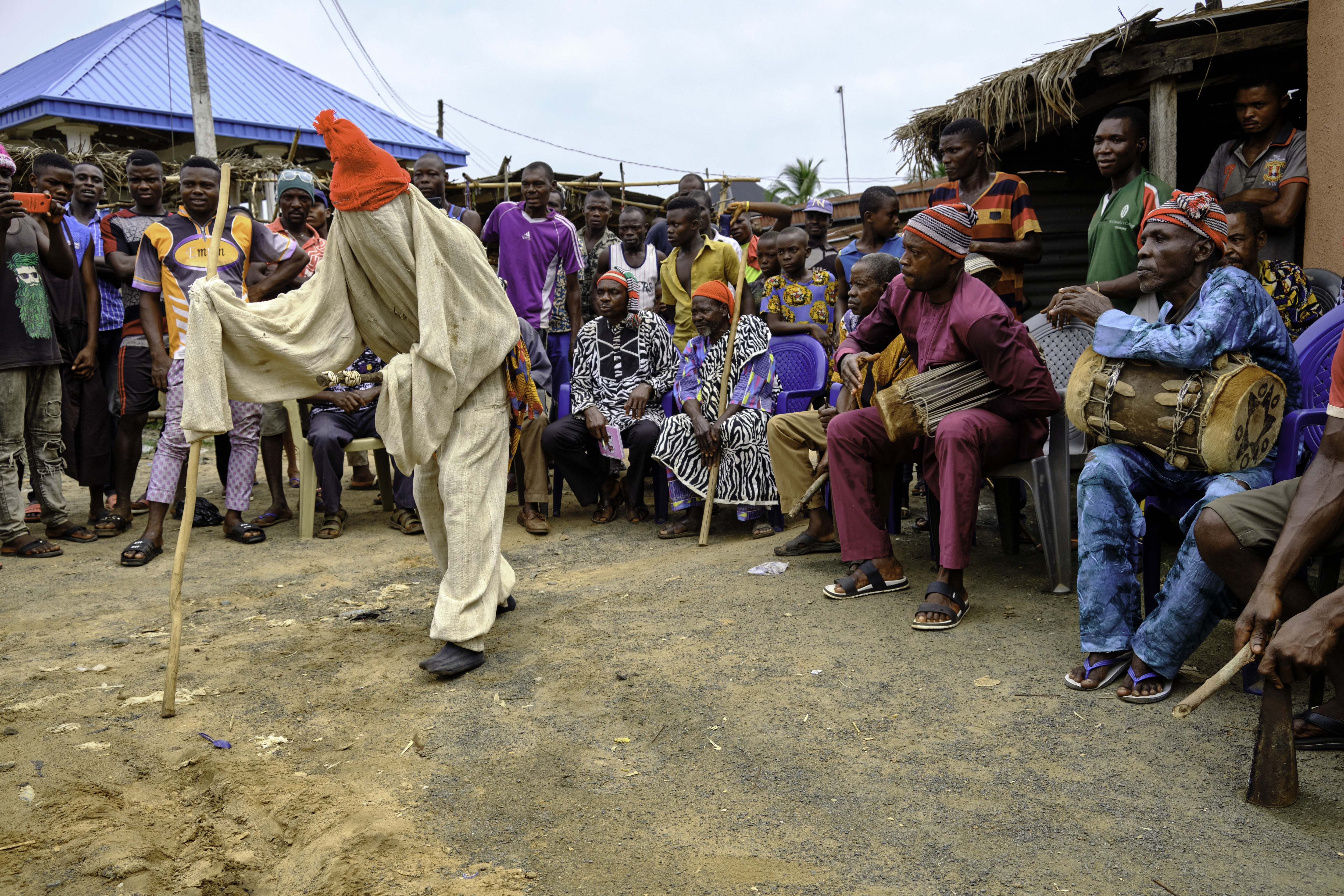
For generations, the tradition of Omabe masquerades has been part of the cultural landscape of the Nsukka area of Enugu State in Nigeria. Masquerades are cultural or religious events that often feature masked dancers embodying various spirits. Omabe masquerades are believed to be representatives of the ancestors of Nsukka.
The region honours these ancestors with annual traditional festivals. Some of these festivals include Onwa Asa (seventh moon), Onwa Eto (third moon) and Onunu. Celebrations occur all through the year, with some timing variations among Nsukka communities.
During these festivals, the venerated ancestors are believed to join in the celebrations, by re-emerging from ant holes as different forms of Omabe masquerades. For varying durations, these masquerades, particularly Oriokpa (the traditional police of Omabe), tarry among the living in Nsukka. They are believed to keep watch over the affairs of the people.
But the Nsukka cultural zone is also the home of Igbo Christians. Christianity is a dominant religion in the area, and has always condemned masquerade practices as fetish and pagan in nature.
Over the past 15 years or so, though, there has been a strong revival of young people – mostly Christians – participating in masquerades. I became interested in conducting a study to understand why many young people in Nsukka are engaging in masquerade practices, despite their conflicting Christian affiliations.
My research found that regardless of their faith, these young people fully identified with the masquerade celebration. They believed the festivals to be cultural revival exercises, whether Christianity approved or not.
However, this has certain implications for Christians and the community. Church members publicly indulging in masquerade rituals casts Christianity in a negative light. Also, some aspects of masquerade celebrations are still rooted in barbarism. A great example is the indiscriminate flogging of passersby during masquerade processions. This casual violence has no place in today’s modern world.
Masquerade celebration as cultural revivalism
Over the past four years, I have conducted field work on youth participation in masquerades in Enugu state. My focus research areas include Nsukka main town, Umundu and Obollo communities, all in the Nsukka zone. I conducted interviews with young people from these villages about the resurgence of masquerade practices, and the revival of interest in these cultural traditions.
I also observed many masquerade celebrations in these towns, noting a strong youth participation. These young people say they are purely driven by cultural revival, as masquerades represent an important element of their local culture.
They aren’t wrong. In the 19th century, Christian Western missionaries arriving in Nigeria held very little regard for aspects of Igbo culture. Especially the parts involving spiritualism and ancestor worship. The missionaries were averse to it, condemning the people’s cultural practices and replacing some of them with imported dogma. This was the case in Nsukka.
In the 1980s, local masquerade practices suffered another setback with the emergence of Pentecostalism in Nigeria and the Nsukka area in particular. Pentecostal teaching emphasises the work of the Holy Spirit and the direct experience of the presence of God by believers. It was in direct conflict with masquerade practices. Traditional culture was therefore branded as ‘paganism’ and strongly discouraged.
In the 1960s, African theologians began to question the Western forms of Christianity in Africa. These leading theologians and scholars began to adapt local Christian practices to fit into existing culture. Worship began to take on some of the features of its local context. A good example is the manner in which worship was conducted in church services and mass celebrations. Igbo vernacular, local drums and homegrown melodies gave Christianity an “African touch”.
Read more: How sacred sites act as living archives in a Ugandan community
This process is called inculturation and it has also helped the masquerade revival. During my fieldwork, I found this to be part of the reason for young Nigerians’ reversion to masquerade practices, particularly within the Roman Catholic context. Some of the youth see a relationship between inculturation and their quest to revive masquerades in Nsukka since both are forms of cultural revival.
Cultural resilience
This shows Nsukka’s cultural resilience. Young people are taking on the responsibility of preserving their traditions, despite lacking governmental or organised institutional support.
Christianity, for all its dominance, hasn’t completely succeeded in deterring members interested in local masquerade celebrations. Despite the long history of churches and religious opposition in the area, the religion still can’t topple culture.
From my findings, Nsukka’s young people believe Christianity has denigrated their cultural practices for a long time. That’s why as a cultural space, they are working to revive and uphold these practices.


