Why Zambia has not benefitted from its rosewood trade with China:
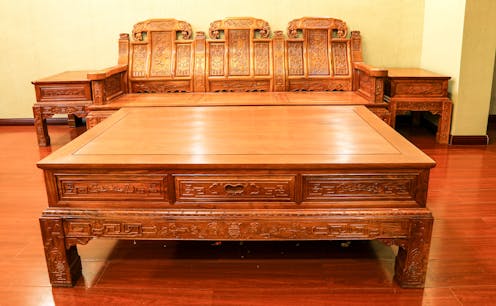
Rosewood is the generic name for several dark-red hardwood species found in tropical regions across the globe. It fetches very high prices because it’s strong, heavy, has a beautiful red hue and takes polish very well – and because the trees are becoming increasingly scarce. On the Chinese market in 2014, for example, prices were in excess of USD$ 17,000 per ton. That’s ten times higher than the price of more standard tropical hardwood.
There’s a huge demand in China for rosewood logs to make hongmu – antique furniture. Hongmu was used historically by the imperial elite and is now coveted by China’s rising middle class. Supplies of the wood from markets in Latin America and South-East Asia have dwindled in recent years, so Africa has become a key source. Within Africa, Zambia has become one of China’s main rosewood exporters in the past decade.
But the harvesting of rosewood is often not done sustainably. Several African species have already received protection under the Convention on Trade in Endangered Species.
We researched the rosewood trade between China and Zambia in 2016 and 2017. We wanted to study the relationship between global and local sources of capital, rural development and environmental impacts. We also wanted to see whether regulations, adopted to preserve natural resources like rosewood, provide the right set of incentives and disincentives for business to be sustainable.
The most common name used to identify rosewood in Zambia is mukula. But because several different species are categorised as mukula, and because comprehensive inventories are lacking, current rosewood stocks are not known. Legal uncertainties and corruption mean that laws, regulations, or sustainable forest management plans, related to rosewood, are rarely implemented and monitored.
This means that Zambia doesn’t benefit much from rosewood trade. Its forests are being decimated, causing serious environmental degradation. And though rural Zambians and their families do profit, this is short-lived. We also found that because the trade isn’t being effectively monitored or taxed, the government loses about USD$ 3.2 million in potential revenue every year.
Monitoring challenges
A couple of big factors have allowed this situation to thrive.
The first is that mukula was only recently added to Zambia’s list of official commercial species. It was previously recorded under the general term “other”, so its trade wasn’t properly recorded or taxed appropriately. In addition, even though there’s an export ban on mukula leaving in log form, it has been allowed to leave the country almost exclusively in log form. Aside from legal considerations, this defies the purpose of the ban, which is to boost local processing and job creation in Zambia.
The second is that the government has been issuing and lifting various regulations in rapid sequence over the years, which have left enforcement agencies on the ground unclear about what rules applied where and when. This has boosted corruption, which means many officials have no incentive to ensure the trade is well regulated. About US$ 1.7 million is paid in rosewood-linked bribes each year. Most of which are collected along Zambian roads where trucks must make payments to proceed towards the points of export.
The results of these legal uncertainties can be seen in the graph below which shows log exports, as recorded by Zambian authorities through the Food and Agriculture Organisation of the United Nations, and log imports as recorded by Chinese authorities.
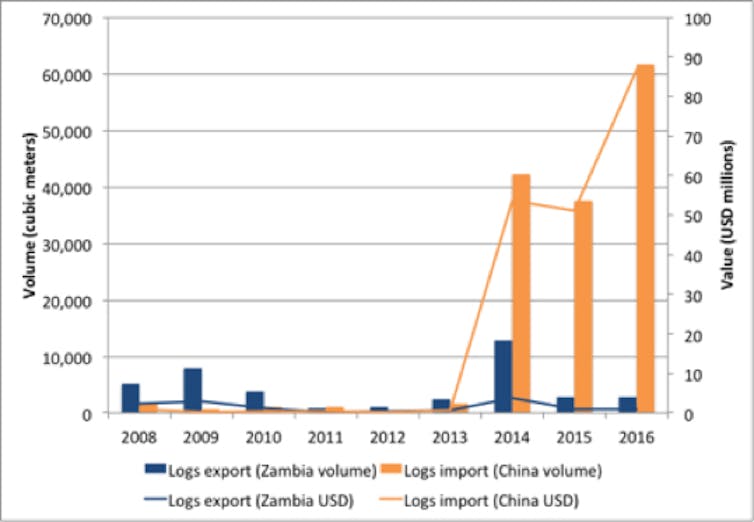
The discrepancies, in volume and value, between the declarations are huge. For example, in 2016, Zambia declared exports for about 3,000 cubic metres at an approximate value of USD$ 900,000. China, meanwhile, declared imports of about 61,000 cubic metres for an approximate value of USD$ 87 million. Because Chinese customs do not recognise mukula as rosewood, we cannot determine the amount, but because Zambia exports only a few species whose volumes haven’t changed much over the years, we are sure that mukula represents the vast majority of those volumes.
It’s clear that a series of measures, in particular log-export and production bans adopted over the years, don’t work. Bans only make sense when coupled with other measures, like effective enforcement or a system of incentives. In fact, bans have contributed to keep the rosewood market underground without really affecting harvest and trade. But solutions are possible.
Focus areas
Our research suggests that four points need immediate attention.
-
The strategy of continuously adopting and lifting production and export bans is not working and should be abandoned. If a ban is deemed necessary, a coherent enforcement strategy must be adopted, enforced and monitored. If not, The Zambian Forestry Department should propose a revision of the legal framework and ensure logs for export are appropriately taxed.
-
The Zambian government must support the Forests Act of 2015. This aims to protect the country’s forests and people’s long-term livelihoods by implementing innovative management and monitoring measures, including community, joint and private forest management approaches.
-
The governments of Zambia and China need to engage in discussions with their respective CITES management and scientific authorities and list mukula as a species that may be threatened with extinction, should the trade not be closely controlled. This would hopefully limit international demand.
-
Countries in sub-Saharan Africa should learn from each other’s environmental challenges and work better together. While Zambian forests were emptied of rosewood – and the government was deliberating potential countermeasures – buyers and traders had already moved into Malawi, the Democratic Republic of Congo and Mozambique. While trying to perfect domestic laws, the precious resource will already be gone.
By working together, the battle to save these fragile forests could be won.
Valued contributions to the research leading to this article were also made by: Xiaoxue Weng, George Schoneveld, Kaala Moombe, Nils Bourland, and Robert Nasi.

The research leading to this article was supported by the UK Economic and Social Research Council and the Department of International Development through the project ‘Natural Resources, Rural Poverty and China-Africa Trade: Equity and Sustainability in Informal Commodities Value Chains’ (ES/M00659X/1) and Danida (Denmark), Irish Aid and Sida (Sweden). It is also part of the CGIAR Research Programme on Forests, Trees and Agroforestry (FTA), with support from the CGIAR Fund Donors: www.cgiar.org/our-funders
Source: The Conversation – Articles (AFRICA)
Read more on The Conversation.
Join the fun: Add Your event | Submit a Press Release | Add your listing.


