Why Zuma’s trial matters for South Africa’s constitutional democracy:
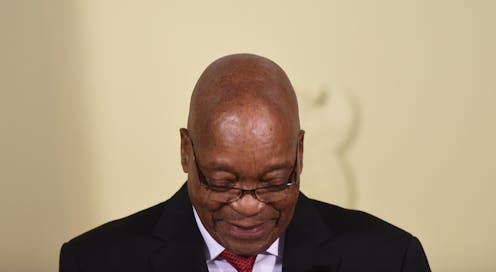
Former South African president Jacob Zuma’s court appearance carries huge significance for the country. That’s because his criminal trial is not merely about public outrage at state capture and corruption in high political offices. Nor is it just about Zuma facing the consequences of his abuse of office. Or the criminal justice implications of a former president being charged with a series of crimes.
Its broader significance is that Zuma’s court appearance affects many of the most important philosophical foundations of South Africa’s constitutional democracy. The charges against him are immensely important for the foundations of the state. They also matter for democracy and for the constitutional social contract.
This is because the legitimacy of any elected public representative is based on the mandate they receive at a general election. That mandate is the product of a contract between voters and public representatives. Voters cede part of their most fundamental democratic rights of public participation to the representatives. In exchange, and as a cornerstone of representative democracy, elected representatives must account for their actions to Parliament and to the voters.
If a public representative deviates from that mandate – or abuses it for other purposes or his own interest, or worse even for criminal purposes – then the foundation of representative democracy is violated. If abuses become widespread, or if a person in a key public position violates this contractual relationship, the foundation of representative democracy is under threat.
Public opinion in South Africa accuses Zuma of such a violation. The public also expects him to take political responsibility for it. In this context, his prosecution will amount to a public process to rectify and remedy his undemocratic and unconstitutional behaviour.
Zuma’s mere appearance in court, and the accompanying public humiliation, should act as a reprimand for his abuse of the public’s trust in him as elected president. In essence, it could be seen as a process to restore the constitutional relationship between the public and elected representatives.
State capture and state institutions
Although his charges don’t address it directly, state capture is a subtext in his court appearance. State capture – the alleged undue influence of Zuma’s friends, the Gupta family, in the running of the state for private gain – has caused serious institutional degradation in the public sector. The works of scholars Daron Acemoglu and James A. Robinson emphasise the importance of strong and capable state institutions.
Once institutions are threatened or undermined, states start to malfunction and constitutional crises develop. Institutions are associated with a number of constitutional principles. These include the separation of powers, judicial independence, a state’s responsibility to provide security and services as well as to collect taxes. Once state institutions are weakened, it becomes impossible to implement and protect constitutional rights.
Zuma’s infiltration of state institutions, such as the criminal justice system, the revenue service, the intelligence institutions and enterprises such as the power utility Eskom, almost broke the institutional spine of the state. This would have happened had it not been for institutions such as the Public Protector and the National Treasury, the Reserve Bank and the judiciary.
Part of Zuma’s legacy also includes the state’s fiscal capacity being seriously compromised as well as state institutions such as the Hawks or National Prosecuting Authority.
It’s necessary for him to account for all, in public.
The law and moral values
The criminal offences that Zuma faces – including corruption, fraud, money laundering or racketeering – are not only crimes. They’re also violations of a society’s moral value system.
A legal system is intended to protect a society’s value system. It’s therefore an essential aspect of any constitutional democracry.
In this light, Zuma’s trial is not only about whether he did, or didn’t, commit certain crimes. It will also serve to reaffirm the moral values that direct the lives of public representatives. Corruption, for example, harms the relationship between the voter and public representative and the electoral mandate that regulates that relationship. It challenges the very essence of representative democracy.
A former president on trial will be a strong reminder that political power is not supreme, that it cannot guarantee uncensored immunity and privilege. A trial will send the message that unbridled power comes with high risks and huge costs.
Luckily, the South African legal system does not allow for presidential immunity. It can thus avoid the spectre of autocratic executives who escape punishment for corruption.
A message for the private sector
Zuma’s trial also sends a message to the private sector – that it’s conduct is judged by the same moral values as those used for public representatives. State capture collusion by private sector entities equally undermines the constitutional dispensation.
Hopefully, Zuma’s case will motivate business executives to reconsider how they relate to government, what form of lobbying is acceptable, how they participate in procurement processes, and how they deal with conflicts of interest.
It’s very important that the Zuma case is approached with utmost professionalism by the prosecuting authority. All the principles of the rule of law should be on display. No special treatment should be considered and no overt political agendas should be tolerated from any side – either to please or to humiliate.

Dirk Kotze does not work for, consult, own shares in or receive funding from any company or organisation that would benefit from this article, and has disclosed no relevant affiliations beyond their academic appointment.
Source: The Conversation – Articles (AFRICA)
Read more on The Conversation.
Join the fun: Add Your event | Submit a Press Release | Add your listing.


