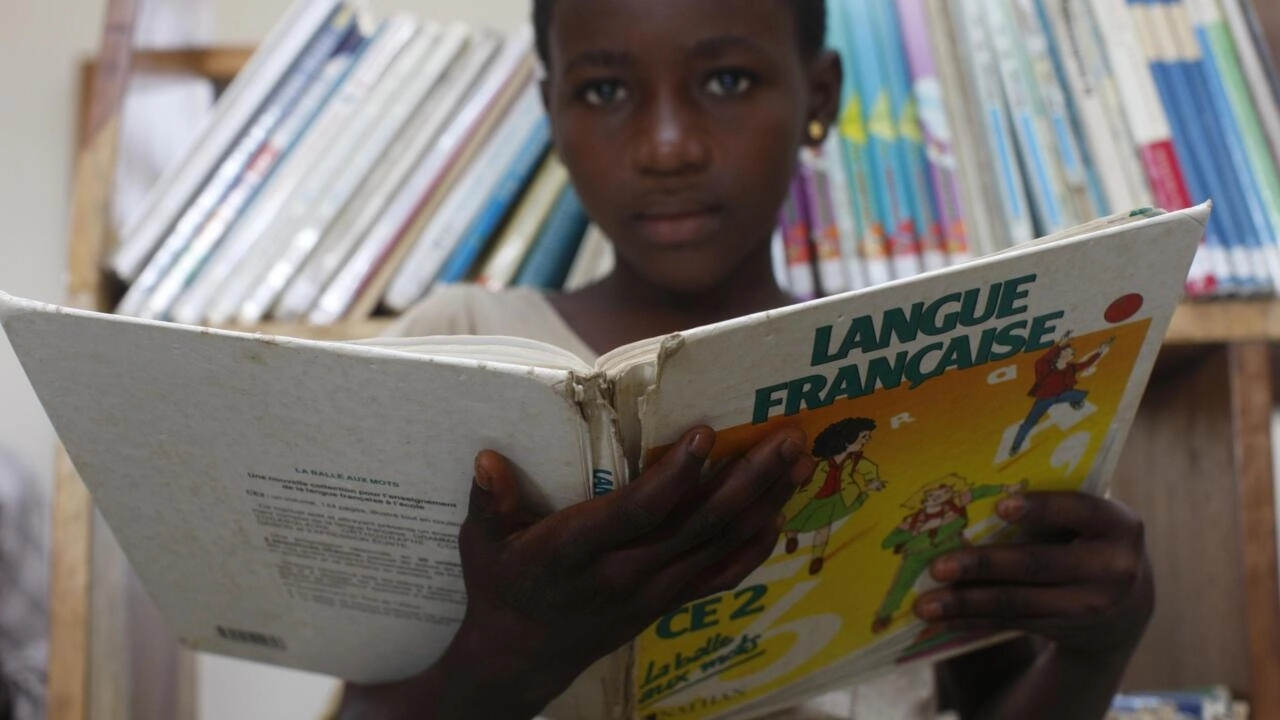
The French language was introduced into Senegal through colonisation. According to Papa Alioune Ndao, professor of linguistics at the Cheikh Anta Diop University in Dakar:
French was taught in Senegal as a mother tongue, as France taught its own children. It 1964 it was decided that French should be taught as a foreign language. This continues to be the status of the French language in education today.
However, the first article of the 2001 Constitution mentions French as the only official language. The other major languages – Malinke, Wolof, Serer, Diola, Soninke and Pular – have the status of “national languages”.
French is the official language of Senegal and is spoken by about one third of the population. National languages are used in the media, in education and in the National Assembly.
However, the golden age of the French language in Senegal seems to be over. Like a coil spring that returns to its original shape after a temporary force is removed, local languages, such as Wolof, are reclaiming territory that was lost to colonisation in the fields of knowledge and work.
Wolof is the most popular language, spoken and understood by at least 90% of the population. It’s the language that bound the Senegalese kingdoms together since the Djolof empire in the 13th century.
As a language of instruction, French historically dominated in society. But today, a visit to the streets of any community in Senegal, an hour spent in any waiting room of a hospital, a bank, a minister’s office, or listening to radio and television programmes, gives a clear idea of the predominance of Wolof in Senegal to the “detriment” of the French language.
Below I present the reasons for the decline of French in Senegal, at a time when the Francophonie – whose objective is to promote this language – is preparing to meet in Tunisia.
No longer the language of privilege
Although French was imposed as the country’s only official language shortly after independence in 1960, there are more than 21 national languages. Wolof is the most widely spoken language, which is spoken in all the country’s communes.
In Senegal, young people look up to role models other than the European-educated intellectuals. And yet this same youth is the vehicle for the vitality of a language, in its creativity, its recreation and its slang.
From the beginning of independence until the end of the 1980s, young people were enrolled in French schools and joined youth movements whose leaders all came from Western schools or Eastern European countries. As a result, public debate took place in French. A high level of French allowed a person to position themselves as a leader of an association, political group or trade union.
Since the 1980s, when the great rural exodus ended, new neighbourhoods formed in major cities, such as Dakar. These were made up of a population that had missed out on schooling due to the absence of schools in villages. This led to African languages being used in urban economic activities.
Many of these groups acquired wealth. This nouveau riche appeared in many sectors including transport, trade and in the creation of businesses and companies.
In addition, wrestling, Senegal’s national sport, has become professional and the role models of young people are multi-millionaire champions who stopped studying before the fifth grade, the highest level of elementary education. Most of them will only speak African languages.
French is no longer the language of privilege. In the past, people went to school to get diplomas, to get a job. That’s why the teachers, for instance, were the symbol of who was a model of success in society. Today, wrestlers and traders – who are not literate in French – are looked up to.
This phenomenon must also be analysed in relation to the development, from the end of the 1980s, of the Hip-Hop movement. It very quickly – unlike the Salsero musical movement of the 1960s and 1970s – turned towards the creation of lyrics in national languages to reach the working classes.
Growing Africanisation
In the workplace, a clothing movement is emerging with the Africanisation of outfits. In Senegal, office fashions began to change on Fridays in the 1980s with the African boubou introduced by administrative assistants. This led to the installation and acceptance of Islam in the workplace and concomitantly of the Wolof language.
From the outset, French was referred to in Muslim religious circles as ‘nasaran’, a negative connotation meaning ungodly.
Given that French is no longer compulsory for economic practice, that the purpose of the administrative service is to receive taxpayers, and that the majority of taxpayers do not speak French, the switch to the Wolof language in the workplace took place very quickly.
At the end of the 1980s, there was a push by followers of historian and politician Cheikh Anta Diop’s pan-Africanist theories towards a linguistic nationalism that found fertile ground in the workplace space.
There were also quite important factors that helped in the evolution of Wolof, such as the setting up of associations whose vocation is the promotion of national languages.
The national literacy programme – a government programme – has shown women in disadvantaged areas that they can manage economic interest groups without French.
Sociological changes
The sociological changes that took place with the arrival in the early 1990s of private radio stations such as SUD FM, gave Wolof the status of a news language with the Wolof-language newspaper “Xibaar Yi”. French used to be the exclusive language of journalism.
Animators were recruited from Dakar neighbourhoods, Arabic-speaking religious columnists gained prominence and political debates started to happen in Wolof – this sealed the fate of the French language. The media have contributed greatly to the valorisation of Wolof.
In addition, social networks allow people who cannot read or write in French to maintain YouTube, Tiktok and other channels in Wolof. Audio and video messages therefore allow this oral society to give strength to local languages. In short, not speaking French is no longer an obstacle for the majority, except for recruitment to public administration positions.
But even at this level, the civil administrator uses more Wolof than French in the exercise of his function in contact with the population.
School and society have ended up meeting in the playground, in class council meetings and in union meetings. Anti-French activist movements have convinced people that French is a language of domination designed to divide and rule.


