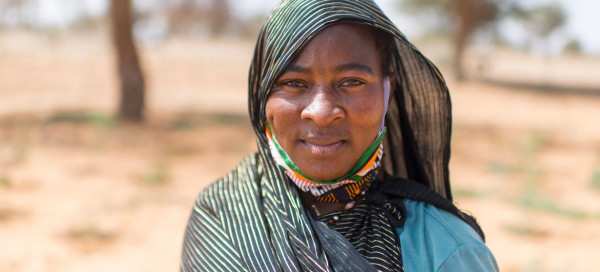
In the dusty plains outside Ouallam, a town some 100 kilometres north of Niger’s capital Niamey, verdant rows of vegetables sprout from the soil in neat plots. Adding further contrast to the parched surroundings, women in bright shawls walk among the rows, checking irrigation pipes and adding a splash of water to any thirsty-looking specimens.
‘We are very happy to work together’
The 450 or so women who work this land are drawn from three distinct communities: some are locals, others were displaced by conflict and insecurity elsewhere in Niger, and the rest are refugees from neighbouring Mali.
“We did this all together with the different communities: the refugees, the displaced, and the local community of Ouallam. We are very happy to work together,” says 35-year-old Rabi Saley, who settled in the area after fleeing armed attacks in her hometown Menaka, 100 kilometres further north across the border in Mali.
The produce she grows – including potatoes, onions, cabbages, bell peppers and watermelons – helps to feed her seven children and provide an income by selling the surplus at a local market. Since its creation, the market garden project has also helped smooth the arrival of thousands of refugees and internally displaced people to the town.
“When we learned that they were going to settle here, we were afraid and unhappy,” recalls Katima Adamou, a 48-year-old woman from Ouallam who has her own plot nearby. “We thought that they were going to make our life impossible, but instead it’s been the opposite.”
Adapting to the changing climate
Political unrest and frequent attacks by armed groups in Mali and Nigeria have pushed 250,000 refugees, most from Mali and Nigeria, to seek safety in Niger, whilst violence within the country’s own borders has forced a further 264,000 internally displaced people from their homes.
Meanwhile, climate change is pushing up temperatures in the Sahel at 1.5 times the global average, and the 4.4 million people forcibly displaced across the region are among the most exposed to the devastating impacts of drought, flooding and dwindling resources.
In Ouallam’s market garden – an initiative launched in April 2020 by UNHCR, the UN Refugee Agency – the women have learned to nourish their plants using drip irrigation to minimize evaporation and preserve scarce water resources.
An added benefit of the project is its role in helping Nigeriens adapt to the changing climate. By cultivating a large swathe of formerly degraded land near the town and planting trees, they are helping to stave off the desertification that threatens large parts of the country.
Building blocks of sustainable development
In another part of Ouallam, a further boost to community integration and environmental protection comes from a less likely source. The town brickyard employs 200 men and women – refugees, internally displaced and locals – in the manufacture of stabilized soil bricks.
Made by combining soil with small amounts of sand, cement and water before compacting and drying in the sun, the interlocking bricks reduce the need for cement mortar during construction. Crucially, they also eliminate the need to burn large amounts of scarce wood or other fuel used in the firing of traditional clay bricks.
“After, these bricks are used to build houses for the people supported by UNHCR – the refugees, the internally displaced, as well as a part of the vulnerable host community,” explained Elvis Benge, a UNHCR shelter officer in Niger.
“Ultimately, the refugees and the populations who host them are the engines of change and can support themselves and ensure the resilience of their communities,” Benge added.
Back in the market garden, having worked with her new neighbours to meet the challenge of daily survival as well as era-defining crises beyond their control, Ms. Saley stands surrounded by the fruits of her labour and reflects on a job well done.
“We have become one community – I even got married here!” she says. “The woman blossoms, just like the plants!”
This story is part of multimedia UN News series featuring women leading initiatives for a more sustainable, equitable future, published ahead of this year’s International Women’s Day on 08 March.
Distributed by APO Group on behalf of UN News.


