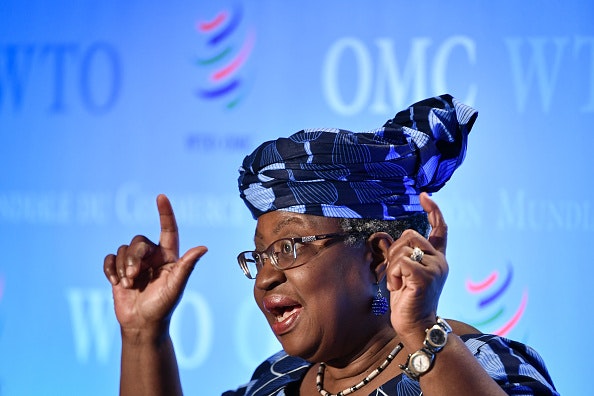
In a recent study South Africa was identified as ranking first of 164 countries in the World Bank’s global poverty database. Underlying this inequality is its very high rates of unemployment. Professor Dori Posel spoke to World Trade Organisation (WTO) Director General Dr Ngozi Okonjo-Iweala about why trade is important in tackling joblessness and inequality. And her experiences of fighting corruption in Nigeria.
Professor Posel: You’ve said that the WTO is all about people. How do we ensure that global trade reduces inequality both between and within countries?
Ngozi Okonjo-Iweala: Trade tends to have a bad name, especially among young people. For them it’s synonymous with globalisation, which they don’t see as a good thing.
But trade has been an instrument for lifting over a billion people out of poverty. It’s worth remembering that in 1980, over 40% of the world’s population lived on less than $1.90 a day, and that just before the pandemic this had gone down to 10%.
And a lot of that was due to the effects of bringing into the global trading system countries that were outside of it. Admittedly, China is a shining example of a country that benefited the most from this trade.
So trade has had its benefits.
That being said, it is undoubtedly true that poor countries were left behind. Now, the WTO charter is about creating employment, enhancing living standards, supporting sustainable development. It’s all about people.
I’m constantly looking at how rules for trade can bring micro, small and medium enterprises that are usually left out into the national, regional and global value chains. This includes women, many of whom own these kinds of enterprises. This is one way you can help create more employment, enhance incomes and so on.
The discussion now about the diversification of supply chains presents an opportunity to use trade as an instrument for inclusion. And I call it re-globalisation. We are talking to companies in developed countries to adopt a strategy of global diversification of value chains. That way they can look at Africa. Take South Africa. It is capable of attracting some of these supply chains. Other African countries that are capable are Ghana, Senegal, Rwanda and Nigeria.
Prof Posel: Could you elaborate on how WTO mechanisms can be used to benefit African countries?
Ngozi Okonjo-Iweala: Africa contributes less than 3% of world merchandise trade. And that is tiny. So how do we turn it around?
We have to trade more among ourselves. Trade among ourselves is only about 15% to 16% (of our trade). But we are all selling the same things. So we need to step back a little. We need to see how we add value. I don’t think we can grab a bigger share of world trade without adding value to the products we have.
So that is why I’m passionate about supply chains.
I see a big opportunity in pharmaceuticals because everybody’s eyes have now opened to the fact that Africa cannot continue with 99% of its vaccines produced elsewhere and 95% of other medicines. Africa has the unique opportunity not just about vaccines, but bringing in the pharmaceutical supply chains on the continent.
We’ve been working with the CEOs to see how we can encourage them to diversify their supply chains in Africa.
We should also have the same approach on the continent to attract companies that can help us add value to our products, to help create employment for young people. Actually, if we don’t do this we will have social instability. And it’s already happening in many of our countries. So this is no joke.
There’s a branch of the WTO called the International Trade Centre. Its job is to really focus on SMEs – small and medium enterprises – and on women, and try to help them penetrate external markets. But they need help. For example, there are lots of sanitary and phytosanitary requirements they must meet to export. In Nigeria, the centre has been working with shea butter producers who had been trying to break into world markets, but were banned from the US and Europe because they didn’t meet the standards. And over five or more years, they worked with them to upgrade the quality of their shea butter. Now they are exporting to the US. This is a group of women cooperatives that are exporting to Europe. They’ve more than doubled their incomes.
Prof Posel: I would like us to move on to another set of constraints on job growth in South Africa. And this concerns issues around trust and corruption. What is your advice to us in South Africa on this particular issue?
Ngozi Okonjo-Iweala: All I can do is share some of my experiences in Nigeria. And some of the ways we approached it. Before I do that, let me say that, you know, a lot of public corruption is also linked to public procurement.
One of the things to look at immediately is how to institutionalise transparent processes. We looked at how to set up a system with lots of transparency because we found a lot of corruption was coming from public procurement. So we introduced rules of the game that had to be followed at certain thresholds.
Was it 100% successful in curbing that?
No, but it did introduce a safeguard into the system so that people didn’t have a free for all.
But let me tell you one thing that has been quite helpful, at least in my time in fighting corruption, is technology.
I’ll just give one example. When I took office as minister of finance in Nigeria, we would get the payroll, let’s say the ministry of agriculture would come to me and say we have X number of people on the payroll, they would send this in, and then we would pay against that.
A lot of things were manual. And corruption had become entrenched because people could introduce ghost workers who became ghost pensioners.
I stood back and with the the economic team and with the support of the president, of course, we thought about introducing government financial management systems based on technology, so that we could take out as much of the manual and human intervention as possible. And we had an integrated payroll and personnel management system that had technology built in so that everyone could be identified.
We had a government financial system that was based on technology that linked the budget, the Treasury, to the other departments, so we didn’t have all this manual stuff.
So again, did that solve the entire problem? The answer is no. But it did solve a lot. We were able to save about US$1 billion by wiping out a lot of these ghost workers and ghost pensioners from the payroll. It’s still not perfect, but we did a lot.
So when you have stealing of state assets, we now have all sorts of technology that can be introduced to see what’s actually happening. We all know we have systems of cameras and drones and things that can be used to monitor what is going on. Technology helps in prosecutions. Prosecutions must take place so people know they can’t get away with it.
There’s no magic bullet, you need an array of policies, technologies, you need to be crystal clear. And people need to know that fighting corruption starts with them. Technology is not the perfect solution, but it can help in certain circumstances.
It starts with you, you have to take responsibility, not just waiting for government or some nebulous organisation to fight it. But that demands courage.
*This is an edited excerpt of the Wits School of Economics and Finance’s centenary webinar titled 100 Years of Economics at Wits: Reflecting on the Past, Looking to the Future. The event can be watched here.


