International migration in South Africa, particularly as it relates to the labour market, is a highly contentious topic. We, the undersigned migration scholars, want to share relevant information about this important topic. Our work shows that international migrants make up only a small percentage of the South African population, and that the overall effect of international immigration on the labour market is not detrimental.
Preliminary data analysis from the 2021 round of the South African Social Attitudes Survey by the Human Sciences Research Council finds that most South Africans see foreign nationals as a threat. Many believe they are a major source of unemployment and other socio-economic problems.
The general public appear to be misinformed about the impact of migration and how it affects the national labour market. Many of the main misconceptions are anchored in an overestimation of the number of foreign-born nationals in the country.
As the undersigned, we are committed to developing effective policies and interventions that will provide South Africans with the economic and physical security they deserve. We also do not wish to dismiss the daily economic and social hardships they face. To do this, we need to ensure our interventions are founded on the best available facts. We aim to provide the most relevant and reliable evidence around migration and labour migration in particular.
The numbers of migrants
How many foreign nationals live in South Africa?
Existing public opinion data shows that the general public is woefully misled about the size of the non-national population. But the numbers tell a different story.
Estimating migration is quite complex in that movements are not universal, may or may not occur, and can occur repeatedly.
Nevertheless Statistics South Africa (Stats SA) has been able to estimate international migrant flows in the country. The primary source for these estimates has been three national censuses it’s conducted since the democratic transition (1996, 2001 and 2011). The 2022 census is currently underway.
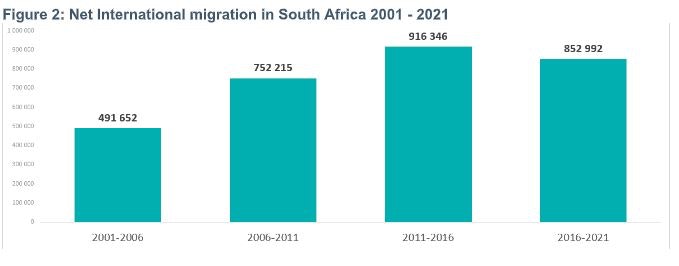
Stats SA estimates net immigration to be 852,992 people between 2016 and 2021.
In 2011 Stats SA estimated that the number of people in the country who were born outside South Africa stood at 2.2 million in Census 2011. The total population in South Africa at that time was about 52 million.
More recently, Stats SA estimates that there were about 3.95 million foreign-born people living in the country at the mid-point of 2021. This is a relatively small percentage of the overall national population, which stood at around 60 million.
The United Nations Population Division estimated that in 2015, there were about 3.2 million foreign-born people in the country (or 5.8% of the total population). In 2019, this estimate had climbed to 4.2 million or 7.2% of the nation’s total population.
These statistics counter erroneous suggestions that there are tens of millions of undocumented migrants in South Africa. It is not possible for Stats SA to identify the number of undocumented migrants living in the country. However, demographic registration data clearly (and unequivocally) shows that claims about millions of undocumented migrants living in the country are false.
Foreign-born migrants and job creation
There is no evidence that international migrants are a major cause of unemployment in South Africa. An analysis of labour migration done by the World Bank in 2018 showed that for every employed migrant in South Africa, two jobs were created for South Africans.
A report published in 2019 by Stats SA showed that international migrants are more likely to be employed than internal migrants and non-movers. However, the work that foreigners generally do does not conform to the Decent Work Framework of the International Labour Organisation. In 11 of the sub-domains on this framework, the score for international migrants was worst in eight of them. It would seem that many foreigners are working in indecent conditions.
A recent investigation into the informal sector showed that many migrants working in the informal economy are very vulnerable. This group was more likely than non-migrants to have poor working conditions. About half (55.6%) had not made contributions to the South Africa’s Unemployment Insurance Fund and 40.5% had no employment contract. Of those with a contract, 41.3% had one with an unspecified duration.
One of the main talking points around international migration relates to the participation of foreigners in the labour market. Whether looking at the population and housing Census of 2011 or the labour migration modules in the Quarterly Labour Force Survey (QLFS) of 2012 and 2017, foreign participation in the various sectors of the labour market is constant at a maximum of 10–12% per sector.
Table 1 shows participation by foreign-born people in selected sectors of the economy. There is no reason to suspect that this may have increased significantly since 2017.

Managing migration
All spheres of government have a responsibility to manage migration with a human rights approach, which is enshrined in South Africa’s Constitution. Local governments, in particular, need to understand and protect the rights of foreign nationals living in their jurisdictions.
Most municipalities do acknowledge the importance of counting their populace to plan better for everyone within their jurisdiction. However, there is often a gross misalignment between services provided and the number of people actually living in a municipality. This is principally due to the paucity of knowledge or skills to translate demographic data.
To understand changes in their population composition, structure, and location, migration data is vital. Better understanding of migration flows would assist local government officials recognise the contribution of internal and international migration to population change.
In addition, it would help them profile migrants in their spaces to understand economic activities they are engaged in and develop economic and skills transfer programmes to benefit their local population with observed migration patterns.
A new perspective
South Africa has many problems, including an unemployment crisis. Official unemployment is now close to 35%. But the data presented in this article indicates that apportioning these problems – including unemployment – to migrants would be wrong.
It is imperative that the country develop policies to tackle the challenges based on sound evidence and that they’re implemented from this perspective.
South Africa is a signatory to the Global Compact for Safe, Orderly and Regular Migration as well as the Global Compact for Refugees in 2018. The non-binding agreements provide a blueprint for migration and refugee governance. Both seek to protect the rights of migrants, and set out how countries can do this.
It is the country’s obligation to aspire to the objectives of these agreements, and to manage the opportunities that migration presents from an evidence-based perspective.
The statement on which this article is based was signed by:
Diego Iturralde (Statistics SA)
Itani Ntsieni (Statistics SA)
Prof. Mark Collinson (Wits School of Public Health and MRC, University of the Witwatersrand)
Nompumelelo Nzimande (University of KwaZulu-Natal)
Hangwelani Magidimisha (University of KwaZulu-Natal)
Dr. Steven Gordon (Human Sciences Research Council)
Ottilia Maunganidze (Institute for Security Studies)
Lizette Lancaster (Institute for Security Studies)
Godfrey Mulaudzi (Institute for Security Studies)
Jacques van Zuydam (Department of Social Development)
Prof. Jonathan Crush (Balsillie School and University of Western Cape)
Dr. Thabi Leoka (Economist)
Prof. David Everatt (School of Governance, University of the Witwatersrand)
Dr. Sasha Frade (Department of Demography and Population Studies, University of the Witwatersrand)


