Zuma finally falls on his sword: but not before threatening to take the house down with him:
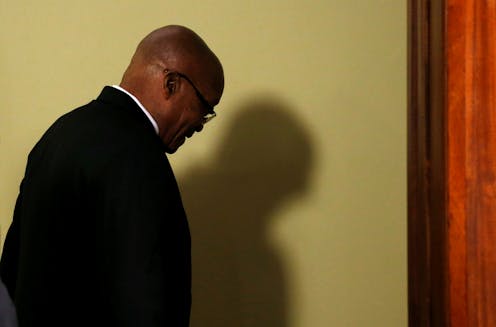
The Zuma years are over. He kept fighting almost to the very end. But South Africa’s scandal-ridden President Jacob Zuma finally accepted the inevitability of his political fate late last night when he resigned with immediate effect. By doing so he cut short his second and final presidential term with over a year still to run.
Even then he toyed with his audience. In a 30-minute address that began close to 10.30pm local time, Zuma appeared to be veering towards requiring the ruling African National Congress (ANC) to use its majority in parliament to remove him by way of a no confidence motion.
With an ardent defence of the constitution – ironic given the many findings of constitutional transgression made by the courts in recent years against him – Zuma argued that the most appropriate way for a president to be removed from office would be by one of the two constitutional mechanisms – a vote of no confidence pursuant to section 102 or impeachment under section 89 – rather than by his party.
But the implication that to bend to his party’s will would represent a subjugation of the will of the people was a typical example of Zuma’s misrepresentation or misunderstanding of South Africa’s system of government. While the head of government is the president, the system is essentially a parliamentary one. The president is elected by parliament and not directly by the electorate.
So this was not regime change as Zuma implied. It was a palace coup, very similar to the one Zuma had overseen when Thabo Mbeki was removed from office ten years ago in September 2008.
Last throw of the dice
At the start of a dramatic week in South African politics, on Monday the ANC’s National Executive Committee concluded a marathon 13-hour meeting by deciding that Zuma should be “recalled” and replaced by Cyril Ramaphosa. Ramaphosa was Zuma’s deputy in government after winning a closely-contested race to succeed him as ANC president at the party’s five-yearly national elective conference in December.
A former trade union leader and, later a successful businessman, Ramaphosa won on a ‘change’ agenda. He promised to end the culture of impunity that has been the hallmark of the Zuma years and to arrest the self-enrichment project of “state capture”. This has seen key state institutions, such as the SA Revenue Service and PRASA, hollowed out, causing great harm to the interests of millions of the most vulnerable citizens.
Earlier in the day Zuma had waged war against his own party when in an exclusive interview with the South African Broadcasting Corporation he defied the ANC’s leadership, claiming that he had not done anything wrong. He also claimed that the party had failed to specify the reason for its decision to recall him.
At one point in the interview Zuma appeared to be threatening instability in the organisation that he has served his whole life – a last roll of the dice for a fearless politician for whom the usual rules of political engagement never seemed to apply.
But Ramaphosa did not blink and preparations for the vote of no confidence continued. Zuma calculated that the game was up and fell, finally, on his sword.
Under the country’s constitution, the deputy president of the country Ramaphosa takes over as interim president immediately. The National Assembly is nevertheless likely to be convened shortly to elect a new president. This will enable Ramaphosa to deliver the State of the Nation Address that was postponed last week.
Victory for the rule of law
Given the history and context of post-colonial Africa in which numerous heads of state have clung onto power for decades, yesterday’s turn of events could be seen as a victory for South Africa’s democracy. It has proved to be resilient in the face of the Zuma-enabled project of state capture.
The rule of law and an independent judiciary have held firm despite the pressures of an unrelenting supply of politically-charged cases. Along with opposition parties, civil society organisations, such as Section 27 and the Council for the Advancement of the South African Constitution, have used the constitution to challenge Zuma.
Now Zuma, along with the Gupta family and many others – including several members of the current cabinet – must face the prospect of being held to account. The process is already underway. Yesterday began with the startling news that one of the Gupta brothers had been arrested and the family’s compound in Saxonwold, Johannesburg had been searched.
And a judicial inquiry into the involvement of the Guptas in state capture will soon commence. This will include their relationship to both cabinet ministers and the leadership of certain key state owned enterprises, such as beleaguered energy utility Eskom.
And one of Ramaphosa’s first appointments will be a new national director of public prosecutions. The courts have already ruled that they must proceed with the prosecution of the 783 corruption charges that were unlawfully dropped against Zuma just before he first became president in April 2009.
Whether Zuma is convicted and imprisoned remains to be seen. But his early ousting from power is a salutary lesson. Those implicated in the corruption that has increasingly undermined investor confidence in South Africa in recent years will be quaking in their boots.
The winds of change are blowing through the corridors of power.
Ramaphosa’s big challenges
Having dealt with the unavoidably messy and awkward business of removing a sitting head of state, Ramaphosa can turn to the even bigger and more important challenges that face the country. These include a fiscal crunch with tough public expenditure choices to be wrestled with in next week’s budget; high unemployment and inequality; and, rebuilding integrity in state institutions and agencies.
With Zuma out of the way, Ramaphosa can expedite his pursuit of a socio-economic “new deal” unencumbered by Zuma’s obstructive tendencies and personal interests. These have included a rumoured deal with President Vladimir Putin to purchase nuclear power plants from Russia.
Ramaphosa, and South Africa, now have a clear run at addressing the many urgent problems that have hindered economic growth and confidence in recent years. They have given themselves an opportunity to rebuild the lost social compact of the Mandela years. And recover from the draining swamp of Zuma’s rule.

Richard Calland is a Founding Partner of the Paternoster Group: African Political Insight, a Member of the Advisory Council of the Council for the Advancement of the South African Constitution (CASAC) and a member of the Board of the Open Democracy Advice Centre.
Source: The Conversation – Articles (AFRICA)
Read more on The Conversation.
Join the fun: Add Your event | Submit a Press Release | Add your listing.


