Zuma trial means that his toxic legacy will haunt South Africa for some time:
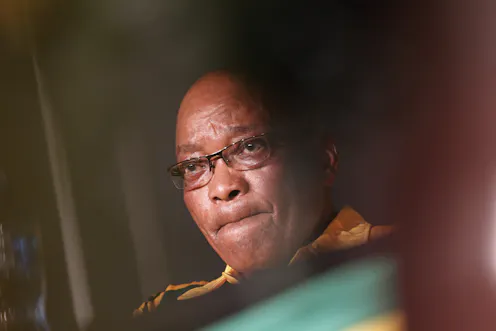
The latest instalment in South Africa’s longest running political soap opera played out dramatically on 16 March when Shaun Abrahams, the head of South Africa’s National Prosecuting Authority (NPA), announced that 16 criminal charges against former president Jacob Zuma must stand and be tested in court.
The charges relate to 783 counts of corruption, fraud, money laundering and racketeering. The charges were controversially dropped in 2009 but reinstated by the country’s High Court in 2016. The Supreme Court of Appeal went on to uphold this judgment in 2017.
This is merely one instalment in a drama that may still have some years to run. It can be traced back to the sleaze and kickbacks surrounding the arms procurement package of the late 1990s. The allegations were that Zuma was a beneficiary of largesse from certain arms companies in exchange for exerting his influence on their behalf.
The Abrahams decision – made despite opposition fears that, as a Zuma appointee, he might flinch from the challenge – is of enormous significance. A former president is now likely to find himself in the dock at a criminal trial, an unprecedented event in South African history.
A different political atmosphere
Looking beyond the groundbreaking historical nature of the decision and its implications for Zuma personally, it seems unlikely that Abrahams’ decision will generate the same passions as the issue did in the 2007-2009 period. At that point Zuma’s standing in the ANC alliance was at an all time high and attempts to prosecute him for corruption were viewed as part of a wider ‘dirty tricks’ campaign to sabotage his rise to the presidencies of both party and state. This included the Thabo Mbeki camp inside the ANC and others outside the party.
His 2006 rape trial had been viewed in similar terms by his staunchest backers such as then ANC Youth League leader Julius Malema, who subsequently, and rather shamelessly, would reinvent himself as Zuma’s chief critic.
Pro-Zuma sentiment was particularly strong on the left of the ANC-led alliance with the Congress of South African Trade Unions (Cosatu) and the South African Communist Party uncritically and unconditionally buying into the mythology around Zuma . They viewed his presidency as an opportunity to engineer a leftwards shift in South Africa’s general political direction after the supposed ‘neo-liberalism’ of the Mbeki years.
Now, in 2018, the left is older and wiser. In the aftermath of a scandal ridden presidency disfigured by endemic corruption and allegations of state capture by private interests close to Zuma, the trade union federation and the Communist Party are more likely to support his prosecution than contest it.
Equally, the broader politics of the issue are now less highly charged. In 2009, Zuma was the president-in-waiting. There was limited enthusiasm, even among his many critics in the movement, to see a South African president inaugurated who faced the realistic prospect of a criminal trial in the foreseeable future. It was felt this would provide a fatal distraction from the responsibilities of government.
As it turned out, he was fatally distracted from those responsibilities anyway by a succession of new scandals which arrived with alarming frequency to paralyse his presidency. These included Nkandla (2013/2014), Nenegate (December 2015), the sacking of Finance Minister, Pravin Gordhan (March 2017), and the various state capture reports of 2016/17.
While prosecutors technically make their decisions on narrow legal grounds, one should not assume they are entirely insulated from broader political and societal pressures in their decision making. Now, however, Zuma is merely a former president and an ANC member. Consequently, the protective shield previously extended by the governing party will not be there. And, given the other scandals mentioned above and with a new leader in place, he may only be able to draw on very modest support from within the ANC’s ranks.
The double-edged sword
Zuma’s proposed prosecution is a welcome reaffirmation of the principle that all are equal before the law. But a trial carries with it very real dangers for the ANC.
First, it will serve to remind a wider South African audience that Zuma did not emerge in a vacuum. He is a product of the ANC. The party elected him twice as its president and, before recalling him in February 2017, rallied round him during the Nkandla saga and in numerous parliamentary votes of no-confidence. Its own National Executive Committee also rejected demands for his recall on several occasions. It will be difficult if not impossible for the ANC to avoid some collateral damage as it was unquestionably the chief facilitator and enabler of that discredited era.
Second, there is always the risk that a trial will see the movement’s dirty laundry being aired in public by Zuma. This will be particularly true if he believes his fate is sealed, taking the opportunity for a wider settling of scores with others in the ANC. The trial could then become an endurance test for the ANC and a propaganda windfall for its opponents reminding South Africans in graphic detail of the looting and embezzlement over which the movement has presided.
Ramaphosa will hope that Zuma’s lawyers revisit their earlier so-called ‘Stalingrad strategy’ of delays and prevarication so that when it finally commences it does so after – and not before – the 2019 election. On past evidence there are likely to be numerous attempts by his lawyers to actually prevent the case from ever coming to court.
For the trial to take place in the run up to, and during that election campaign, would be extremely unwelcome for the new leadership. It will blunt the Ramaphosa message that he is ‘purifying’ the movement, restoring its traditional values, and seeking closure on a discredited era.
Moreover, even in the aftermath of an election, the issue will return to the top of Ramaphosa’s agenda if Zuma is eventually found guilty. The question of granting or not granting him a pardon will then arise. This will test the credentials of a leader supposedly making a definitive break with a sordid past.
It is also possible that further charges could be brought against Zuma once the whole state capture phenomenon is laid bare by an official commission of inquiry headed by Deputy Chief Justice Raymond Zondo. The state capture saga makes the existing charges against Zuma look insubstantial by comparison.
Zuma’s presidency may be over, but his toxic legacy seems likely to haunt the ANC – and through it South Africa – for some considerable time yet.

James Hamill does not work for, consult, own shares in or receive funding from any company or organisation that would benefit from this article, and has disclosed no relevant affiliations beyond their academic appointment.
Source: The Conversation – Articles (AFRICA)
Read more on The Conversation.
Join the fun: Add Your event | Submit a Press Release | Add your listing.


