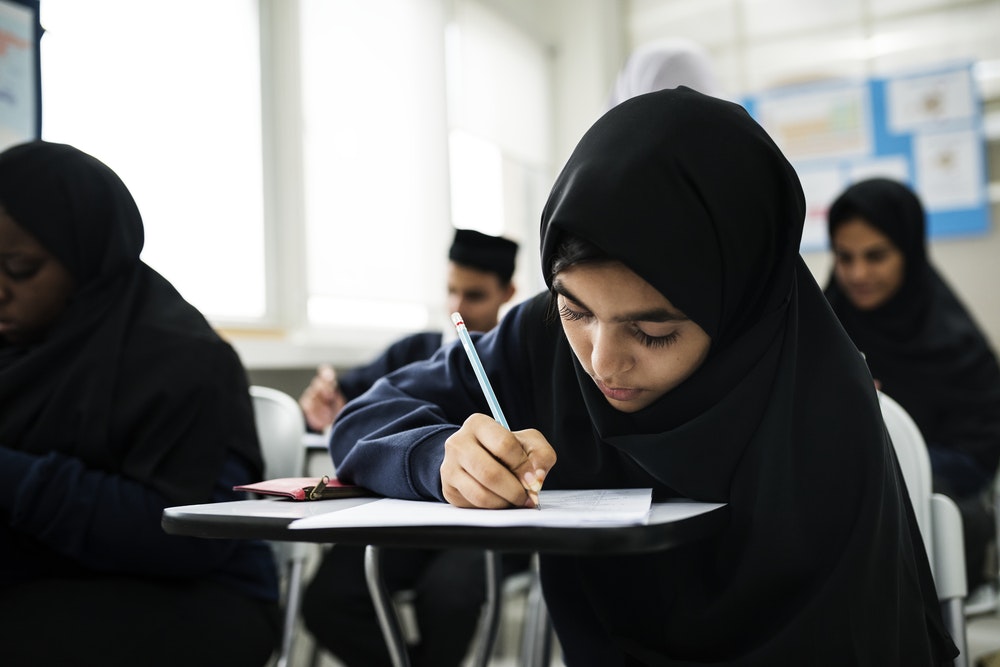
Political and social landscapes are shifting in most liberal democracies, and one of the issues coming under the spotlight is the purpose and legitimacy of faith-based schools. The South African Schools Act makes provision for the establishment of independent schools, which includes privately run and faith-based schools.
Muslim schooling in the country has its roots in the forced migration of slaves and political prisoners from Indonesia and the Indian sub-continent, which lasted until 1834. It has endured through different political milieus – colonisation, apartheid and now democracy – and a changing Muslim world.
Because Muslim schooling has been, and still is, partially informal, it’s difficult to say exactly how many schools and learners there are in the country. Taking into account statistics from the Association of Muslim Schools and provincial directories, a conservative estimate would be 96 formally registered schools.
In today’s South Africa, few would argue against the right of Muslim-based schools to exist. Like other faith-based schools, they serve as an expression of human and religious rights, and so are a necessary and desired feature of diverse societies.
But there’s a concern among scholars that Muslim schooling and education in South Africa has remained unchanged in its ideas and the way it’s taught. The worry is that Muslim schools and communities may be too isolated and may not adequately prepare its learners or its teachers for the demands of a pluralist and diverse society.
In a recent journal paper we have argued that despite vast shifts in its socio-political contexts, Muslim education has remained closed off from broader political discourses. We raise the question of whether the cocooning of Muslim education has rendered its educational institutions and communities incapable of self-critique, reflection and interrogation, and hence, unprepared to adequately prepare its learners for a democracy?
More of the same
Muslim-based schools in democratic South Africa slip into two distinct camps – influenced by the historical heritage of Islam – of either a predominant “Malay” or “Indian” ethos. Because these schools are classified as independent, they don’t enjoy full state support. They rely on school fees or the generosity of donors. These fees are often out of the reach of black Muslim communities, who, despite immense political reform, continue to suffer economic marginalisation.
The result is that Muslim-based schools have retained the same racial and cultural exclusivity as that enforced during apartheid. This suggests particular implications not only for whether learners at these schools are equipped for dealing with those who are different to themselves, but also how these learners conceive of themselves in pluralist society.
Furthermore, Muslim-based schools, like all other schools irrespective of whether they are public or independent, are obligated to implement the national curriculum of South Africa. Often, the curricula of Muslim-based schools are characterised by additional subjects such as Arabic, Qur’anic studies and Fiqh.
Pedagogical practices at these schools reveal an overwhelming reliance on memorisation and rote learning. Seemingly, scant attention is given to critical thinking and consciousness. Teaching and learning are largely constructed along dichotomous lines of the teacher as the only authority and the learner as a passive recipient.
This kind of teaching is closed off to deliberation and debate. Learners don’t get the skills to make sense of who they are in relation to others, and their worlds.
What needs to be done
All schools in a democracy have an obligation to ensure that the type of education which they advance speaks to pluralism, diversity, mutual recognition and peaceful co-existence. A democracy is reliant on democratic forms of engagement, which necessarily implies a willingness to engage with divergent views. The fact that Muslim-based schools, as well as all other faith-based schools, exist in a democracy implies that they ought to contribute to that democracy.
The value of any form of education lies in its ability to respond to the broader society. If education fails to address social problems of exclusion, marginalisation and violence, then it has not fulfilled its responsibilities. It needs to be rethought in line with the democratic aspirations of post-apartheid South Africa.
It doesn’t make sense to practise Muslim education as separate from education in other schools, as if Muslim education were only concerned with the private, spiritual aspects of human life. Integrating it into the broader school curriculum would fuse the rational, emotional and spiritual dimensions of education and relate them to the public sphere.
Muslim education in South Africa’s colonial and apartheid past has always been concerned with struggle and contestation. It should persist with the struggle to become more relevant and responsive to socio-political developments of the day.
The challenge of education is to bring opposites – like the secular and non-secular – into conversation and not to present them as out of touch with each other.


