A personal journey sheds light on why there are so few black women in science:
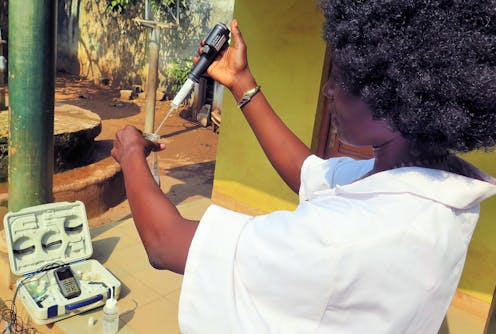
Nine years into my research and academic career, one of the most common questions I hear from family and friends is, “uzoqedanini ukufunda?” (“Will she ever finish studying?”)
They’re not the only ones who struggle to understand what it is that I do. My experience is that most black women “fall into” research and academia, rather than deliberately choosing it as a career direction from the start. That would explain why black women undergraduates often ask me “What is research?” and “Is reading all you do?”
The United Nations marks February 11 each year as the International Day of Women and Girls in Science. This is an important occasion – but, based on the kinds of questions I receive almost daily, I’d suggest that retention rather than participation should be the focus of February 11 and related initiatives.
In South Africa, where I conduct my research and am working towards a PhD in climate change and food production, there is a particular need to attract and retain black women to the sciences. This has been a difficult, fraught process. Mamokgethi Phakeng, a full professor of mathematics education and a deputy vice-chancellor at the University of Cape Town, has offered several reasons for this.
For instance, she has pointed out that black women wishing to enter “non-traditional” careers face opposition from patriarchal African cultures. This, she suggests, is part of the reason that men dominate science and technology-related careers.
These issues can be addressed in several ways. Mentors and role models are crucial; so too are opportunities for black women scientists to find and build more collaborative spaces where they can combine their technical training with other skills. Cultural attitudes to the notion of “women as scientists” also need to be addressed.
The reality
During my talk at the Science Forum South Africa conference in 2017 a young man asked me: “What is the big deal? Could it be that women are just not interested in the Sciences?” My answer was, “No sir!”, and that’s backed up by figures. University enrolment data shows that attracting young black women to science courses at undergraduate level in South Africa is not the problem.
Retention is the issue. There is a “leaky pipeline” that sees women complete undergraduate science degrees – and then leave academia rather than pursuing postgraduate qualifications.
This means that black women lecturers in the sciences in South Africa’s academy have the lowest representation. Fewer lecturers ultimately mean fewer professors – the most senior, admired and respected in their academic disciplines.
In an environment like this, young black female scientists feel isolated and misunderstood. I know this first hand, as a young black women researching methods to improve food production for sub-Saharan Africa on limited land and in the face of changing climate. My own experiences are part of the reason I started an organisation called Black Women in Science.
I was also responding to complaints from other science students, who felt the same worry about their own skills and sense of isolation that I did. Black Women in Science, which has 150 members, aims to encourage women’s participation in science, technology, engineering and maths by approaching the career of a scientist in a collaborative manner. It’s not about sticking to one discipline or area of specialisation.
Role models and cultural norms
So what’s holding young black women back? The giant leap from high school to university is an enormous hurdle. This is true for all students, but – as data about first-year dropout rates in South Africa show – especially among black students. This is because they tend to come from lower quality primary and secondary school systems than their white peers.
For those who remain in the system and look to pursue postgraduate degrees, the lack of mentorship and role models is another issue. When you don’t identify with people who are lecturing in terms of image, culture and background, it’s easy not to relate to the field or subject. Diversity in the lecture hall is a way to show black women students that they can also take ownership in a particular field.
It’s important for these young women to look beyond the academy for mentors, too. One of the women I admire is Getty Choenyana, who trained as a mechanical engineer, then founded Oamobu Naturals and uses her scientific skills and knowledge to successfully produce marketable products.
Family, marriage and culture also influence black women’s experiences as scientists. A number of African communities and cultures do not have a tradition of professional women. There is a strong expectation that women must conform to the traditional roles of wife and mother.
I am a Zulu woman. If I were married, my in-laws would probably struggle to understand that I am unable to attend “umembeso” (one of the many stages and rituals in a Zulu wedding) because I have a thesis to write-up.
This is an added layer of complexity and a daunting burden. I, and black women scientists like me, feel enormous pressure to be perfect in the eyes of our academic peers and our own communities.
This points to the need for institutions to change too. It’s important that departments, faculties and senior academics understand the language and cultural challenges black women scientists face, and try to be more sensitive to them.

Ndoni Mcunu is doing her PhD at the Global Change Institute – Witwatersrand University. She is the founder of Black Women in Science (BWIS).
Source: The Conversation – Articles (AFRICA)
Read more on The Conversation.
Join the fun: Add Your event | Submit a Press Release | Add your listing.


