ANC power struggle shows that South Africa is not exceptional (after all):
South Africa is in the grip of political uncertainty. That President Jacob Zuma will go before the official end of his tenure after national elections next year is inevitable. But when, how, and at what cost to the ANC and the country?
The current crisis is being framed as one of internal party politics – or the immorality of Zuma and his supporters. In fact, the impact is much bigger and wider, affecting South Africa’s standing in Africa, and in the world.
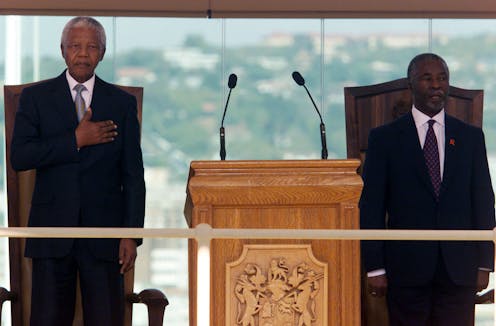
In 1994 the world, and particularly African countries, looked to South Africa to provide ethical leadership after the end of apartheid. This was boldly depicted in the “African Renaissance” – the cultural, scientific and economic renewal of the continent championed by former President Thabo Mbeki.
For a short time, South Africa occupied the moral high ground and was able to influence the agenda of intergovernmental organisations like the United Nations, the African Union and the South African Development Community.
South Africans were called on to play a key role in a number of areas. Two stand out: conflict management in, for example, Burundi, DRC, Lesotho, Ivory Coast and Zimbabwe. And as the “bridge-builder” between the West and Africa.
It also twice took a seat on the United Nations Security Council and was part of initiatives such as the India Brazil South Africa Dialogue Forum. It also became part of the Brazil Russia India China and South Africa (BRICS) association among other international bodies.
But from around 2010 South Africa’s leadership role began to slip. It has now arrived at a point where it can no longer claim to be leading any renaissance. The new reality is that it’s beset with governance challenges similar to many other African states.
The rest of the continent watches and sees yet another example of a dream deferred. The expectations that the country would lead the continent have gone. It, too, is in the throes of regime survival. The lament is:
South Africa has become just another African country.
The beginning of the end
The meltdown of the ANC should not have come as much of a surprise given events over the past 20 years, and the inevitable decline of liberation parties. Pointers to the inglorious direction the country was headed in were evident in the corruption around the arms deal (1999), the fight over Mbeki’s refusal to roll out antiretroviral treatment (1990s), the decline in the economy on the back of a global crisis (2008-2009) and rising unemployment (from 2008). To this should be added the growing appetite of an emerging black elite, whose acquisition of wealth was closely tied to state resources tenderpreneurs.
Then in 2007, buoyed by populist appeal for a change of the guard, Zuma rose to power as president of the ANC. The following year the ANC’s National Executive Committee forced Mbeki to resign. Mbeki had lost the support of the committee over a range of issues including economic policy, his style of leadership, and a focus on continental and international affairs rather than domestic issues.
Mbeki sacked Zuma in June 2005, after the court findings of a corrupt relationship with Schabir Shaik, his friend and financial advisor at the time. The political contestation between the Mbeki and Zuma factions set in, leading to Mbeki’s political demise.
The deepening of the structural roots of the malaise in South Africa has therefore been long in the making.
Conflation of the state and the party, state capture, and patronage politics became the defining features of Zuma’s presidency. And ultimately they became the factors that led to his dethroning. South Africa began to display the stereotypical symptoms of the typical African state:
-
elite decadence in the midst of poverty,
-
accumulation of wealth through proximity to state resources and state capture,
-
challenges in the delivery of services, and an inability to provide human security.
South Africa’s exceptionalism claim is dead
South Africa’s claim to exceptionalism in Africa has been dispelled. Two decades ago Ugandan academic and author Mahmood Mamdani pointed to the myth of South Africa’s exceptionalism and that it shares the legacies of colonialism and the bifurcated nature of the state that colonialism had bequeathed other African states too. This meant that South Africa was no different in its political and development outcomes.
Leadership is an important mediator for the direction of any country. Visionary and principled leadership led the continent – and South Africa – to liberation. It’s what is sorely needed now across the continent, and in South Africa.
South Africa finds itself in its current situation because the country has succumbed to nationalist, chauvinist, patriarchal and elite interests. But changing the president, though necessary, won’t be sufficient to get South Africans out of this quagmire. South Africans needs new leaders as well as new forms of leadership that understand the driving forces of post-colonial states and their proclivity towards non-democratic forms of governance.
South Africa needs leadership that places it once again in the political and socio-economic trajectory of Africa and fosters a collective responsibility to develop and share its wealth among all who call it home. It must also develop the governance structures that will lead it to that goal. To do this requires moving beyond regime survival towards reinvigorating a visionary pan-African leadership that once again begins to set an agenda of unity, prosperity and dignity.
South Africa is no longer the beacon of hope for the continent it once was. But South Africans needn’t despair. The recognition of its banality finally presents the opportunity for its people to sit as equals at the table with other Africans and engage in much needed dialogue on the kind of leadership and governance that would take them forward on the journey to an African Renaissance.

Cheryl Hendricks is affiliated with organisation. ISIS-WICCE, UNWomen,SADC Gender Alliance, SA Political Science Association, CODESRIA
Source: The Conversation – Articles (AFRICA)
Read more on The Conversation.
Join the fun: Add Your event | Submit a Press Release | Add your listing.


