Africa’s rich fossil finds should get the air time they deserve:
Palaeontology, like much else in the cultural landscape, has a strong western influence and bias. Students are more likely than not to be given textbooks and external readings from Europe and North America no matter where they are in the world.
I often think about my own experiences as a palaeontology student in France now that I’m lecturing the subject at a South African university. Back in those days, I knew more about North American and British fossils than about those from my own country. The textbooks haven’t changed much since. So, when I started as a lecturer at Wits University in 2017, I wondered if I should just be talking to my students about North America’s fossil record, or Britain’s.
There are, of course, some good books written on the subject from an African perspective. But these are nowhere near as ubiquitous as the works of palaeontologists from North America and Europe.
I decided to set the usual textbooks aside and to create my own lecture series based only on African literature about palaeontology and the continent’s fossil heritage. There were two reasons for this. The first is that while Africa is widely acknowledged as the birthplace of humankind, its incredibly varied fossil record is often overlooked.
And secondly, how can the continent hope to produce world-class scientists in the future if students aren’t learning about their own heritage.
Many of the planet’s most important life forms originated in Africa: bacteria-like organisms; many dinosaur species and, of course primates – including humans. Even the rocks on the continent are among the oldest in the world. Some of them date back more than three billion years.
From single cells to complex organisms, from sea to land, from small to giant, the continent’s many and breathtakingly diverse landscapes and the soils beneath them have witnessed and recorded all the great transitions in the history of life on Earth. It is crucial to give this unique heritage the attention it deserves so that current students and future generations can better understand the evolutionary processes that have brought us to this point.
Some crucial moments in time
Life originated in seas, and the African fossil record documents the origin of multicellular organisms two billion years ago in what is today Franceville, a city in Gabon. Fossils in Namibia, meanwhile, represent the Ediacarian biotope, the earliest discovered marine ecosystem, dating back 600 million years and made up entirely of strange, pneumatic creatures that floated.
The rise of fish, too, is well represented in Africa’s fossil records. Fossils embedded in South African rocks that date back 320 million years offer evidence of lobe-finned fish (the same family as coelacanths). They’re the ancestors of all terrestrial vertebrates – that is, amphibians and reptiles.
You may think that one of these fish evolved into a walking creature whose new legs took it from the water to the land. But the very first transition from sea to land wasn’t actually achieved by a vertebrate. It was a scorpion, as a fossil also found in South Africa has taught us.
Some fossils found outside modern-day Africa also hold lessons about the continent.
Mesosaurus was a small crocodile-like animal that lived 300 million years ago. Mesosaurus fossils have been found in both Africa – Zimbabwe, Namibia and South Africa – and in Brazil in South America. Its fossil presence in those two very different places made Mesosaurus very important, since this proved that what are today two separate continents were once part of a giant landmass (along with Antarctica, Madagascar and Australia). It was a “supercontinent” called Gondwana.
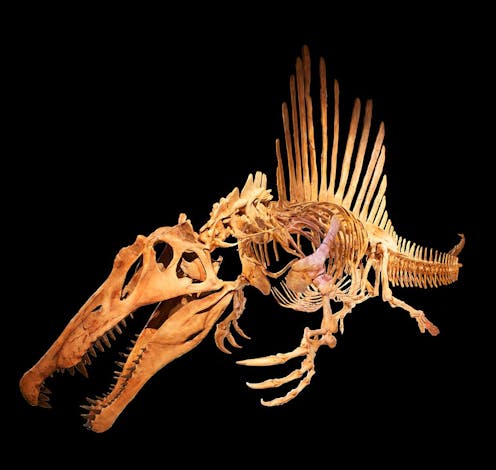
It was on Gondwana that the earliest dinosaurs were born. And they thrived across what is today Africa. For instance, fossils show that the tallest animal which ever lived – the Giraffatitan, which stretched to a huge 12 meters – roamed modern-day Tanzania. Peeling back layers that were formed 100 million years ago in the Cretaceous in parts of North Africa yielded evidence of predatory carnivorous dinosaurs like the Spinosaurus (which you may recognise from the Jurassic Park films). These beasts were as big, or sometimes larger, than the famous North American Tyrannosaurus rex.
The next transition came 66 million years ago. Dinosaurs died out and mammals diversified. These mammals’ fossil records show them to be the ancestors of some of Africa’s most famous wildlife, like elephants.
And of course, there were humans – or there would be, eventually. The earliest hominim fossil was found in Chad; it dates back between six and seven million years. Time moved, landscapes shifted; and, 300 000 years ago, the continent’s first recorded fossil hunters emerged. Fossils and other evidence have revealed that the earliest representatives of our own species, Homo sapiens, collected fossil sea shells in Morocco.
Sharing knowledge
This is but a quick glimpse into what I want my students to learn. By teaching them how amazingly rich and diverse their palaeontological heritage is, I aim to inspire this new batch of future scientists to keep studying the evolution of different species.
Only by educating more students about their past will academics have a chance to reach out to communities across Africa, raising awareness about the importance of the continent’s fossil heritage to us all, and ultimately give to Africa what the continent really deserves: more African palaeontologists.

Julien Benoit receives funding from The Claude Leon Foundation; PAST and its Scatterlings projects; the National Research Foundation of South Africa; and the DST-NRF Centre of Excellence in Palaeosciences (CoE in Palaeosciences).
Source: The Conversation – Articles (AFRICA)
Read more on The Conversation.
Join the fun: Add Your event | Submit a Press Release | Add your listing.


