Bringing al-Bashir to justice: the pros and cons of various options:
After coming into power in a military coup in 1989, Omar al-Bashir, former president of Sudan, targeted the civilian populations in the Fur, Masalit and Zaghawo regions of Darfur, whom he regarded as opposing his rule. According to the International Criminal Court, he played an active role in the design and coordination of the atrocities against them.
This is why the court indicted him on numerous charges of crimes against humanity – including murder, torture, rape, war crimes and genocide – in 2009 and again in 2010.
Yet al-Bashir never faced trial. For over a decade he travelled throughout Africa managing to evade arrest. This was despite the fact that 33 African countries have signed the Rome Statute establishing the International Criminal Court.
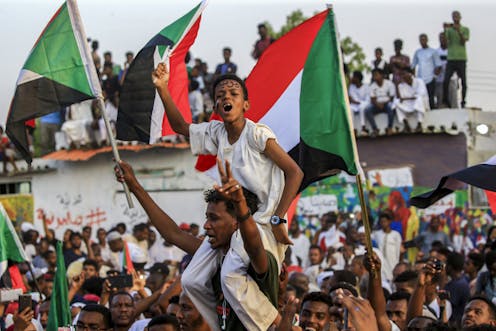
But the tide turned in early 2019 when peaceful protests by Sudanese led to al-Bashir being ousted. This led to the new ruling Sovereign Council of Sudan announcing earlier this year that it would hand al-Bashir over, together with four of his aides, to the International Criminal Court. It used the emotive words that
We cannot achieve justice unless we heal wounds with justice.
An International Criminal Court delegation has since visited Khartoum to discuss cooperation with the Sovereign Council. But it’s unclear what will happen next.
The Sovereign Council’s initial announcement stated that al-Bashir would be surrendered to the International Criminal Court. But other possibilities have subsequently been floated, including a hybrid court. These remain under discussion.
Al-Bashir’s legal counsel will also be strongly opposed to sending him for trial in The Hague on legal and political grounds. They assert that the International Criminal Court lacks jurisdiction because Sudan is not a signatory to the Rome Statute. And they argue that the interim government is merely attempting to placate world leaders.
This legal argument’s weakness is that the Rome Statute gives the United Nations Security Council the mandate to refer non-signatory countries to the International Criminal Court.
Whatever the reason – true justice or placating other countries – some form of accountability is required. But prosecution by the International Criminal Court is not the only way for victims to obtain justice. Various options are available for his prosecution and with the ICC dependent on the cooperation of the Sudanese government, the new Sudanese government will ultimately hold his fate in their hands.
The options
Al-Bashir can be handed over to the International Criminal Court for prosecution. This option should receive due consideration since his arrest and handing over was one of the primary demands of those who rose up against his rule.
It would also be seen as a reflection of the new Sudanese government’s commitment to justice and international law.
But handing al-Bashir over to the International Criminal Court need not mean prosecution in The Hague. One argument is that consideration should be given to the need for the victims and survivors to have access to his trial. The International Criminal Court could therefore opt for an ICC trial away from The Hague, conducted in Sudan.
This would create its own challenges. For example, there may be jurisdictional issues as Sudan is not a signatory of the Rome Statute. Another potential hurdle is that factions of the military that still support al-Bashir will stop the prosecution from interviewing witnesses and conducting the trial in Sudan.
A third possible route would be for al-Bashir to stand trial in a Sudanese court. But some argue that the Sudanese courts aren’t fit to prosecute war crimes and crimes against humanity . There is also little trust in the courts, since the rule of law has been compromised.
Yet another option would be a hybrid court consisting of Sudanese and other international judges as originally mooted by the African Union. This would be to counter the mistrust, particularly if the judges were from African countries.
This model was used successfully in the prosecution of former Chadian president Hissène Habré by the Extraordinary African Chambers in Senegal. The hybrid court in that instance was hailed as the future of African tribunals.
But the use of “universal jurisdiction” to justify the prosecution of Habré in a foreign country was controversial. The AU has been critical of this legal concept since a Rwandan general’s arrest in London on a Spanish warrant. Al-Bashir’s supporters might echo this and once again claim a lack of jurisdiction. And whether this option could work in the prosecution of al-Bashir may ultimately depend on the political will of the heads of states with whom al-Bashir had strong political ties, especially those in neighbouring countries.
The final option would be to see The Hague as only a last resort should the Sudanese justice system fail. This would fit into the idea of complimentarity – that the ICC is authorised to take cases only where states cannot or will not prosecute. Considering the African Union’s stance on the court, and its desire for the continent to solve its own problems, a trial in Sudan, with The Hague as only a last resort should the Sudanese justice system fail, may be the most appropriate option.
Will justice be done?
Considering the AU’s vehement criticism of the International Criminal Court, it has been strangely quiet in response to al-Bashir’s arrest and the likelihood of his being handed over to the court.
With the narrative already changing from the definite handing over of al-Bashir to the International Criminal Court, to one of options being considered, it remains to be seen whether justice will indeed be done – and seen to be done – for his victims.

Michelle Nel does not work for, consult, own shares in or receive funding from any company or organisation that would benefit from this article, and has disclosed no relevant affiliations beyond their academic appointment.
Source: The Conversation – Articles (AFRICA)
Read more on The Conversation.
Join the fun: Add Your event | Submit a Press Release | Add your listing.


