How waste pickers in the global South are being sidelined by new policies:

The world is producing more and more waste, with serious health and environmental consequences. In urban areas, domestic waste is accumulating fast and landfills fill up quickly.
Public authorities are trying to manage this problem in new ways. In the global South these tend to involve private corporations and expensive technology rather than waste pickers. This policy shift towards the privatising of waste management is limiting waste pickers’ access to recyclable materials.
This is happening despite the fact that waste pickers are responsible for a very high percentage of recycling. By collecting, sorting and selling discarded materials waste pickers deal with between 20% and 50% of the overall generated waste.
Sidelining waste pickers is leading to conflicts, which a group of researchers and activists are tracking. The Barcelona Research Group on Informal Recyclers – in collaboration with EnvJustice, the Global Alliance of Waste Pickers and Women in Informal Employment: Globalizing and Organizing (WIEGO) – has released a map showing conflicts related to informal recyclers.
The map is a selection from the Environmental Justice Atlas of 50 conflicts in Africa, Asia and Latin America in which waste pickers are fighting for social and environmental justice. The map makes it easy to see who loses and who benefits from policy shifts.
Historically, waste pickers have been confronted with dangerous working conditions, social marginalisation and persecution. The map shows how this precarious situation is getting worse.
Waste, once freely available to the poor, is being appropriated for business purposes. As a result, private corporations obtain large profits, while waste pickers loose their livelihood.
Meanwhile society at large looses the environmental benefits of recycling.
The business of waste
The informal recycling sector is a way of making a living for 19 million to 24 million people in the global South, according to the International Labour Organisation. Their skills and knowledge about materials such as metals, plastics and paper enables them to give items a value.
They provide services to society free of cost, but their work and rights are not always fully recognised. In some countries, such as Brazil and Colombia they are strongly organised in cooperatives and associations. This enables them to voice their claims and even formally take up municipal waste services.
In the past decade, threats to waste picker livelihoods in the global South have been triggered by shifts in public policy towards privatised formal management of urban waste. This has taken three main forms: incineration, privatisation and urban space restrictions.
Incineration: these technologies get large public subsidies, for example as emissions reduction projects from the Clean Development Mechanism of the Kyoto Protocol. The first incinerator in Africa was built in Ethiopia in 2018 with Chinese investment and Danish technology. National bans on incineration are being challenged from the Philippines to Mexico.
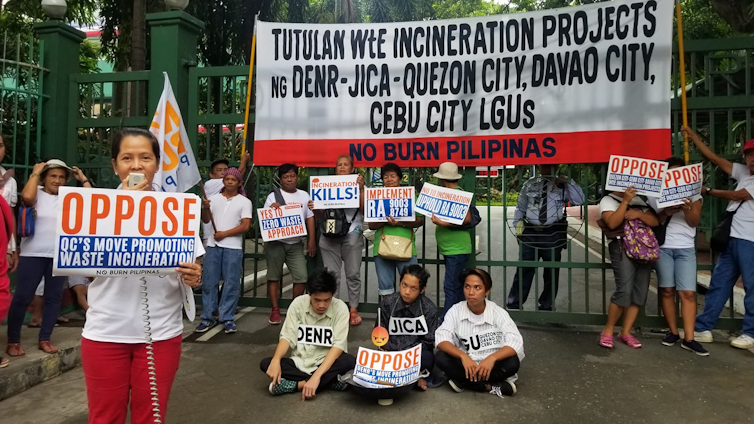
But research shows that recycling is always preferable to burning. This is true both socially in terms of the livelihoods of waste pickers as well as environmentally for Co2 emissions and risks of air pollution.
In Delhi waste pickers and residents have allied against incineration.
Privatisation: corporations have become increasingly interested in waste as a resource. For example in Johannesburg, the Genesis landfill was privatised and waste pickers got violently evicted. Formal criteria for contracting municipal waste management services that are being put in place end up excluding waste pickers, for example in Egypt and Ghana.
The closure of problematic landfills has often led to the simple shifting of environmental damage in places like Belém and Rio de Janeiro as well.
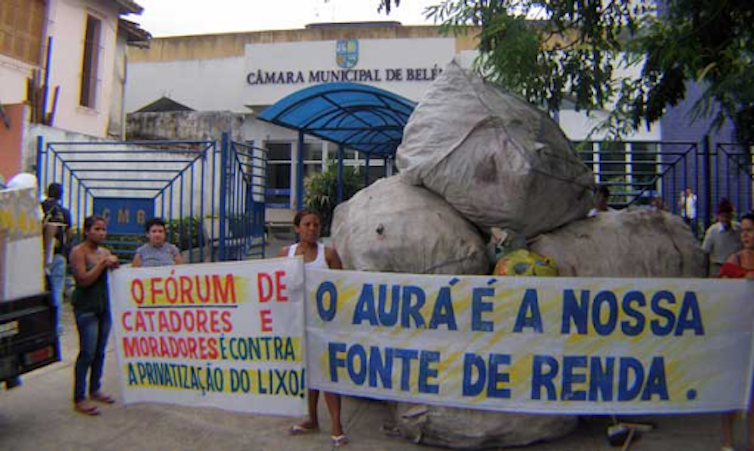
Restrictions in urban space: these can affect waste pickers, and their livelihoods. An example is the prohibition of animal or human-drawn vehicles. Such examples can be seen in Porto Alegre and Montevideo.
Another example is the installation of “anti-poor”, “smart” containers in Buenos Aires and Bogota.
And, in the name of modern, beautiful and hygienic city centres, waste pickers are denied access to certain urban areas, like in Phnom Penh.
Resistance and mobilisation
Waste pickers are increasingly taking action to oppose policies that exclude them from their source of livelihood. The main areas of focus are social rights and formal inclusion into municipal waste management. They also organise to make their environmental services visible, fight discrimination and empower their communities. This is happening mostly in Latin American countries. But it’s also happening in South Africa and India, among others.
The Global Alliance of Waste Pickers, supported by the nongovernmental organisation Women in Informal Employment: Globalizing and Organizing, works with organisations in more than 28 countries. Their aim is to include waste pickers in decision-making, improve their working conditions, develop their capacity and achieve recognition for their work. Civil society groups have also formed a network in the Global Alliance for Incinerator Alternatives.
Recognition of the contribution that waste pickers make is growing in some countries. But most still face social marginalisation, highly unsuitable working and living conditions, and most recently a global trend of privatisation of waste management that threatens to deprive them completely of their livelihood.
This article has been written by Nina Clausager, Max Stoisser, Federico Demaria and Marcos Todt. They compose the Barcelona Research Group on Informal Recyclers at ICTA-UAB, together with Valeria Calvas, Rickie Cleere and Chandni Dwarkasing, with the support of Lucía Fernández Gabard and Federico Parra (WIEGO-GlobalRec).

Federico Demaria recibe fondos del European Research Council (EnvJustice project; GA695446) .
Marcos Leite de Matos Todt recibe fondos de "Coordenação de Aperfeiçoamento de Pessoal de Nível Superior – Brasil (CAPES) – Finance Code 001”
Source: The Conversation – Articles (AFRICA)
Read more on The Conversation.
Join the fun: Add Your event | Submit a Press Release | Add your listing.


