David Koloane fought for the right to define himself — and his art:
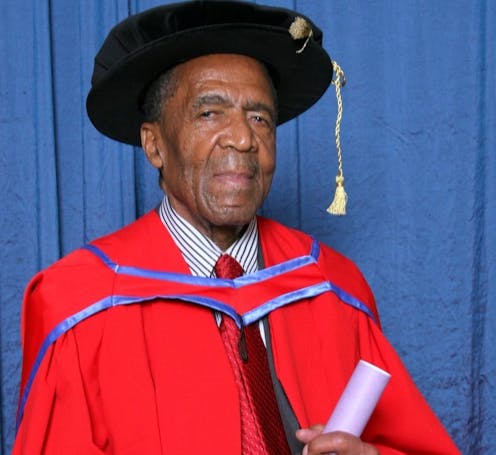
Dr David Nthubu Koloane, who was born in South Africa in 1938, was an extraordinary pioneer in the visual arts who fiercely defied any form of categorisation. As an artist, teacher, mentor, curator, arts administrator and author, he fought for the human right to define oneself and to determine one’s own future.
Over the years he has consistently received high praise. President Cyril Ramaphosa referred to him as a “giant in the arts”. Former President Thabo Mbeki called him
a loyal fighter for the liberation of our people.
And renowned author Nadine Gordimer referred to him as a “leading force in the promotion of South African artists”.
Koloane’s contribution to the visual arts in South Africa is unsurpassed. Despite the accolades and multiple honorary doctorates bestowed on him, his role as Ntate-moholo (grandfather) to young artists was most precious to him.
Mentored by the South African artist Louis Khehla Maqhubela, who was also his friend, Koloane in turn mentored numerous artists. His perception of education extended far beyond the borders of institutions. “Travel has been the best education of my life,” he stated.
Koloane was deeply influenced by Steve Biko and the Black Consciousness movement. It was important, he suggested, “to try and instill that sense of self-worth in… local artists”.
When he curated the South African component of Seven Stories of Modern Art in Africa at London’s Whitechapel Gallery in 1995, he brought together artworks by Ezrom Legae, Sam Nhlengethwa, Paul Stopforth and Alfred Thoba that depicted the events leading to Biko’s death. Koloane said at the time:
The Biko event, more than any other occurrence, touched every human chord… It provoked international outrage.
A few years later, Koloane created his own series of artworks that grappled with the physical and psychological torture of Biko. Titled “The Journey” (1998), the series of 20 works depicting Biko reflected the broader context of what Koloane called the “immense human tragedy” of apartheid.
This series, revealed Koloane, was “also a journey for me”. Many of Koloane’s artworks dealt with the daily experiences of living in apartheid South Africa and navigating, for example, the Group Areas Act and the Separate Amenities Act. “I had not been inside an art museum until I was in my mid-thirties” he lamented, as one had to be “accompanied by a white and, by implication, superior person”.
Abstraction as resistance
Notions of contentious and uncomfortable space (whether public space, domestic space or the means of moving through space) were important to Koloane’s artwork. In his Johannesburg cityscapes; his depictions of dogs roaming the streets; and his aerial views of minibus taxies (or as he referred to them, “moving coffins”), he often leant towards abstraction. By doing so, he refuted categorisation.
He explained this in many interviews as well as in his own writing:
We were expected to do township work, black work, rather than work done by any artist.
The work of practitioners in urban settlements has been indiscriminately referred to as “township art” as a means of differentiating the artist’s work from mainstream art produced by white practitioners.
The art market sought a depiction of townships that was a “sentimental form of expression rather than a depiction of real social conditions”.
Koloane’s abstraction, as such, became a form of resistance; a refusal to create the work that the art world expected him to create. While some critics then referred to his work as abstract expressionism, he paid little attention to the labels and categories of art critics. “What is abstract art?” he once asked. “In order to express anything you have to abstract it. To say it is realistic, you have to abstract it to bring out the realistic elements”.
Boldly moving forward with his own artistic process, he attached little importance to reviews of his work, declaring:
I enjoy not having to look over my shoulder.
This is a critically important lesson for young artists today, who work in the contrived and fickle world of “global art” that tends to prey on those deemed profitable by the Western-driven art market.
Remote-controlled identities
In the current art market, the label “African artist” is deeply problematic when imposed on artists by dealers and curators not only disconnected by context but also blinded by privilege. As Koloane once wrote:
It is only Black artists who are insistently reminded at every possible occasion about their own identity, and how they should be conscious of it.
In his writing, Koloane was courageous in his censure of international curators who flocked to South Africa after 1994 to consume what was deemed the new fashion in the arts.
He was critical, too, of South Africans in the art world who clamoured “for international acceptance” despite the fact that South African identities were being “measured by remote-controlled Western standards”.
He referred to curators who transplanted Western-styled biennales onto African soil as “choirmasters on pedestals” and “ultimate surveyors” involved in the power game of the “mega-exhibition merry-go-round”.
Critique still relevant today
Although such critiques were espoused two decades ago, Koloane’s views are still pertinent today. He lamented the fact that in the early post-apartheid years, the art world viewed international exposure as connection with Western Europe and North America, rather than connection first with Southern Africa and then with the rest of the African continent. He wrote:
The very axis of the Johannesburg Biennale was based outside South Africa, and its emphasis was therefore on things non-African… The link with Africa is essential to the redefinition of creative expression and the interchange of skills and resources.
There is still much to learn from Ntate-moholo, as the contemporary hype about “African art” continues to be largely driven by Western capital. Perhaps his greatest gift to others is the example he set in terms of being himself and defining himself as an artist and as a human being. When questioned about his shift to abstract work he answered:
One doesn’t consciously say “now I am doing abstract art, now I am doing something else”. The analogy is to singing. You sing.

Ruth Simbao receives funding from the South African National Research Foundation and the Andrew W. Mellon Foundation.
Source: The Conversation – Articles (AFRICA)
Read more on The Conversation.
Join the fun: Add Your event | Submit a Press Release | Add your listing.


