Why Uganda needs new laws to hold police in check, and accountable:
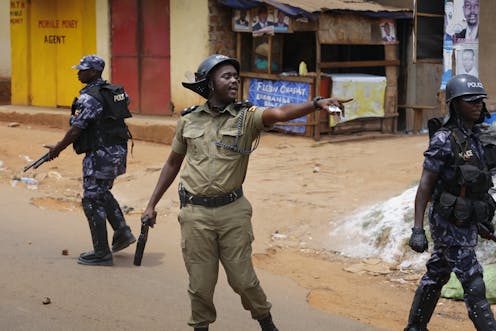
In May this year Uganda’s Constitutional Court made a ruling that offered a welcome development for domestic justice for victims of police violence, as well as an opportunity for police reform.
The Court declared a provision of the Uganda Police Act unconstitutional and void. The provision allowed police officers to use unlimited force when dispersing crowds with no liability for deaths or injuries.
This is a big win for Uganda. The country has a record of police killings as a result of excessive force used during mass protests for which there is almost never accountability.
The decision is indeed a milestone. But it isn’t likely to have any major effect unless there is pressure for new laws in Uganda that set international standards on the use of force and firearms during crowd control. Previous milestone decisions by Ugandan courts have either been ignored by the state, or have been circumvented through other legislation.
The courts have acted before
In 2008 the Constitutional Court nullified a provision of the Police Act which granted powers to the Inspector General of Police to disperse public assemblies if he or she believed they might cause a breach of the peace. The Court ruled that the Inspector General’s discretionary powers were excessive and effectively rendered freedom of assembly under the Ugandan Constitution illusory.
But in 2013 the Ugandan Parliament passed the Public Order Management Act. This gave the Inspector General powers to regulate the conduct of all public gatherings. It also required all conveners to notify the Inspector General of planned public meetings in advance. And it granted the Inspector General powers to bar the convening of a meeting at any venue if it was in the interest of crowd and traffic control.
This effectively revived the Inspector General’s powers to limit freedom of assembly. The Inspector General has used this discretion to bar the public assemblies and activities of some political opposition and civil society groups. These decisions have been based on broad and unsubstantiated claims of security interests and crowd control.
For example, the Inspector General has banned music concerts by prominent opposition Member of Parliament and musician, Robert Kyagulanyi, alias Bobi Wine. This has included concerts on his private property.
When it comes to the excessive use of force, Uganda has a multiplicity of laws that empower the police and other security agencies to carry out arrests as well as to control and disperse crowds. The laws place no limits on the use of force or the use of firearms. This means that, despite the Court’s ruling, loopholes for the use of excessive force persist within Uganda’s legal framework.
For example, the provision of the Police Act nullified by the Constitutional Court exists in the same substantive terms under the Penal Code Act. This allows the police to disperse riotous assemblies by all means necessary without legal consequences for any deaths or injuries.
Other gaps in the law exist in the Criminal Procedure Code Act, The Prisons Act, and The Uganda Peoples’ Defence Forces Act.
What needs to be done
Uganda needs a comprehensive regulatory framework to govern public assembly. This framework would balance law enforcement and human rights interests, including protecting the right to freedom of assembly. Without this framework the enjoyment of this right will continue to be subject to the political interests of the regime in power.
The same dynamics apply when it comes to excessive force used to disperse public gatherings organised by political opposition groups or those opposed to the regime.
A clarity and harmony of standards is especially important as there’s an increasing blurring of police and military roles in the country.
Uganda has an active civil society and a liberal constitutional provision for public interest litigation that can enable this.
As a practical way to ensure the Constitutional Court’s most recent decision doesn’t become another forgotten milestone, civil society organisations such as the Uganda Law Society can do two things. The first is to undertake a comprehensive mapping of all laws related to use of force in the country and determine where they fall short of constitutional and human rights standards.
The second would be to engage the police, parliament and the judiciary to map out a regulatory statutory framework. This would lay down more detailed standards on the use of force by all mandated to use force when controlling crowds.
These standards can be drawn from the wealth of relevant international guidelines. These include the 1979 Code of Conduct for law enforcement officials, the 1990 United Nations Basic Principles on the Use of force and Firearms for Law Enforcement Officers, and the African Union Guidelines for Policing of Assemblies by Law Enforcement Officials in Africa.
Reforms along these lines aren’t relevant only to Uganda. Recent civil uprisings in Sudan and Algeria show that people are increasingly seeking change through public protest. This underscores the need to get clarity on standards police should be obligated to apply against protesters. And to crystallise a legal basis of criminal liability for excessive force at both national and international levels.
The clarity of legal standards would ensure that citizens can advance democratic and human rights in Africa using peaceful means.

Sylvie Namwase works for The Human Rights and Peace Centre, School of Law Makerere University. She receives funding from The Danish Ministry of Foreign Affairs. She is affiliated with The Centre for Resolution of International Conflicts at the University of Copenhagen, Denmark.
Source: The Conversation – Articles (AFRICA)
Read more on The Conversation.
Join the fun: Add Your event | Submit a Press Release | Add your listing.


