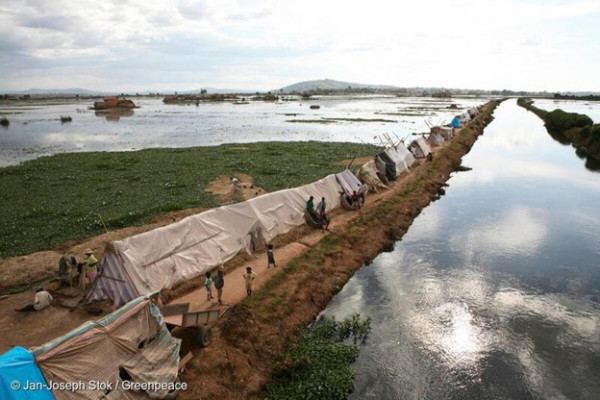
A Greenpeace scientific report released today reveals that extreme weather events such as heatwaves, floods and intense rain are increasing in intensity, frequency and severity across many parts of Africa, gravely threatening human health, food security, peace, and biodiversity.
Download Document: https://bit.ly/3ki2wP6
Weather across sub-Saharan Africa has become more extreme and unpredictable in the twenty-first century, a trend that climate scientists project will become more pronounced in future decades. This is the key finding confirmed by the comprehensive report published today by Greenpeace Africa (https://www.Greenpeace.org/africa/en/) and the Greenpeace Science Unit. The report ‘Weathering the Storm: Extreme Weather and Climate Change in Africa' (https://bit.ly/32uXPeN) explores the relationship between extreme weather events and climate change in Africa and summarises the scientific data on how the climate crisis is spiralling out of control across Africa, including irregular extreme heatwaves, floods, droughts and cyclones at a scale hitherto unknown. Climate-related problems can often be disproportionately felt in the poorest communities because they are least equipped to cope with and adjust to changes.
“Science shows there is very little that is natural in the disasters striking our continent. A human-made crisis requires a human-made solution. Africa is the cradle of humanity and it shall be the cradle of climate action for our future. Health, safety, peace and justice will not be achieved only through prayers and bags of rice and maize in the aftermath of a disaster. Only the one who preserves has no misfortune – and African leaders must declare a climate emergency to preserve our collective future,” said Melita Steele, Greenpeace Africa Programme Director.
Key findings of the report include:
- Future average temperatures in Africa are projected to increase at a rate faster than the global average in all warming scenarios [1].
- The mean annual temperature increase for much of Africa is projected to exceed 2 ℃ or to fall within the range of 3 ℃ to 6 ℃ by the end of the twenty-first century if high emissions continue – two to four times beyond the rise permitted in the Paris Agreement.
- The rising temperature is likely to lead to deaths, displacement, climate-related conflict, irregular rainfall, drinking water shortages, obstruction of agricultural production and accelerated extinction of endemic African species.
- The frequency, intensity, and duration of extreme heat events are expected to increase, following trends already observed in Southern, East and Northern Africa.
Climate Scientist, founder of Black Women in Science and co-author of the report Ndoni Mcunu:
“There needs to be better incorporation of indigenous knowledge in scientific evidence on extreme weather events in Africa. African countries need to be more involved in leading the development of new databases and models rather than being dependent on countries outside Africa. This will ensure better communication, planning and future projects of events. Access to information needs to be provided at a community level.”
Hindou Oumarou Ibrahim, Director of the Association for Indigenous Women and Peoples of Chad (AFPAT):
“Over the last 50 years, we have already experienced a warming of 1.5C, well over the world average. In the Sahel, climate change destroyed our crops, our homes and tore families apart through forced migration. But Africa is not only the stage where the worst climate impacts will play out; it is a continent of millions of citizens determined to stop climate change, to move away from fossil fuels, who will stand up to protect our forests and our biodiversity from industrial agriculture.”
Ugandan Climate Activist Vanessa Nakate:
“I have seen climate change disproportionately affect the people in my community, in my country and the African continent. It is disastrous for agriculture which is key to our survival; our livelihoods are in danger with everything being lost to floods, droughts, and heatwaves. Leaders: you must wake up, you must listen to the science, and you must face the climate emergency. We must put an end to food and water insecurity, to the violence, to the gender inequality that is being caused by climate change.”
Distributed by APO Group on behalf of Greenpeace.
Notes to the Editor:
[1] See page 14 of the report.
[2] In South Africa, for example, all climate modelling scenarios projected the extinction of more than 100 species and some modelling scenarios predicted the extinction of more than 2,000 plant species from the Cape Floral region. Other regions of the continent are also projected to experience species extinction in a warming global climate.
Petition
Greenpeace Africa's petition demanding climate action can be accessed and signed here (https://bit.ly/35laK5b).
Photo and video
Editors may use photos and footage of extreme weather events in Africa from the Greenpeace media library (link) (https://bit.ly/2Is6SWE)
Media Contacts:
Chris Vlavianos
Greenpeace Africa Communications Officer
+27 79 883 7036
cvlavian@greenpeace.org
Tal Harris
Greenpeace Africa International Communications Coordinator
+221-774643195
tal.harris@greenpeace.org
Hellen Dena
Communications and Story Manager
+254 717 104 144
hdena@greenpeace.org


