How adapting to different climates has helped a pest spread across the globe:
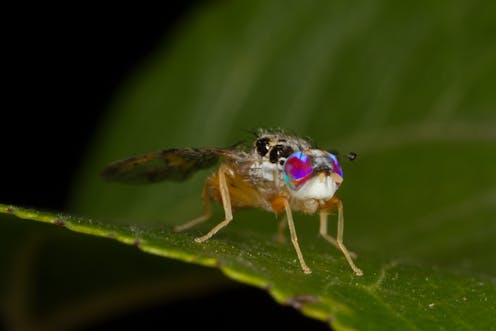
If you have ever bitten into a fruit and been disgusted to find it wriggling with cream-coloured maggots, you have already met at least one member of the fruit fly family.
True fruit flies belong to the fly family Tephritidae, and are quite different from the small Drosophila or “vinegar flies” that hover around and drown in your glass of wine. Unlike Drosophila, which lay their eggs in decaying organic matter such as fruit in a bowl in your kitchen, true fruit flies lay their eggs in ripening fruit that’s developing on the tree.
Once the larvae hatch, they feed on the fruit they were laid in. The damage caused by this larval feeding means that true fruit flies are trouble for fruit growers. Farmers often turn to costly control tactics to try and prevent infestation by true fruit fly larvae, reducing their profits. And fruit infested with true fruit fly larvae can’t be exported. This pest costs fruit farmers and governments well over US$ 1 billion each year.
The Mediterranean fruit fly, Ceratitis capitata, is among the most destructive true fruit flies in the world. It is native to Africa but is now found in countries around the Mediterranean Basin and Middle East, South and Central America, and parts of Australia and the US. What’s remarkable about this almost global distribution is the wide range of climates that the Mediterranean fruit fly has been able to colonise and thrive in.
My colleagues and I set out to study how this little pest has managed to spread over such wide-ranging environments. We found that the Mediterranean fruit fly is highly adaptable to different environments and can survive extremes in temperature, and water and food availability.
Environmental stress tests
All insects are ectotherms. This means that their body temperature and all life processes – movement, digestion, growth, development and reproduction – are determined by the temperature around them. Water and food availability are also important for survival and growth.
We measured the ability of Mediterranean fruit flies from different climates across South and East Africa to survive high and low temperatures, as well as a lack of water or food. We collected infested fruit from eight sites in South Africa and Kenya, then held the developing larvae and pupae under common environmental conditions in the laboratory. The adult flies were then used in experiments.
First we transferred flies from each site to different temperatures. This is because prior exposure of the Mediterranean fruit fly (as well as other insects) to a warmer or cooler temperature improves their survival when it comes to tolerating extreme temperatures.
We also wanted to know whether closely related populations responded to environmental stress more similarly than populations that were more distantly related. We built a phylogenetic tree based on the genetic fingerprint of each population. Then we compared populations taking into account how closely they were related and the climate they were sampled from.
Our results, recently published in the open access journal Scientific Reports, showed that the Mediterranean fruit fly is highly adaptable.
The eight populations we sampled showed different patterns in their ability to survive high and low temperatures, and lack of water or food. The results lead us to believe that each population adapts differently to its local environment.
In addition, all populations exhibited some flexibility in their environmental tolerance as a result of the temperatures they had experienced before testing. If flies had experienced cooler temperatures before testing, their tolerance of cold temperatures was improved but they were less able to withstand high temperatures. Prior experience of warmer temperatures led to improved tolerance of high temperatures and reduced tolerance of cold temperatures.
An adaptable pest
Our research suggests that the Mediterranean fruit fly has been able to leave its native Africa and become a globally invasive fruit production pest because of its ability to adapt rapidly to new environments.
Its ability to evolve rapidly to different environmental conditions also suggests that the Mediterranean fruit fly will be well suited to cope with climate change.
Short of using pesticides, which are expensive, there are other steps farmers can take to limit the numbers and spread of the Mediterranean fruit fly. Harvested fruit should be inspected and sorted to prevent infested fruit from reaching markets. Temperature or radiation treatments can also be applied to kill larvae in the fruit.
For countries not currently affected by the Mediterranean fruit fly, it is vital to prevent its entry and establishment by enforcing stringent quarantine regulations.
In both cases, government agencies and grower collectives need to provide support required to limit the economic damage caused by this adaptable pest.

Christopher Weldon receives funding from the South African National Research Foundation and Citrus Research International. He is affiliated with and is the current elected President of the Entomological Society of Southern Africa.
Source: The Conversation – Articles (AFRICA)
Read more on The Conversation.
Join the fun: Add Your event | Submit a Press Release | Add your listing.


