Ramaphosa’s efforts will fail unless corrupt officials are brought to book:
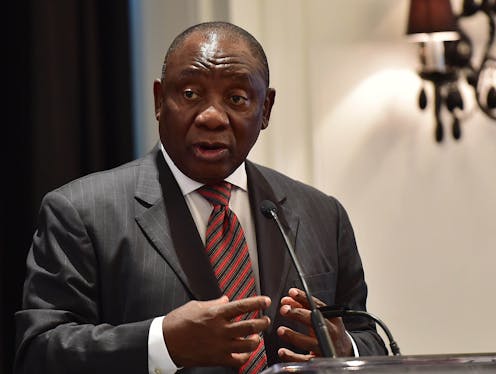
South Africa’s new President, Cyril Ramaphosa, has been showered with praise for his early moves of fighting corruption. But he will need to do much more to win back investor confidence.
Critically, Ramaphosa needs to display that wrong doers of former President Jacob Zuma’s era are going to be held accountable through prosecution. Numerous academic studies, including mine, show that investors consider the effective execution of law and order as an indicator of property rights protection.
For South Africa, this means that stabilising government debt and attracting much needed investment will entail both the investigation of corruption as well as prosecution of those implicated. Achieving this will prove impossible if investors aren’t convinced that the rule of law is alive and well.
Ramaphosa has started well. He devoted a great deal of his early days to removing compromised and corrupt elements in key leadership positions, including government departments, state owned enterprises and in security and justice agencies.
He followed up by setting up outwardly focused initiatives to attract investment. These include the establishment of special envoys to attract $ 100 billion of investment into the country.
These measures will go some way to fixing the wrongs of the past but they are far from sufficient. It’s not enough for politicians who oversaw and actively contributed to the decimation of the country’s social and economic fabric to simply retire from politics, move to new positions in the African National Congress (ANC), or be moved to other state departments. Similarly, reversing Zuma’s legacy of state capture won’t be possible unless the officials appointed by his ministers are also investigated and prosecuted.
Significant damage
The economic damage caused during the Zuma years is huge. The latest economic growth numbers are not encouraging. Gross domestic product shrank by 2.2% during the first quarter of this year and is expected to remain muted for the rest of the year.
The latest reviews from global rating agencies are also unflattering. For example S&P has noted that South Africa’s fiscal and economic trajectories are still very weak. As a result, the country is vulnerable to investor sentiment. This is being reflected in the weakness of the country’s currency as investors dump domestic equities and bonds.
The damage is especially prevalent in public institutions. The extent of the damage is reflected in the latest report of the auditor-general, Kimi Makwethu. Irregular expenditure, which includes payments made for contracts awarded unlawfully or without necessary approvals, rose by 75% compared with the previous financial year. Fruitless and wasteful expenditure, which are payments made in vain, increased by 71%.
The Auditor General notes that municipal corruption had been steadily increasing for over a decade but that the problem had rapidly worsened over the past five years. The key reason for the deterioration in state finances was that corrupt officials increasingly believed that they were immune to prosecution. That does not bode well for investor confidence.
Does the state have the means?
A troubling problem is that the country might not have the ability to effectively deal with the litany of ills bequeathed by Zuma. The country has limited resources available for a prosecution process that is going to be long and laborious.
The prosecuting capability of the state was in the spotlight recently when a court ruled against the state’s Asset Forfeiture Unit in a case against the Gupta family. The judgement shows that the country’s prosecuting institutions have been systematically compromised.
And although a commission of inquiry into state capture has been set up under Judge Raymond Zondo, it’s unlikely to wrap up its work in under two years.
This suggests that, despite the optimism, realistically South Africa may not have the institutional capacity to fight systemic corruption and prosecute those involved at a pace sufficient to convince domestic and foreign investors that their investments are safe from ongoing corruption.
Accountability
While there are many leaders with large public profiles that need to be investigated thoroughly for corruption, it isn’t enough to fixate on the “top of the pyramid” only.
Massive corruption needs many enablers, in both the private and public sector, to either actively participate in the wrongdoings or, at the very least, look the other way. This means that although a few high profile arrests and convictions can be useful signals to investors that concrete steps are being taken to reclaim the state, a much more robust process is needed to shore up the economy and South Africa’s crucial institutions.
This raises an essential question: how much pain is the country prepared to endure in the short term to fully excise the rot of corruption, creating more sustainable prospects for the country?
Recent experiences from Brazil show that inquiries into state corruption can profoundly complicate economic recovery. That’s more so if the slow pace of the court processes mean that politicians, officials and directors are not held to account expeditiously.
Ramaphosa has done well in turning the ship of state over the last 100 days, but eradicating and rectifying the legacy of state capture will need immense political will and institutional capability. Without visible accountability, corruption will just decentralise into the shadows and South Africa will once again be in peril.

Sean Gossel receives funding from the National Research Foundation and University of Cape Town.
Timothy London works for the Allan Gray Centre for Values Based Leadership which receives funding from the Allan Gray Orbis Foundation. The Centre is a part of the Graduate School of Business at the University of Cape Town.
Source: The Conversation – Articles (AFRICA)
Read more on The Conversation.
Join the fun: Add Your event | Submit a Press Release | Add your listing.


