How design thinking united Malawian researchers and farmers:
Many African higher education institutions are under tremendous pressure to produce innovative research to solve local problems. They are encouraged to produce their country’s next generation of innovators. Scholarly journals and the popular press call on these institutions to drive their nation’s development.
Yet most of them are underfunded and tasked with enormous teaching loads. External donors and their priorities, rather than local demand or need, tend to drive institutions to mimic the work of the developed world. Evidence suggests that these approaches are not effective for deeper changes. Relying too much on external donors rather than local drivers means innovative improvements fail to become standard practices.
It’s clear now that different models are needed. Researchers at the Lilongwe University of Agriculture and Natural Resources in Malawi and Michigan State University in the US joined forces to test a different approach. We used design thinking in a bid to help researchers in Malawi produce innovation research to improve local food systems.
Design thinking is,
a human-centred approach to innovation that draws from the designer’s toolkit to integrate the needs of people, the possibilities of technology, and the requirements for business success.
Increasingly common in academia, design thinking helps faculty and leaders think past their immediate structures to find systemic challenges and solutions.
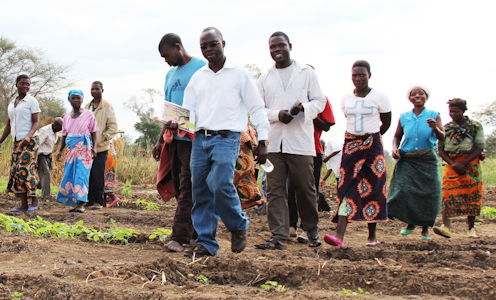
The 18-month project, which involved 22 Malawian faculty and leaders, over 50 farmers and about 10 entrepreneurs, was a success. Farmers learned about faculty research, and in turn welcomed academics to conduct studies on the land. Community cooperatives learned about market based pricing and in turn welcomed student interns to participate and observe in the cooperatives. The project is being replicated – and adapted – at a second university in Malawi and represents a way to match research with local needs.
The research
Lilongwe University of Agriculture and Natural Resources wanted research capacity-building that included both faculty and administration, and that was tailored to its unique campus.
At the same time, a group of Michigan State University researchers began to ask why there was plenty of discussion about the need for African universities to provide innovative training, but very little about innovative methods to develop such capacity. By building on preexisting partnerships, the two institutions figured out that they might be able to help each other.
All Malawian faculty participated in seven three-day workshops. Each workshop presented updates on a relevant topic (for instance, teaching and learning) and spent time on improving the applications of research. Each workshop was flexible enough to respond immediately to the learning that emerged. When we found out more discussion was needed on a concept, we rescheduled. So, using design thinking as a model to change research approaches, the project aimed to influence behaviours and patterns that led to innovative outcomes in the local food systems.
Design thinking training packages the outcome of “innovation” as a set of skills that can be learned through exposure, practice and reflection. Researchers didn’t introduce a predetermined technology to solve a specific problem. Instead, they aimed to shape the way individuals think about and implement their work differently.
Outcomes
For example, the Malawian university created relationships with smallholder farmers to test propagation of indigenous vegetables at scale. Another internship placed students with agricultural business knowledge into communities that needed their knowledge. Students learned how local farmers conducted their business. The farmers, meanwhile, were able to access to up-to-date methods and information.
One of the most surprising and positive findings was that participants applied design thinking for needs outside of this programme. For instance, the faculty took these approaches to their departments to guide curriculum changes and the development of a new major. This is important for two reasons. First, it showed that participants were learning applying design thinking skills in relevant areas. Second, the tools and approaches proved practically useful.
Our experience suggests that design thinking provides a framework in which anyone can learn. With practice, coaching and application, participants apply their own expertise to create their own innovations to solve their own challenges. It may not be a silver bullet – but it is a valuable approach which universities in Africa might consider applying if they want to meet local needs.
David Poulson, the senior associate director of Michigan State University’s Knight Center for Environmental Journalism, also contributed to this article

Kurt R. Richter receives funding from the United States Agency for International Development.
Bill Heinrich receives funding from USAID.
Source: The Conversation – Articles (AFRICA)
Read more on The Conversation.
Join the fun: Add Your event | Submit a Press Release | Add your listing.


