South Africa’s voter turnout: a mathematician runs the numbers:

It has commonly been believed in South Africa that voter turnout in national elections has been fairly high when compared with other countries, among them the UK, US and France.
To a mathematician like myself, “voter turnout” is not a very precise term. What exactly does it mean? And how is it calculated?
After South Africa’s recent national and provincial elections, I drew from several definitions and understandings of “voter turnout” to crunch the numbers and work out what country’s real voter turnout was.
The results suggest that, when measured either as a percentage of the voting-eligible population or as a percentage of the voting-age population, South Africa’s voter turnout has been worryingly low by international standards – not just in the 2019 polls, but for the last few elections.
For instance, by one measure – voting-age population, or simply the number of people living within the country who are of voting age – voter turnout in the 2019 elections was 46.7%. This places it among the lowest in the world.
The problem, as I discovered while gathering the numbers, is that very different definitions of “voter turnout” are used in different parts of the world. It is important, for the sake of accuracy, that everybody uses the same denominator. This will allow countries to correctly understand their voter turnouts, and design interventions to improve these where necessary.
Voting-eligible population turnout
To begin with, here’s how South Africa’s Independent Electoral Commission (IEC) defines “voter turnout”: the number of people who voted divided by the number of registered voters.
But globally, the “gold standard” in measuring voter turnout is to take the number of votes cast and divide by the size of the voting-eligible population (VEP). The VEP is the number of citizens living in the country who are legally allowed to register and vote.
In South Africa, this means all citizens over the age of 18. In other countries it is slightly different; for instance in the US, it means all citizens over the age of 18 who are not felons or mentally incapacitated.
The trouble is that estimating the citizen population living in a country is difficult: counting the population is fairly easy; this is done in a census. But counting the number of citizens is harder and is generally not done in a census.
South Africa’s IEC has sometimes provided such estimates; for instance in the 2019 elections it estimated that 74.5% of eligible voters were registered.
Since 66% of registered voters cast a vote, we conclude that the VEP turnout was 66% x 74.5% = 49%.
With these calculations, I created a graph comparing the VEP turnout of South African parliamentary elections to the major elections in the UK, US and France, from 1999 to the present day.
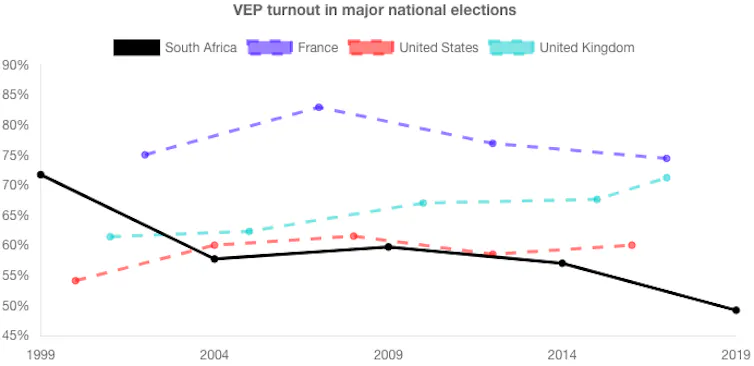
From the graph it’s clear that, since the 2004 elections, the VEP turnout in South Africa has consistently been much lower than in the UK and France, and a little lower than in the US. Also, VEP voter turnout plunged dramatically in South Africa from 57% in 2014 to 49% in 2019.
Voting-age population turnout worldwide
Next I turned to a more readily available statistic, the voting-age population (VAP). Using this in my calculations allowed me to compare South Africa’s voter turnout to a broader spectrum of countries.
The VAP is simply the number of people living within the country of voting age; in South Africa, as in most countries, that means older than 18. This number is usually fairly accurately known from census data.
VAP turnout is not as good a measurement of voter turnout as VEP turnout, since it does not account for non-citizens and other residents of a population not eligible to vote. However, it is a more accurate reflection of voter engagement than only dividing by the number of registered voters, as it takes into account those who do not register.
The International Institute for Democracy and Electoral Assistance keeps tabs on VAP turnout data. The VAP turnout for the 2019 South African elections is not yet in the IDEA database, but we can readily compute it ourselves. The official Stats SA figures allow one to estimate that there were 37.8 million people aged 18 years and older living in South Africa in mid-year 2018. Furthermore, 17.6 million votes were cast. This means the VAP turnout can be estimated at about 46.7%.
Here is a graph of VAP turnout in the most recent major national election for all “free” or “partly free” countries in the world with greater than 1 million inhabitants. Some countries have been highlighted for the sake of comparison.
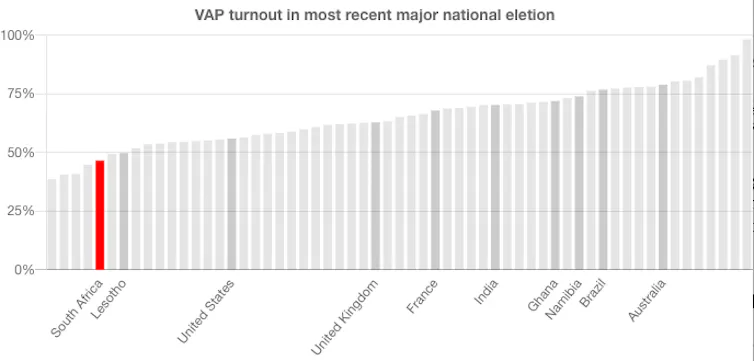
We see from the graph that the VAP voter turnout of 46.7% in the South African 2019 elections was the 5th lowest out of the 59 countries in the dataset, higher only than Switzerland, Cyprus, Mali and Jamaica. In recent weeks, the media has started to realise the problem of voter apathy and various experts’ concerns are being heard.
Author’s note: A longer form of this article containing more detailed and interactive graphs, further details about the sources for the data and the computations behind them, can be found on my webpage.

Bruce Bartlett does not work for, consult, own shares in or receive funding from any company or organisation that would benefit from this article, and has disclosed no relevant affiliations beyond their academic appointment.
Source: The Conversation – Articles (AFRICA)
Read more on The Conversation.
Join the fun: Add Your event | Submit a Press Release | Add your listing.


