How Huddleston and Powell squared off about racism in a televised debate:
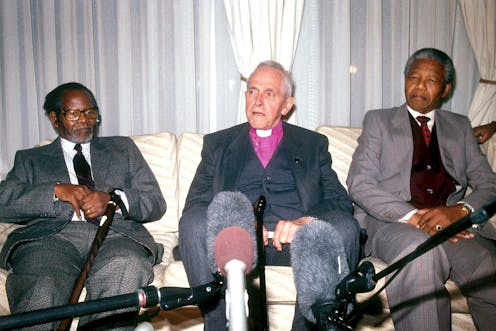
British Conservative MP Enoch Powell’s 20 April 1968 “Rivers of Blood” speech has been making headlines as the UK marks the 50th anniversary of its delivery.
Powell claimed that immigration was responsible for a demographic and social revolution that threatened British society. His toxic rhetoric and the responses to it, shaped policy and legislation.
Only fragments of Powell’s speech were captured on film, and the address in its entirety was preserved as a text. This April, Radio 4 asked actor Ian McDiarmid, who played Powell on stage, to read out the notorious 3183 word speech. Uproar ensued.
Critics argued that the broadcast contributed to normalising racism. Others thought it should not be aired. The BBC defended its decision to proceed with the broadcast. It explained that the speech was interspersed with historical context. It claimed that the discussion emphasised the harmful impact of Powell’s words on his contemporaries.
I came across an astonishing piece of television during my research on the anti-apartheid activist and Bishop of Stepney Trevor Huddleston, and the impact of his experience in apartheid South Africa on race relations in Britain. The programme, called The Great Debate: My Christian Duty, aired on October 12, 1969 on ITV.
It was the result of a lengthy and public confrontation between Powell and Huddleston.
Huddleston protested the “rivers of blood” address and the two commented on each other’s positions throughout the year. When Huddleston called Powell’s rhetoric “evil”, the latter wrote to Huddleston to defend his position. In their correspondence, they agreed to present their arguments to the public.
The location for their public meeting turned out to be a television studio with a live audience. This may sound like a curious choice of venue. In fact, Powell turned to the media habitually to promote his agenda, as did Huddleston.
During the 40 minutes of the debate, both men used the emerging genre of the televised political debate to rally support for their views. The terms of the debate were set by Powell and the links he created between immigration, race and British decline. Huddleston could not sever these imagined ties. He did, however, invoke the evils of apartheid as a warning post to his fellow countrymen. He used his experience in Johannesburg to reflect on the dangers of racial discrimination.
Faith in humanity
Huddleston cultivated his public image as a moral authority in South Africa from the mid-1940s. Between 1943 and 1955, he worked as a priest in Sophiatown, a black suburb of Johannesburg. In those years, until his forced recall back to England in 1955, Huddleston was a prominent participant in the struggles against apartheid. By then, his biographer concluded
[Huddleston’s face was] the most photographed of any Christian except the Pope.
His bestselling memoir of the period, published in 1956, made him a household name in Britain too. Huddleston reminded viewers of Britain’s material and moral debt to its former empire in Africa and Asia. He argued that the British, through colonial expansion, had “quite deliberately” moved into other people’s countries. They have
created and sustained regimes of power over African and Asian people.
This, and Britain’s long reliance on the slave trade, and later, on the inscription of labour from the Commonwealth to fight its wars and build its towns, created a commitment to these populations.
Huddleston’s aim, however, went beyond a history lesson. He harnessed the medium of television to issue a call for solidarity to fight the crisis ensuing from Powell’s address. He drew on his experience of collaborating with activists across the colour line in South Africa to signal a path for a dispersed group of anti-racist protesters.
He was successful in this, as the hundreds of letters from viewers that he received in response to the debate testify. His performance energised anti-racist and anti-apartheid activists, lay and clerical Christians, as well as individuals affected by so-called Powellism. Huddleston offered Britons his faith in humanity as flexible, tolerant and inclusive, and his arguments were rooted in the language of reconciliation. Accordingly, in his vision, immigration was a source of opportunity, and an indication that Britain was embracing its role as a positive engine of change.
Tackling toxic rhetoric
Today, as in 1969, Huddleston’s alternative vision to Powell’s remains relevant. The animated public reaction to Huddleston’s television performance, which included bags of hate mail in addition to support, demonstrates the price and profit of standing up to toxic rhetoric.
When we assess the legacy of Powell’s speech, it is important to consider the diverse experience that fuelled the opposition to it. Huddleston’s vision for Britain, shaped by his tenure in South Africa, and the solidarity and political activity it spurred, should also be remembered.

Tal Zalmanovich receives funding from the European Research Council under the European Union’s Seventh Framework Programme (FP/2007-2013) / ERC Grant Agreement no. 615564.
Source: The Conversation – Articles (AFRICA)
Read more on The Conversation.
Join the fun: Add Your event | Submit a Press Release | Add your listing.


