How the SKA telescope is boosting South Africa’s knowledge economy:
We’re living in a time when data and knowledge have become key resources for economic development.
Developed economies have recognised this and have increasingly embraced knowledge creation as a way to secure their competitive advantage. They’ve done so by, among other things, investing more in education with an eye on producing more highly skilled graduates who can thrive in an increasingly technology-driven world.
Some countries have also spent a great deal on huge scientific projects that involve international collaboration. Examples include the European Organisation for Nuclear Research (CERN) in Switzerland and the Large Synoptic Survey Telescope in Chile, which is a billion dollar project.
And in South Africa, the Square Kilometre Array (SKA) project is an example of a promising knowledge-based initiative. It could be one of the drivers that contributes to the country’s economic growth.
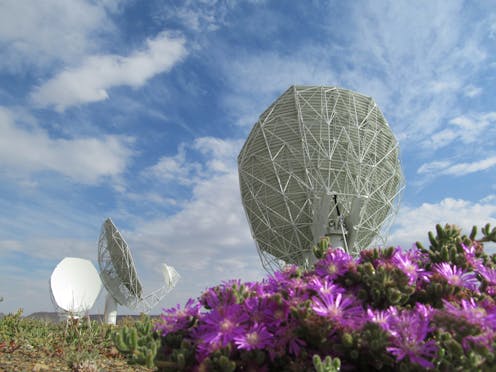
The SKA is a global project to build the world’s largest radio telescope. It’s co-located in South Africa and Australia. When it’s completed it will cover over 1 million sq metres and will help scientists seek answers to fundamental questions about the nature and origin of the universe.
But the road that leads from a complex project like the SKA to the creation of a thriving local knowledge economy is by no means a straightforward one. In a recent paper for the South African Journal of Science, I explored the various factors that impede or encourage the extent to which the process might work.
I found four key factors that determine the extent to which the SKA will be able to contribute to the creation of a robust knowledge economy. These factors are institutions; interrelationships; innovation and individuals. My research suggests that, thanks to these four factors, the project has already borne fruit for South Africa. It has led to good collaboration, sharing of skills and substantial growth of the country’s astronomy community.
Four pillars
Firstly, a project like this needs to be supported by sound institutions if it’s to contribute to the long-term, sustainable growth of a knowledge economy. There must be stable and consistent funding and policies at government level. And a country’s broader institutional environment needs to be open and inclusive. This all encourages diverse participation and creative cross-over of ideas.
SKA South Africa has benefited from stable and consistent policies and funding. But, given that SKA SA is publicly funded, policies can sometimes be cumbersome. This can slow things down.
Interrelationships are also crucial. Collaboration and knowledge sharing are extremely important, especially in a field like astronomy. So the cultivation of stronger interrelationships boosts the promotion of knowledge economies.
These interrelationships need to be fostered across multiple disciplines and sectors, as well as across international boundaries. The SKA in South Africa is doing well on this front. Its collaboration with industry partners that range from small, medium and micro-sized enterprises to multinationals has helped the spread of scientific and operational expertise among other sectors.
For instance, teachers from the towns closest to the SKA site have received training in robotics through the project. And members of the SKA’s management team have shared their skills to help the municipality with its integrated development planning.
Data collected by the SKA array in a single day would take nearly two million years to play back on an iPod. Processing and analysing such astronomical data sets requires both cutting edge technology and collaboration with a diverse set of stakeholders. The SKA in South Africa is benefiting from both such technology and that level of collaboration.
More fundamentally, the different stakeholders are working together to develop technologies that have not yet been invented.
The third factor, innovation, presents an opportunity for developing economies to close the gap with developed economies. But this is only true if ways can be found to commercialise some of the initiatives that emerge.
SKA’s South African arm is taking part in numerous collaborations across sectors that promote knowledge sharing and joint problem solving. Its commercialisation strategy is essential for the project to have a great impact on the knowledge economy.
Finally, individuals matter. A project like the SKA must be able to attract, retain and train skilled individuals to establish a viable knowledge economy. Here SKA South Africa has been exemplary.
It has done substantial work to grow South Africa’s astronomy community through a special human capital development programme that’s aimed at training young people. More than 1000 young people have benefited from this and similar SKA programmes, and those who’ve been trained are not limited to careers in astronomy: they contribute to the knowledge economy by using their skills in other sectors.
Forward to the future
The SKA project is still in its infancy. Science observations are expected to start with a partial telescope array in the mid 2020s. The second phase is set to be completed in the late 2020s.
But, even at this early stage, the project is already contributing to the growth of South Africa’s knowledge economy. The four pillars I explored in my research provide a framework for better understanding how further growth and gains can be encouraged.

Nishana Bhogal does not work for, consult, own shares in or receive funding from any company or organization that would benefit from this article, and has disclosed no relevant affiliations beyond their academic appointment.
Source: The Conversation – Articles (AFRICA)
Read more on The Conversation.
Join the fun: Add Your event | Submit a Press Release | Add your listing.


