New copyright law will benefit South Africans with disabilities:
South Africa’s current copyright law was enacted 41 years ago. The Copyright Act No. 98 of 1978 had no provisions for people with disabilities – and that hasn’t changed in more than four decades.
This means that every time a person who is blind, deaf, partially-sighted, dyslexic, or paralysed needs to access any information, the content has to be converted into an accessible format before they can read and understand it.
Students who have disabilities are particularly prejudiced and discriminated against in this regard. They do not receive their learning material at the same time as other students. Whether it is a textbook, articles, chapters of books, mathematical problems, PDF documents, or images for study purposes, these have to be converted into an accessible format and often require editing and reformatting too.
Copyright permission has to be obtained before the works can be made accessible via Braille or other accessible formats. Rights-holders do not always respond timeously or at all, which means the students have to wait for their study material in accessible format. Sometimes it doesn’t come at all. They also have to pay high copyright fees for the conversions, which they do not always have in view of their limited budgets or resources.
There are thousands of people with disabilities studying at South African universities. It’s crucial that these issues are taken seriously. People with disabilities worldwide battle what has been described as a “book famine”. The “famine” refers to the fact that less than 10% of published works, such as books and educational materials in developed countries, and less than 1% in developing countries are ever made into accessible formats, such as Braille, large print or audio.
South Africa’s new Copyright Amendment Bill, which is awaiting President Cyril Ramaphosa’s signature to become law, could help the country take an important step in tackling its own “book famine”. Section 19D of the Bill has a number of provisions for people with disabilities.
Students’ struggles
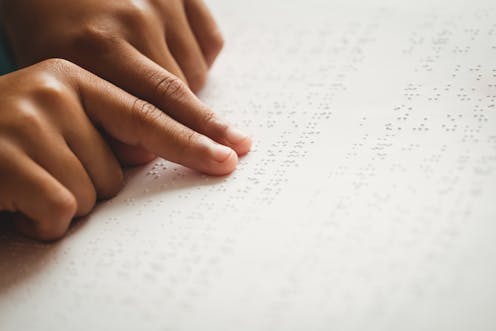
Currently, blind and partially-sighted students have to purchase the printed version of a textbook and then have it converted into Braille by personnel in their Disability Rights Units.
I am a member of the University of the Witwatersrand’s Disability Rights Forum, and have been involved in various disability fora in the higher education sector in the past. Issues of late receipt of study material, and lack of accessible formats being available in bookshops, are common problems experienced by students with disabilities. They would prefer to have textbooks available in an accessible format at the same time and at the same price as sighted students do.
Unfortunately, textbooks are not available in accessible formats in book stores, so students are at a disadvantage right from the start of their school or university lives. Some publishers provide the digital file to university disability rights units to make accessible formats. But this is not done by all publishers.
Another way in which the current law disadvantages blind and visually impaired people is that it prevents them from exercising their rights under “fair dealing”. “Fair Dealing” in Section 12(1) of the existing act allows reproduction for the following purposes, without permission from the rights-owner:
- Research or private study
- Personal or private use
- Criticism or review
- Reporting current events (e.g. in a newspaper or broadcast)
- Judicial proceedings or a report of judicial proceedings
Quotation (a fair portion, with proper acknowledgement) and use of works “by way of illustration” for teaching purposes (e.g. in a PowerPoint presentation) is also permitted under fair dealing.
A sighted person can browse, copy and read a chapter of a book or a journal article for personal study, research or personal use. A blind or visually- impaired person would first need to loan the book from the library, then find someone to browse the chapters for them before they can decide what section to use, then find someone to convert that information into an accessible format – all at a cost and delay.
It takes several months and a lot of money to braille a chapter or whole book. There are limited outlets where accessible formats can be done: disability units at universities, the SA Library for the Blind and a few printers in South Africa.
Because the current copyright law does not have any exceptions for people with disabilities, people who cannot afford these services will not be able to access that material.
The Marrakesh Treaty
South Africa’s Department of Trade and Industry has committed to ratifying the Marrakesh Treaty as soon as the Copyright Amendment Bill has been enacted. The treaty was adopted by member states of the World Intellectual Property Organisation in 2013.
The Treaty makes the production and international transfer of specially-adapted books for people with blindness or visual impairments easier. It does this by establishing a set of limitations and exceptions to traditional copyright law.
It’s time for South Africa to catch up. Once it ratifies the Marrakesh Treaty, it will be able to exchange accessible formats across borders. It will also reduce costs and duplication of effort by organisations and individuals who provide services to people with disabilities.

Denise Rosemary Nicholson does not work for, consult, own shares in or receive funding from any company or organisation that would benefit from this article, and has disclosed no relevant affiliations beyond their academic appointment.
Source: The Conversation – Articles (AFRICA)
Read more on The Conversation.
Join the fun: Add Your event | Submit a Press Release | Add your listing.


