Niger: a reminder of why the US military’s presence Africa needs constant scrutiny:
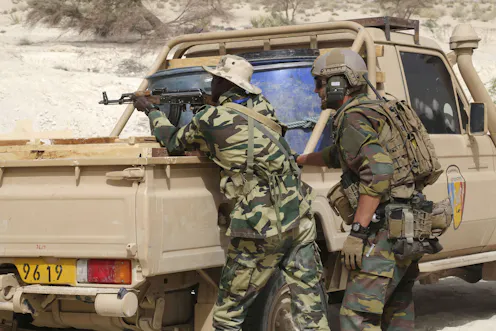
On October 4 an American Special Forces team was ambushed by a contingent of Islamic State affiliated fighters in Niger. Four American soldiers were killed and two wounded. The team of 12 soldiers was returning from a meeting with community leaders when it ran into a group of up to 50 terrorists.
The incident caused a furore in the US, sparking recollection of 1993’s “Black Hawk Down” incident in Somalia that saw 18 American soldiers killed. Questions were raised about how it was that four US soldiers died, why one of the bodies was retrieved only 48 hours after the ambush, and why US troops were in Niger in the first place. US President Donald Trump’s failure to address the matter with the necessary transparency and sensitivity fuelled the agitation.
The Niger incident reaffirmed the need to ask important questions about US military presence in foreign territories and in this case, in Africa. African institutions that advocate for human security must continuously question the motives behind US military presence on the continent as well as its impact.
The US has an extensive military presence on the continent. In 2016 it was reported that its military had been involved with more than 90% of the 54 countries in Africa.
Two important and related questions arise following the Niger incident. Is the US military’s presence in Africa good or bad for Africa’s security? And is America pursuing the right strategy to combat terrorism on the continent? These are pertinent questions given that Africa is “the new battleground” in the fight against terrorism.
The history
The US military’s presence in Africa is best understood in the wider context of America’s national security strategy. In establishing a military presence with global reach, the Americans are informed by what they call “forward strategy”. This is a national security policy shaped during the Cold War.
“Forward strategy” was based on the idea that establishing and maintaining a significant US military presence in close proximity to the former Soviet Union would discourage communist expansion. This encouraged the emergence of America’s global military footprint either through a physical presence or in the form of proxy forces belonging to sympathetic or opportunistic governments.
Forward strategy gained renewed impetus following the 9/11 attacks on the World Trade Centre and the Pentagon. This renewal was marked when the president George W. Bush declared a war on terror.
Africa had already featured in the story of the fight against terror, when in 1998 US embassies in Tanzania and Kenya were bombed by Al-Qaeda. In 2007, and following Bush’s declaration, the “United States Africa Command” (AFRICOM) was established as the ninth unified combatant command. AFRICOM was founded with the operational objective to neutralise violent extremist organisations and beef up regional security on the continent.
The US troop contingent in Niger is part of this effort. AFRICOM is also engaged in an array of supporting activities deemed necessary for ensuring regional security. These include foreign military sales, military education and training, provision of healthcare and veterinary services.
The US military’s strategic objective is underpinned by two ideals: the “economy of force” and “preventative war”. “Economy of force” refers to the idea that it’s more cost effective to train and equip African forces in the fight against terror than to commit extensive numbers of US troops. “Preventative war” centres on the argument that large wars can be avoided by fighting on smaller scales wherever necessary.
America’s forward strategy persisted under both the Bush and Obama administrations. By all indications it is a strategy that’s likely to continue under Trump.
Citizens will pay a price
The danger is that, in some instances, citizens can bear the brunt of a US military presence that involves training and equipping of African forces. This is particularly true in countries where interventions, inadvertently perhaps, strengthen repressive state apparatus. On the other hand Africa’s gatekeepers – self-interested, ruling elites – have the means to ensure their own security. They control the state, and its access to foreign partnerships and aid, whether military or otherwise.
A case in point is Uganda’s Yoweri Museveni – a key African ally in the war on terror.
And of the 16 African countries that host US military presence, ten are categorised by the US-based Freedom House as “not free”, four as “partly free” and only two as “free”.
Various reports this year indicate that armed forces in a number of countries that host a US military presence have abused civilians. Burkina Faso, Cameroon, Chad, Ethiopia, Kenya and Uganda are a few examples.
These sorts of situations have the potential to fuel fundamentalist backlash.
Is America’s strategy working?
What is the efficacy of the US’s military presence in Africa?
Research by the Institute for Security Studies suggests that heavy-handed anti-terrorism strategies breed insecurity by making fundamentalist organisations appear attractive to ordinary citizens. The exercise of what ordinary citizens perceive to be illegitimate force, on the part of state security institutions, increases the likelihood of those same citizens joining fundamentalist organisations.
But it seems these findings are being ignored. The danger is that if current patterns encouraged by the US military persist, countries are likely to experience an increase in extremism. This in turn is likely to perpetuate the heavy-handedness of already illiberal regimes and the vicious cycle of interventionism in Africa.
In the words of former UN Secretary-General Kofi Annan,
Our responses to terrorism, as well as our efforts to thwart it and prevent it, should uphold the human rights that terrorists aim to destroy.

Craig Bailie is currently engaged in part-time voluntary work with the YALI Southern Africa Regional Leadership Center – an institution funded by USAID.
Source: The Conversation – Articles (AFRICA)
Read more on The Conversation.
Join the fun: Add Your event | Submit a Press Release | Add your listing.


