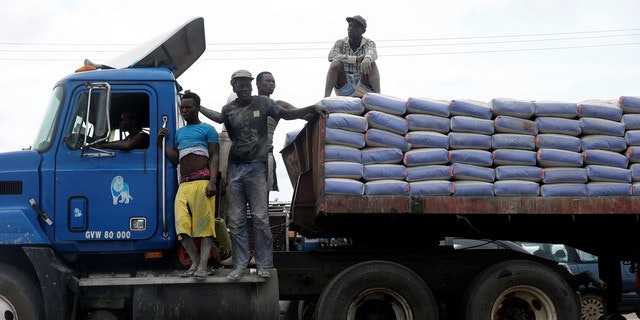
Nigeria’s transport network is largely in a state of disrepair due to inadequate investment over the decades, economic and population growth, and ineffective policies and plans.
For instance, Tin Can and Apapa ports in Lagos continue to suffer from inadequate cargo handling equipment. This results in expensive delays. And when goods are eventually cleared, absence of rail connectivity results in them having to be hauled over poor and congested roads to the northern and eastern parts of the country.
These factors often result in accidents, breakdowns and further delays. All are detrimental to the economy.
Such ineffectiveness is in spite of a series of national transport policies. Reforms were initiated in 2003, 2008 and 2010. These paid some attention to the possibility of intermodalism – ensuring trucked goods are moved on to rail or water, and back to truck for final delivery. These reforms also considered privatisation and public-private partnerships. However, none of these policies and reforms made a significant difference.
Costs associated with ineffective and inefficient national transportation and logistics systems are well documented. The International Trade Administration, an agency of the US government, citing a survey by the Lagos Chamber of Commerce and Industry, showed that the Nigerian economy loses an estimated revenue of N3.46 trillion annually.
Nigeria connects to the global and regional economy through international maritime shipping and air while its internal connections are mostly by road and rail movements. Given this, any freight logistics plan for the country must be seen as part of a global supply chain network.
In my view, the time has come for a serious consideration of an overarching and holistic national freight logistics strategy for Nigeria for the next few decades.
It would bring together all tiers of government and industry to provide a coordinated, national multi-modal approach to freight planning. And it would address Nigeria’s freight challenges, while supporting its long term international competitiveness.
As an experienced logistics analyst, consultant, scholar and educator in the developing and developed worlds, I have come across a range of relatively effective national freight logistics strategies such as those of South Africa, Panama, Vietnam and Thailand.
They provide useful benchmarks for what is possible.
Why plans haven’t worked
Firstly, transport traditionally gets constant attention from public authorities. But logistics and supply chain management is often considered to be a private business-oriented activity.
Public authorities should be paying much closer attention to it, especially in relation to its integration with trade, and the economy.
Secondly, decision makers still take a piecemeal view and approach. This is clear from the fact that there are a number of disparate plans that touch on transport. These include the Nigeria Integrated Infrastructure Master Plan which was put in place in March 2015 by the National Planning Commission. And then there’s the Economic Recovery and Growth Plan which was approved by the government in 2016 for execution in the period 2017 to 2020.
Similarly, there are several oversight agencies. For example, air transport alone has three – the Nigerian Airspace Management Agency, Nigerian Civil Aviation Authority and the Federal Airports Authority of Nigeria – but none has a freight focus.
A piecemeal approach results in insufficient integration of trade and economic considerations in the design, operation and management of the national transport system. The outcome is poor logistics and supply chain management.
What the plan needs to cover
A well-developed freight logistics strategy should be integrated and overarching. It should facilitate the safe and efficient movement of freight within the country. It would also integrate the country seamlessly within the West African sub-region and beyond.
The plan should address sources of freight generation, commodity flows and associated data-based modelling. It should also cover the transportation and distribution industry and workforce, storage and warehousing location principles, and movement of bulk commodities, containers and general cargo through major ports, airports, inland dry ports, transport corridors and intermodal terminals.
In addition the plan should cover railroad access, water port access and air cargo access to allow efficient access of bulk freight to support agricultural regions, production clusters, local industries, businesses and consumers.
Lastly, the strategy should address compatibility of data and information standards, platforms and systems. This would ensure smooth interactions between trading partners and carriers, as well as the introduction of modern and productive freight technologies. South Africa, Panama, Thailand and Vietnam are some examples Nigeria can learn from.
How it can be achieved
A national freight logistics strategy like this would be different from the myriad existing government plans and policies. For example, it would reduce transaction and coordination costs for freight operations and the economy as a whole.
The policy can be developed through systematic freight research based on accurate data and other evidence from stakeholders. This may include a series of nationwide inquiries into the priorities for national freight and supply chains.
Other relevant data and information can be collected through industry partnerships and extensive non-partisan consultations.
Each country has its unique issues. A thorough and representative consultation process would therefore be crucial.
A thorough mapping exercise also needs to be done.
Freight networks and hubs consist of multiple visible and invisible economic, social and political connections. These combine to provide an effectively working system and must be identified.
For example, Lagos and Kano are monocentric hubs. What’s meant by this is that freight has to be trucked in or out from the outskirts of the city sprawl, and from other parts of Nigeria at great cost. And with difficulty. A national decentralised system with several hubs across Nigeria would make much more sense. This would allow logistics facilities and infrastructure to be located closer to the sources of major freight generation and consumption, and closer to key transport corridors.
This would make freight transport less reliant on Lagos ports. In turn this would ease the pressure on transport networks. This has positive implications for efficiency, productivity, transport emissions, noise reduction and social equity.
Consideration should therefore be given to several other hubs outside of Lagos, Kano, Port Harcourt and Abuja. For instance, Enugu-Onitsha may serve as a freight hub to support manufacturing and trade, while Makurdi or a similar middle belt city can serve as hub for the food producing regions of the area.
Overall, an audit must be undertaken to identify regulatory, economic or environmental challenges. Skills and geography also need to be part of the picture.
Nigeria’s current approach to the movement of freight is fragmented. It needs a single point of national accountability.
While the current emphasis on road infrastructure projects is good, an integrated freight logistics and supply chain management approach would be better.
Logistics is not as attractive to senior politicians as simply building roads. It therefore struggles to gain political attention. But that’s no reason for the country not to pursue an integrated national freight logistics policy.


