Policies in South Africa must stop ignoring families’ daily realities:
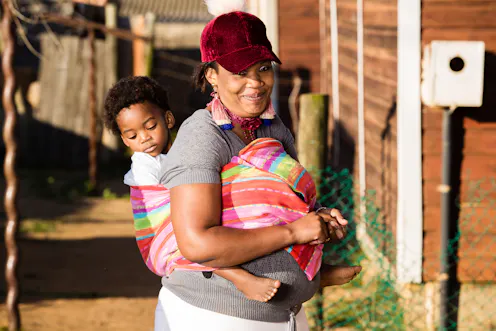
What is “a family”? In South African law, the answer – or rather, answers – are broad. For example, it’s not considered unusual or unacceptable for children to move between kin and to be raised at different stages by grandparents, parents and other relatives. Kinship care is a widespread and customary practice in South Africa, as it is elsewhere in southern Africa.
The reason for this is partly cultural and partly historical. The apartheid system literally capitalised on the role of extended family, particularly women. It forcibly fragmented families and separated children from parents.
The result of this can be seen in international comparisons from the World Family Map: according to this report, South Africa has one of the lowest rates of parent co-residence with children in the world. Over 12 million of the country’s 19 million children don’t live with their fathers. Four million don’t live with either of their biological parents.
Across the world, families are changing: marriage rates are falling; single parenting is on the rise. In some ways South Africa follows this trend. But it differs in the case of parental absence and the fact that most children’s parents don’t live together.
Apartheid imposed legislation to fracture families. Its policies saw many men leave their families to work in mines or cities, and to live in single-sex hostels away from their wives and children. Forced removals and a lack of suitable family accommodation in cities presented huge obstacles to family life. Many of these obstacles persist today. The country’s policies don’t, by and large, address them meaningfully.
The diversity of families is one of the important underlying themes of the South African Child Gauge 2018, launched on November 20 to coincide with World Children’s Day.
The Child Gauge describes childcare as one of many, often competing, family strategies. It recommends that policies and services should be more sensitive to the realities of South African family dynamics.
Policies ignore reality
One of the hangovers from apartheid is the entrenched idea of the nuclear family – heterosexual mother and father living together with their children – as “ideal”. This notion has remained remarkably persistent; its privileged status is sometimes implicit in policies and in the attitudes of those who implement policy.
The White Paper on Families consciously departs from assumptions about nuclear families as a normative model. It acknowledges the diversity of family forms and living arrangements.
Yet much of its content suggests an underlying vision of the ideal family as a stable unit built on the foundation of marital union and biological parents living together with their children.
This ignores global and South African realities. Marriage rates are declining across the world. In South Africa, they have been dropping since the 1960s.
The laws and systems for birth registration are oriented to nuclear arrangements. This makes it difficult for unmarried fathers and grandparents to register children in their care. An astonishing 60% of children don’t have their father’s name on their birth certificate. That can have real consequences: it’s difficult to claim maintenance, and if the child’s father dies it’s difficult to prove orphan status and claim the associated benefits and protections.
And while the law states that children have a right to family care and grandparents have a duty of care, some of its policies undermine this. The state places orphaned children who already live with family members (mostly grandparents) in foster care with their family. This formalises an existing arrangement, but introduces an enormous amount of paperwork and red tape.
The foster care system is resource-intensive. It requires investigations and reports by social workers, formal placement by the courts and regular reviews. It’s meant to be a temporary arrangement for children who are removed from their families because of abuse or neglect.
By insisting that orphaned children living with grandparents should be monitored by social workers, the state seems to regard extended families with suspicion. This is an inappropriate use of resources given that extended families care for much larger numbers of children whose parents live elsewhere, and are not subjected to the same scrutiny. It has also reduced the state’s capacity to protect children who are abused.
Such policies suggest that the state doesn’t realise kinship care isn’t always a choice. It may sometimes be a necessity as families strategise to maintain multiple households, to secure adequate housing at migration destinations, to further the education of their members and to find work and provide income.
Addressing the issues
What can be done to improve this situation?
First, demand-driven responsive services need to be strengthened so that families can rely on an efficient response when they need urgent assistance. All services should be delivered in a way that enables equitable access for families who need them, irrespective of their structure or household form.
The Draft Care and Protection Policy, published for comment in 2018, proposes that for children living with kin whose parents live elsewhere, the kinship carer and parent must formalise the arrangement by concluding a “parenting rights and responsibilities” agreement.
Rather than trying to regulate families, the current state structures should support families to achieve their desired living arrangements and childcare choices. It needs to address the structural constraints by providing services and infrastructure – like adequate housing, safer environments and quality childcare facilities – that make it possible for children and parents to live together if they wish.
It is only in this way that the Constitution’s progressive and inclusive vision will be fulfilled.

Katharine Hall has received funding from the National Research Foundation.
Source: The Conversation – Articles (AFRICA)
Read more on The Conversation.
Join the fun: Add Your event | Submit a Press Release | Add your listing.


