Rocks hold clues about how falling sea levels caused havoc 400 million years ago:
The Earth was a very different place 400 million years ago, during what’s known as the Devonian Period. Africa, Antarctica, South America, India, Australia, Madagascar, parts of Asia and even Florida were part of the large super-continent, Gondwana. It occupied a substantial area south of the equator.
Large parts of southernmost Gondwana (including what we know today as South Africa, Antarctica, Falkland Islands and parts of South America) were situated over the South Pole throughout this period.
By observing the types of rocks, minerals and sediments that form in different climates today, we are able to use this information to get a picture about what the climate was like during the Devonian Period. Similarly, we can use Devonian fossils to work out climates based on the environments and climates these organisms are found in today.
They’re also vital for inferring sea-level changes through time – and how both climate and sea-level affected marine creatures of the Devonian.
What is interesting is that there is no evidence of extensive ice sheets at the South Pole during the Devonian Period, as we have today covering Antarctica. Of course, there are polar ice caps in the region today. This suggests that climatic belts were distributed differently then, and have shifted through time.
During the Devonian, certain groups of animals congregated around the equator. Others were found in more temperate regions. A group known as the Malvinokaffric Fauna was located around the South Pole. The Malvinokaffric Fauna were a group of marine invertebrates only found in what we know as South Africa, Antarctica, the Falkland Islands and parts of South America.
We don’t know much about their ecology, where they came from or why they disappeared, nor about the environments they lived in around what was then the South Pole and is South Africa today. That’s where my research comes in.
My findings, drawn from the study of certain rocks and their sediment, as well as remnants of biological activity called trace fossils, suggest the Malvinokaffric Fauna in the Devonian South Pole were wiped out because of falling sea levels.
We don’t yet know what caused the drop in sea levels. But my research offers evidence a previously unrecorded large extinction event during the Devonian, a period which experienced several such events.
Wiped out
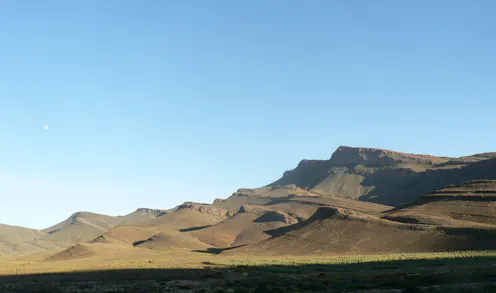
South Africa has perhaps one of the best preserved and most complete records of Gondwana during the Devonian Period at polar latitudes. This record is preserved in the rocks of the uppermost Table Mountain, Bokkeveld and lower Witteberg Groups within the Cape Mountains along the country’s southern margin.
I study and interpret both the palaeontology and sedimentology of these rocks. I also look for any trace fossils such as trackways and burrows in the rocks. Trace fossils indicate a biological organism’s activity, which is directly related to its ecology and environment.
By examining sedimentary rocks, fossils and trace fossils, I’ve been able to form a picture of the lives and times of the Malvinokaffric Fauna in South Africa. From there, I can infer whether environmental changes were sudden and rapid or long-lived and gradual and how they affected the Malvinokaffric Fauna.
I’ve found that because this group of animals lived in certain environments, they were very sensitive to periods of excessive falling in sea-level, particularly sea level drops greater than 10 m.
Coincidently, the disappearance of the Malvinokaffric Fauna in South Africa is gradual and occurs with a gradual trend of falling sea-level that is observed in the rocks of the upper Bokkeveld Group. Evidence from the meagre fossil and trace fossil record after this event suggest that the disappearance of the Malvinokaffric Fauna resulted in a total collapse in marine ecosystems around the South Pole.
Even though different immigrant organisms from elsewhere moved in during a subsequent rise in sea-level, they never truly were able to reach the diversity of the Malvinokaffric Fauna, nor to form stable ecosystems. Life around the South Pole seems to have only truly recovered in South Africa in the Late Devonian, between 370 and 360 million years ago.
Read more: Fossil find offers first evidence of four-legged aquatic ancestors in Africa
What I have found suggests that many shallow marine environments – beaches, shorefaces, deltas, barrier islands, lagoons and estuaries – dotted South Africa’s shoreline throughout the Devonian.
Initially, sea levels were low. Then about 400 million years ago they rose, only to gradually fall some 10-15 million years later. It was during this period of rising sea-level that the Malvinokaffric Fauna made their appearance in South Africa and are found in the rocks of the upper Table Mountain Group and the lower Bokkeveld Group.
My research indicates that these animals lived and thrived in deeper water conditions, preferably within the deepest portions of the shoreface and offshore environments where they formed specific ecosystems.
Now that we know that falling sea-levels probably caused the fauna to vanish. The hunt is now on to find what caused sea-level to drop.
Tracking the extinction
There are several possible answers, which I’m exploring in new, ongoing research.
For instance, local tectonic events may have caused the sea to change its configuration and sea-level to fall. Or, perhaps a global event like climatic shifts caused sea-level fall.
The Devonian, after all, is a time marred by extinction events that seem to be on a global scale, ultimately linked to changes in climate.
Right now, I don’t have the answers. But I’m exploring ways to precisely date these rocks, and see if they correlate with known local or global events and tease out the solutions from there. Hopefully soon we’ll know more about the event that wiped out the Malvinokaffric Fauna.

Cameron Penn-Clarke receives funding from the South African Department of Science and Technology-National Research Foundation Centre of Excellence in Palaeosciences (DST-NRF CoE in Palaeosciences), the African Origins Platform (DST-NRF AoP) as well as the Palaeontological Scientific Trust (PAST). He is a scientist at the Council for Geoscience, Bellville Office and is an honorary research associate of the Evolutionary Studies Institute, University of the Witwatersrand. He is also a stratigrapher for the South African Committee on Stratigraphy and is the South African associate member for the International Subcommission on Devonian Stratigraphy (International Commission on Stratigraphy).
Source: The Conversation – Articles (AFRICA)
Read more on The Conversation.
Join the fun: Add Your event | Submit a Press Release | Add your listing.


