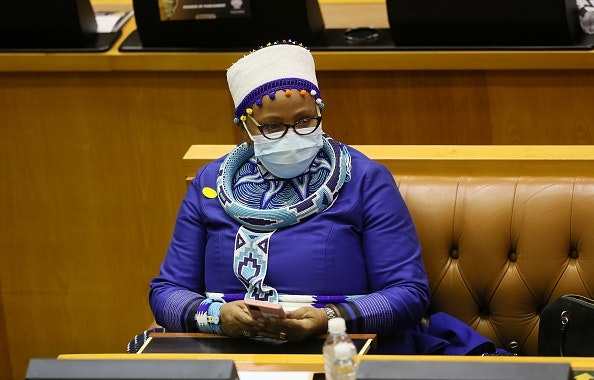
On Thursday 19 August the members of South Africa’s National Assembly convened physically for the first time in a while. They met in several locations in parliament to achieve sufficient distancing in the pandemic. And there was only one item on the order paper: the election of a Speaker.
This was duly done and the former minister of defence, Nosiviwe Mapisa-Nqakula, was elected to the office.
The Speaker in South Africa presides over proceedings in the National Assembly. They also are the titular head of parliament as a whole, including the National Council of Provinces. The Speaker is elected by a majority of members of the assembly, and may be removed in the same way.
The Speaker is responsible for providing political leadership and strategic direction to the National Assembly. And they should do so in a nonpartisan manner.
Why was this an important temperature check for the state of health of South Africa’s constitutional democracy?
This question must be answered against the background of the ingrained identity politics which characterise the country’s long history of racial oppression and its relatively recent reversal. It would, therefore, have been unrealistic in the first years of democracy to expect conscientious adherence to the unwritten rules and conventional spirit that ideally should prevail in parliament. But the expectation was that this would gradually be achieved.
Indeed, those who served in the position immediately after the country’s first democratic election in 1994 did so with distinction. However, over most of the past 15 years the Speaker has been both weak and partisan, and was responsible for allowing the executive, particularly that of former president Jacob Zuma, to conduct themselves in ways that have brought the government into disrepute.
The election of the new Speaker was thus a significant moment for the governing African National Congress (ANC) to show that it was moving away from its “wasted years” under Zuma.
It failed the test. Mapisa-Nqakula’s elevation to this significant constitutional office reflects extremely poorly on the party leadership. It contrasts starkly with President Cyril Ramaphosa’s oft-stated commitment to uncorrupt governance and to the values of the constitution.
A brief history of the role
The title given to the highest authority in parliament originated in the English parliament in the late 1300s. It then described the person who “spoke” on behalf of the monarch. After the “Glorious Revolution” of 1688, the Speaker became the presiding officer in the House of Commons.
South Africa inherited that office and title as a former British colony, together with almost all other members of the Commonwealth.
Any legislature needs someone to chair its proceedings, to manage and administer the support services, to oversee the exercise of discipline among its members, and to represent it in discussions with the executive and judicial arms of government.
Various approaches are taken towards the impartiality and independence of the office of Speaker.
In the UK, an MP is elected as Speaker immediately after a general election. The person is generally a member of the governing party, but does not have to be. On election the MP ceases to be a member of the party caucus.
In the US the Speaker of the House of Representatives is drawn from the senior ranks of the majority party in the lower house of Congress. They play a partisan role, balanced with a degree of fair play towards all members of the house.
Most other national constitutions position their equivalent of the Speaker between these two approaches.
What the job entails
As the parliamentary website provides, the Speaker’s responsibilities include:
-
preserving parliamentary integrity and the decorum of the house,
-
ensuring the smooth running of legislative business and the functioning of committees,
-
presiding impartially over sittings and maintaining order.
The Speaker represents parliament as a whole. Their responsibilities include ensuring sufficient budget for its activities, monitoring expenditure and the provision of support for all MPs, and initiating or responding to any litigation in the courts.
In terms of South Africa’s constitution, the Speaker heads the legislative branch of government, and should act as its champion at all times, both nationally and internationally. This is particularly the case in its relationship with the executive.
Effective fulfilment of all these functions requires a highly efficient, dignified, respected and wise MP. The experience of the past 27 years has been patchy.
Rollcall of speakers
An exemplary start was made by Frene Ginwala, who served for the first decade of democratic government. She ruled with a firm yet fair hand, and presided over many initiatives to transform parliament from its lapdog role under apartheid to the vision set in the constitution. The ideal is that parliament represents the electorate and also plays an effective role in regulating the exercise of executive power.
Max Sisulu (2009-2014) and latterly Thandi Modise (2019-2021) broadly followed the Ginwala approach.
Regrettably, the double tenure (2004-2008 and 2014-2019) of Baleka Mbete fell far short of the expectations of the Speaker’s office. On her watch, particularly in her second term, she was frequently accused of treating opposition MPs less favourably than government MPs. She was also accused of blocking parliamentary investigations into actions of the ruling ANC, in particular Zuma.
Indeed, in May this year, she testified at the Zondo Commission into state capture that she had ignored an anonymous whistle-blower’s report alleging corruption in 2007. And, she said, if called upon to decide how to respond to any such report today, she would do so again.
Flawed system
The problems surrounding the role of the Speaker in South Africa are rooted in the autocratic racism of our past. The ability to transcend it is eroded by the electoral system and by the organising principle of the ANC.
The party-list proportional representation model means that only loyal party members will be elected to any legislature in the country. This leads to the tendency to put party interests before those of the country.
This is substantially compounded by the “democratic centralist” basis on which the ANC is modelled. This approach maintains that a degree of disagreement and debate is tolerated within closed party meetings, but that, once a decision or policy is adopted by the majority, every party member has to adhere uncritically to that line.
The consequences for any Speaker are self-evident.
By definition, someone who is appointed as Speaker will be a senior member of the ruling party, steeped in its history, culture and traditions. This is unacceptably reinforced when the Speaker remains an office bearer of the party, as was seen with Mbete, who was national shairperson of the ANC while serving as Speaker.
Mapisa-Nqakula was elected to serve as Speaker after being dropped from the cabinet following an utterly undistinguished period of 15 years as a cabinet minister in three portfolios. She is herself the subject of investigation by a committee of Parliament for alleged unethical conduct. And she’s been under a cloud for unaccountable and suspect misuse of her authority a number of times.
Parliament’s failure to hold the Zuma administration to account has been graphically and repeatedly illustrated in evidence to the Zondo commission. Given this shockingly delinquent failure by parliament to fulfil its constitutional obligations, the prospects are at best bleak of the new Speaker tolerating, let alone initiating, any more active and effective scrutiny in the next few years.
The temperature check reveals an ailing system of public governance, unable to shift from the burdens of the past.


