South Africa’s police: at times proud, at times shamed by the work they do:
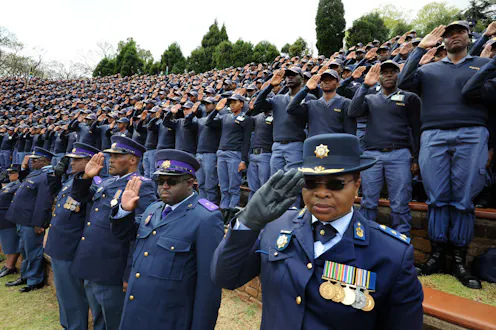
Police officers are central to modern states and societies, including South Africa. But contrary to popular belief, the standard model of policing – random patrol, rapid response and follow up investigation – has limited impact on general crime.
Instead, crime and violence are shaped by a myriad of factors including: in utero stress; childhood loss of a caregiver, neglect and malnutrition; untreated mental health and cognitive disorders; stark income and opportunity inequality and related constructs of and damage to masculinities; and early exposure to violence, including at home and school. About much of this, police alone can do little.
Rather, many South African police officers are the products of the same forces that shape the “criminals” against whom they are pitted.
In 2012/13 I spent eight months shadowing SAPS officers as they went about their work at four stations: two in Cape Town (one poor township, one affluent city) and two in the Eastern Cape (one rural town, one rural village, both poor). Aware of the limits of policing, I wanted to explore who officers thought they were – the stories they told themselves about themselves – and how these shaped their work. My findings have just been published in the book, Police Work and Identity.
So what did I find?
Accidental officers
Born and raised in the poverty stained shadow of South Africa’s minority wealth, most officers I met found themselves in the SAPS after original aspirations had slipped beyond reach. Some told stories of having disliked or been in conflict with the SAPS before signing up.
Yet, once inside, given a gun and uniform and asked to do the dirty work of a fragile and anxious democracy, they found themselves rewriting their self-narratives. They told themselves the SAPS was not ideal, but it was not bad either. It offered them secure employment, a decent salary and, often, interesting and rewarding work in a country where these are rare.
And so, for most officers a job in the SAPS is primarily just that, a job – a means to strive and survive in contexts of great precarity. The meaning and income the work brings to officers’ lives is usually more important to them than the work they carry out. Consequently, they seek first to please managers, and so to ease the pressures placed on them.
They enact institutional performances that promote the myth that the SAPS is a rational, effective, evidence based and rule-bound organisation consisting of well-trained officers performing common sense crime prevention tasks. This, while hiding the grimy by products of police work. Through official reports and statements, and carefully choreographed public performances, the SAPS and its officers present a strategically crafted façade behind which they cocoon themselves and seek to build their lives on the precarious socio-economic terrain of contemporary South Africa.
Because officers are aware of their limits, and that the SAPS’ public face is part fiction, some officers seek to distance their identity from the organisation. Instead, they present themselves in private as what might be thought of as “accidental police officers”, people who had hoped for more in life and who thus deserved more respect and dignity than the South African public gave them. But, with prospects of comparable financial remuneration and job security outside of the SAPS unlikely for most, they simultaneously and contradictorily invest in and protect the SAPS image. This is achieved both through dedication to legitimate task, and by ignoring abuse by colleagues.
Incongruence
While officers aspired to lives characterised by middle class materialism, few had the money to do so. Instead they deferred their dreams to their children, investing in their education, while sharing what little remained with networks of precarious kin.
Some officers invested in more than their immediate relatives. They volunteered their time and money to support youth in their communities who they believed to be at risk. Like the skollies (the colloquial name for thugs) they hunted at work, the teens reminded officers of themselves.
By investing in them officers hoped to deflect the teens from the violence of the criminal justice system. In a sense, they offered them carrots so that they might avoid becoming the objects of the violence through which some officers asserted their right to manhood and respect on the job.
A notable portion of the police behaviour I observed was in congruent with the imagined ideals of an exemplary police service. In less orderly spaces – the township and rural town for example – police were more likely to disregard traffic laws, litter, speak their prejudice, and resort to violence.
Their turning to such behaviour in such spaces has its roots in the disparate ways the apartheid state governed Black and White space, and the opposition to state law and authority this fostered. Extended into the democratic era, it seems that disorderly space encourages disorderly police conduct, while order encourages police compliance. As such, police reproduce both order and disorder in their work, rather than enforcing order.
Raised on the periphery
Who do SAPS officers think they are and how does it shape police practice?
Like so many South Africans, they are men and women born and raised on the periphery, chasing a vision of a more prosperous future. At times, proud, at times, shamed by the work they are required to do, they are nourished by the knowledge that while they may not be able to make South Africa safe, they can provide themselves and those they care for, with a better life than the one they were born into.
In the meantime, they do what they must do to get through the day, hold fast to the story they tell themselves about themselves, and with it secured, strive to colonise the future with a vision that is golden.

Andrew Faull has previously received funding from the National Research Foundation.
Source: The Conversation – Articles (AFRICA)
Read more on The Conversation.
Join the fun: Add Your event | Submit a Press Release | Add your listing.


