The new architectural frontier: buildings and their microbiomes:
As we grow to better understand the microorganisms in built environments – and what dynamics support their survival – we will be able to design and engineer buildings for better health.
Our built environments matter. Research shows that 85% of our time is spent indoors, and we are the main source of bacteria in indoor environments. Some of the bacteria and viruses sourced from humans are pathogenic – they can cause disease.
Not all microorganisms are bad for us. In fact, only about 1% of known microbial species are harmful. It’s true that that’s not the full picture, given that microbiologists have only been able to define an estimated 1% of the potential microorganisms out there. Nevertheless, the 1% of the known 1% enable infectious diseases that kill an estimated 16 million people a year.
Along with urbanisation and population growth comes densification and increasing time spent indoors. By 2018, according to the United Nations, 55% of the world resided in urban environments – towns and cities. By 2050, it’s predicted it will be 68%. Africa is expected to see a 300% increase in urbanisation over the next 40 years.
The profound impact of global interconnectivity and urban densification on the character and composition of the indoor environment has been demonstrated by the rampant spread of the COVID-19 pandemic.
Health-related conditions arising from the ‘sick building syndrome’, and healthcare-associated infections are further negative consequences of microbes in the built environment. The transmission of infectious diseases like tuberculosis, measles and COVID-19 is escalated in shared space.
All of this puts a firm focus on indoor environmental quality. Architects and built environment professionals design and shape these spaces that will soon host 68% of the world’s population. Without realising, they also design the microbial landscape – the conditions favourable for the growth and proliferation of microbial communities.
A new approach
Buildings are unique ecosystems that form part of larger urban ecosystems. Building ecology expert Hal Levin, formerly from the College of Environmental Design at the University of California, Berkeley, says
A building is a dynamic combination of physical, chemical, and biological dimensions.
Levin, a research mentor, introduced me to the emerging field of the microbiology of the built environment. This research field investigates and characterises the indoor built environment microbiome. The microbiome is the entire habitat, including the microorganisms like bacteria and viruses and the surrounding environmental conditions.
This is a multi-disciplinary approach, a nexus of architecture, engineering, microbiology and anthropology. Environments studied have included schools, university residences, hospitals, offices and even the international space station.
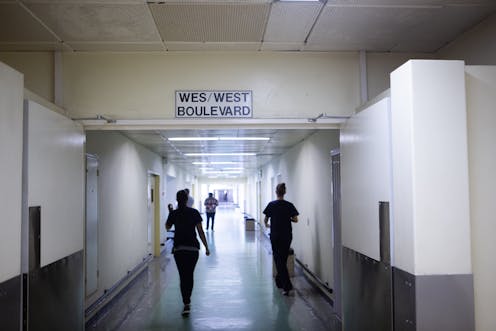
My recent study into microbiomes and the built environment was a first for the continent. The microbiomes of two South African hospitals were characterised and sequenced. We identified engineering and architectural factors and measured the environmental conditions of each building in different seasons. We simultaneously sampled the air and surface. Each of the 288 DNA samples that we collected was gene sequenced to help define each building’s unique microbiome.
We found some very interesting things. Human-sourced organisms accounted for most of the microbes sequenced. Only 35% of organisms were from outdoor sources. This included rooms with open windows and rooms with no windows. Some common pathogen species were found and were still viable – they could still potentially cause disease.
Read more: Architecture: four ideas from history that offer healthier design
Building microbiomes vary dynamically according to season, ventilation, occupancy and spatial patterns. Our research supports the premise that niche areas exist within indoor environments.
Investigating building ecology through the lens of microbiology presents insight into how building design, planning and engineering decisions affect microbiomes – and potential infection, prevention and control of disease in the built environment.
Most microbiome studies globally emphasised microbiological approaches and engineering methodologies, with architectural analysis still lagging.
Architecture has for too long followed a self disciplinary approach. It’s now time to deepen inter- and transdisciplinary research collaboration towards integrated knowledge solutions.
Where to from here?
Our understanding of the micro-environments of buildings is very limited. More study offers untapped insight into human health, infection spread, material selection, building systems and building programmes.
From what we have learnt studying the composition and distribution of microbial communities in buildings, a rethink is needed. We need to reconsider the character of indoor public spaces, highly congregated settings, building user pathways and ventilation solutions.
We need to convert our growing data and knowledge in the field into real world applications – like ‘add-in’ software programs for building models used by architects and engineers. We need empirical data to support and inform public health policy and design guidelines.
What if a data matrix of building factors and related microbial dynamics could be translated into a design tool? A model that would guide and inform building designers of potential risks or even benefits from microorganisms. Could this be the future for building design in a post-COVID-19 world? After all, it’s time for healthier buildings.

Dr. Jako Nice is permanently employed at the CSIR, and received research funding for this work.
Source: The Conversation – Articles (AFRICA)
Read more on The Conversation.
Join the fun: Add Your event | Submit a Press Release | Add your listing.


