The spread of shothole borer beetles in South Africa is proving tough to control:
A tiny tree-killing beetle with the awkwardly long name of Polyphagous Shothole Borer was detected in South Africa for the first time last year. It’s now attacking and inserting its deadly fungal ally, Fusarium euwallaceae, in a wider array of tree species across a much wider geographical area.
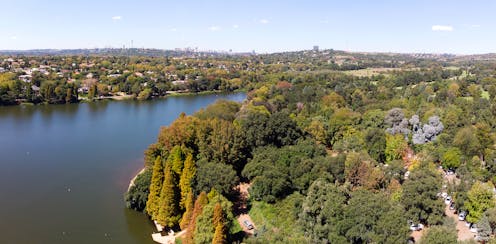
The beetle was initially discovered in a Botanical Garden on the country’s east coast. It has since been detected along the southern Cape coast line as well as in several inland urban areas. The number of tree species attacked in South Africa has also risen alarmingly. It currently stands at more than 80, 35 of which are native.
The shothole borer, which is native to Southeast Asia, has the potential to affect fruit, nut and wood production, but also to permanently change urban landscapes and natural forest ecosystems. This has happened on farms, in suburbs and in forests along river valleys in California.
The South African government has started to take steps to manage the problem. The Department of Agriculture, Fisheries and Forestry has set up a steering committee to guide national efforts. It’s made up of representatives from various government departments, the forestry and agriculture sectors, as well as academics, arborists, and nurserymen.
The major challenge with the beetle infestation is that the insect is crossing the boundaries between agriculture, commercial forestry, natural forests, and urban trees. Never in the country’s history has any insect attacked and killed trees in all these sectors. The protection of trees the different sectors is typically dealt with by different government departments, namely Department of Agriculture, Fisheries and Forestry, the Department of Environmental Affairs, and municipalities. But given the beetle’s unusual behaviour, routine action plans aren’t enough to curb the problem.
The threat to South Africa’s trees
Of the 80 species of trees under attack in South Africa, about 20 are reproductive hosts in which the beetle inoculates its fungus and then multiplies. These trees pose a serious risk to the environment around them as they become a source of infestation.
In the remaining 60 host species the beetle also inserts the fungus, but it doesn’t reproduce in them. Although some of these trees may eventually die, they don’t pose a threat to the other trees around them.
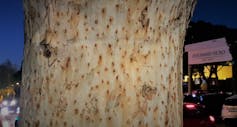
The species of ornamental and street trees most affected in South Africa’s cities are the London plane, Boxelder, Japanese maple, Chinese maple, English oak and Liquidamber. Several streets of maples and liquidamber have died in some cities, and large, old English oaks and plane trees have been severely affected in some areas.
During countrywide surveys conducted by our team at FABI, we found several fruit trees (peach, olive, grapevine, guava, fig) infested in urban areas. However, the only commercial crop that’s affected at present are pecan nut trees on farms in the Northern Cape.
In Israel and California the beetle caused substantial damage in avocado orchards, and although South African orchards are closely monitored by FABI team members, we have only detected it on a single backyard avocado tree in Johannesburg. Similarly, we found it on roadside wattle and eucalyptus trees, but so far the pest hasn’t been detected in commercial Eucalyptus, wattle or pine plantations.
In our opinion the most significant threat, but also the most difficult to predict and manage, is to South Africa’s native tree species such as coral trees, wild olives, yellow woods and Natal figs.
Managing the problem
California has been battling the beetle problem for the last 10 years. A recent visit to the area helped us to establish what practical actions have been taken to bring the problem under control.
An effective public awareness campaign was launched, informing residents and local governments about the beetle and its impact. Municipalities removed reproductive host trees, most of which were going to die anyway. The state also introduced legislation preventing infested wood from being moved from one area to another. Although researchers there have shown that chemical control of the beetle and fungus on individual trees can protect them, this has not been applied widely, and is typically only used to protect high value individual trees.
The major challenge in South Africa is to connect different stakeholders and government bodies through effective communication. Roles and responsibilities (also financial) of all contingents, at national, regional and local levels, should be clearly defined to avoid a duplication of efforts, and to ensure appropriate management strategies are devolved to regional and local government.
Structures are in place at the national level to deal with pests like these. Most pest invasions affect agricultural or forestry crops, and the Department of Agriculture, Fisheries and Forestry then engages with relevant stakeholders with strategic guidelines for control. For its part, the Department of Environmental Affairs is responsible for protecting the country’s natural forests and ecosystems. But it’s focus is usually on things like climate change, pollution and alien invasive weeds or animals.
At the local level municipalities has never had to deal with a problem like this, are not equipped to deal with it, and need clear and practical guidance from the national departments.
A consolidated strategy and pragmatic action plan is urgently needed. Pest risk assessments and countrywide surveys need to be done for the different sectors. We can learn a lot from ongoing research efforts in California, but local research is needed to determine the impact of the pest on different tree hosts, especially native trees, and to evaluate possible control measures in different South African climatic regions.
Research results need to be translated in management strategies that can be rolled out to stakeholders like farmers, commercial foresters, nurseries, arborists, municipalities, and quarantine authorities. This implies that people need to be trained to recognise the problem in order to appropriately deal with it.
Special policy might need to be formulated by the different levels of government, but legislation is only as good as its enforcement. For any of the above to succeed, efficient communication channels and a public awareness campaign is needed. All of this needs leadership, dedicated and competent human resources, and funds.
One thing is sure, the little shothole borer is here to stay. Protecting the country’s trees is everybody’s responsibility, but our government needs to lead the way.

Wilhelm de Beer receives funding from the National Research Foundation, the Tree Protection Co-operative Progamme, and the University of Pretoria.
Trudy Paap receives funding from the South African National Biodiversity Institute and the Tree Protection Cooperative Programme
Source: The Conversation – Articles (AFRICA)
Read more on The Conversation.
Join the fun: Add Your event | Submit a Press Release | Add your listing.


