What drives police violence in Ghana, and what can be done about it:
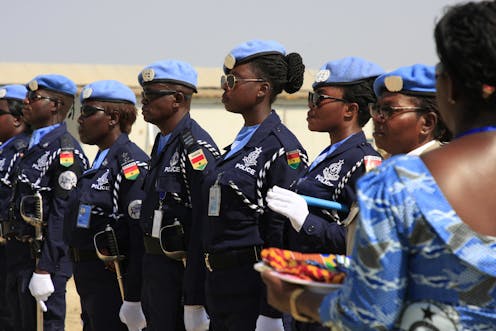
Student protests in Ghana resulted in the temporary closure of the Kwame Nkrumah University of Science and Technology. The cause: police use of force in the arrest of students following a vigil to protest the possibility of all-male halls becoming mixed. The Conversation Africa’s Moina Spooner spoke to Justice Tankebe about Ghana’s police service, and their use of force.
Does Ghana have a professional police force? What is their reputation? Is it justified?
To say a police service is professional is to claim that there’s a code of ethics that governs them, there are credible structures of accountability and that these ensure their integrity in delivering a certain quality of service to the public. These features remain undeveloped in Ghana’s police force.
The police’s reputation is it intimidates, is violent, corrupt and that it treats civilians unfairly. Earlier this year there were reports of police officers brutalising citizens without provocation. This included a video of a woman and her toddler being beaten in Accra. Police are also accused of being trigger-happy. In one incident police killed seven young men that they claimed were robbers.
This type of violence happens for a couple of reasons. I conducted two studies of Ghanaian police officers. The first showed that most police officers supported the use of force for a range of reasons. Including; they didn’t have strong bonds with the service and the rules about when and how to use force don’t have legitimacy in their eyes, so they disregard them. This lack of legitimacy was put down to the fact that there are high levels of corruption in the police force.
My second study revealed that officers were treated badly by their supervisors. The result is that officers take their frustrations out on civilians and that the supervisors lose credibility in encouraging good behaviour. Improving police treatment of civilians therefore requires paying attention to the moral climate within police departments in Ghana.
To address the problems there needs to be a proper diagnosis. This isn’t being done. Ghana’s police managers believe the issues can be traced to problems with individual rogue officers. For example, the national police chief, Asante Appeatu, said that:
we must fire the bad apples because they are dangerous.
But the problems facing Ghana’s police are systemic. There are conditions within the police service – like poor supervision, poor training, and unfair treatment of lower-ranked officers – that make misconduct more likely to happen. Focusing on individual officers diverts attention from these conditions and it also means police managers can avoid responsibility for the problems.
How does it compare to other countries in the region?
There’s no systematic tracking of police violence in the region which makes country comparisons impossible. My own work has focused on Ghana and, as Director of the African Institute of Crime, Policy and Governance Research, I have started to collate cases of police violence in Ghana. With time this will be extended to other countries so that a solid basis for comparison can be made.
Is the government taking steps to address police violence?
Rhetoric about curbing police violence haven’t been matched by concrete action or strategy. The government’s approach is reactive, responding to public pressure to investigate instances of police violence. There are no efforts to delve into the broader issues and to develop national standards.
If this type of impunity persists, the rule of law loses credibility and police become part of the problem rather than the solution. Unless government takes steps to address police violence, the situation is bound to worsen.
There are a few things that can be done.
Firstly, there needs to be independent and credible oversight institutions that can investigate serious cases of police violence and other forms of misconduct. For instance in England and Wales, the independent office for police conduct investigates misconduct by individual officers while the inspectorates of criminal justice regularly inspects police forces with the aim of improving policing and ensuring public safety. Ghana needs similar institutional arrangements.
Ghana’s police also need to develop a strategy for dealing with public disorder. This should guide the training of officers on how best to handle public order so that they can manage situations, like the one at the Kwame Nkrumah University of Science and Technology campus, discretely. It was clear from the way the police behaved that they reacted impulsively, escalating tensions. Policy direction and regular training will help avert unnecessary violence.
Thirdly, part of the problem with the police in Ghana is that they confuse legality with legitimacy. They believe that just because their orders are lawful, they are legitimate and deserve public compliance. This mindset means they pay only lip-service to the hard work of understanding and engaging with local communities, taking complaints seriously, improving treatment of civilians, and holding officers to account.
Finally, police legitimacy needs to be part of a strategy. Unless police officers command legitimacy –- that is, they are perceived to be effective, to act lawfully, and to treat civilians fairly –- violence will remain a stable feature of their interactions with civilians. The strategy should involve training which puts more emphasis on building better relationships with civilians through fair treatment – explaining decisions, listening to civilians, being respectful, trustworthy, and being impartial. It could also involve investing in equipment – like body-worn cameras by officers – to track and capture data on interactions with civilians. These significantly reduce the use of force by police.

Justice Tankebe is affiliated with the African Institute for Crime, Policy and Governance Research. Some of his research outside Africa has been funded by the British Academy and the European Union.
Source: The Conversation – Articles (AFRICA)
Read more on The Conversation.
Join the fun: Add Your event | Submit a Press Release | Add your listing.


