Victim surveys show that crime in South Africa may be dropping, yet fear is rising:

South Africans consistently rank crime among their top concerns, second only to unemployment. Between 2003 and 2015, 79% of people surveyed annually by the country’s Human Sciences Research Council were dissatisfied with the government’s efforts to reduce crime.
The latest crime statistics released by the South African Police Service provide reason for both optimism and concern. They show year-on-year declines in many crimes, including aggravated robbery, burglary, and vehicle theft. If these reflect real declines, that may be because of more intelligent policing – and developments in anti-theft technology and residential fortification, among other factors.
But murder rates increased for the sixth consecutive year. The recent rise includes a 14% increase in the murder of women and children. Given that murder rates more than halved between 1994 and 2011, these increases are worrying.
Amid the focus on crime statistics, another set of data is often ignored. South Africa is fortunate to have victim and perception survey data.
This is valuable because police data alone offer only a partial picture. It also tells us almost nothing about public experiences and perceptions, including how many crimes aren’t reported, whether people trust police, or if they feel safe.
Where trends in police data match trends in victim survey data, they are more likely to be accurate – particularly for certain crime types. Perceptions, on the other hand, are subjective. It can take years for an actual crime decline to result in improved feelings of safety. Where violent crime declines but remains common, or where stories of violence saturate daily media, feelings of safety may not improve, despite real crime declines.
It’s important that governments take these perceptions seriously. Improved feelings of safety and confidence in police should be central to how government evaluates itself.
Police data
Fewer crimes were reported to police in 2017/18 than in the preceding year. Although most victims don’t report crime, some crimes are more likely to be reported than others. These include residential burglary, vehicle theft, carjacking as well as home and business robbery. These all showed a decline. Other violent crimes that are most likely to be reported, including murder, bank robbery and cash in transit robbery, increased.
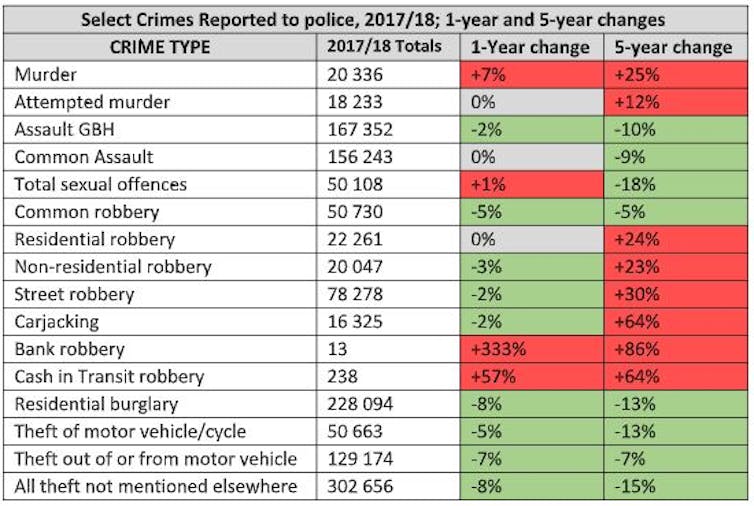
Common assault and assault with intent to do grievous bodily harm also declined. This is perplexing.
With attempted murder remaining flat and murder increasing, it would be surprising if assault had declined. Police analysis suggests that many murders begin with an assault.
However, considering that 41% of murders involved firearms and another 31% knives, it’s possible that most lethal violence takes place under different conditions, or between different people, to that classified as assault. For example, more murders are likely to occur during robberies today than they did in the past.
But, it is at least as likely that the decline in reported assaults is a result of police dissuading victims from opening cases, including domestic and child violence cases, or victims simply not reporting.
Victim surveys
National victim surveys are conducted among representative samples of households. Victim surveys explore experiences and perceptions of crime, regardless of whether respondents experienced crime or victims reported crimes to police. They are not perfect, but offer a means to gauge crime trends, reporting rates, and public perceptions.
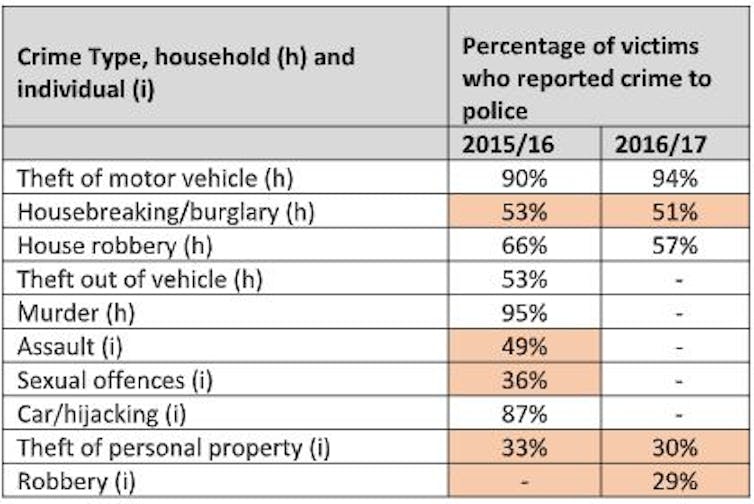
The 2017/18 police data should be compared with the 2017/18 national victim survey, but this has not yet been released. The 2015/16 and 2016/17 surveys indicate a slight, general decline in reporting in recent years.
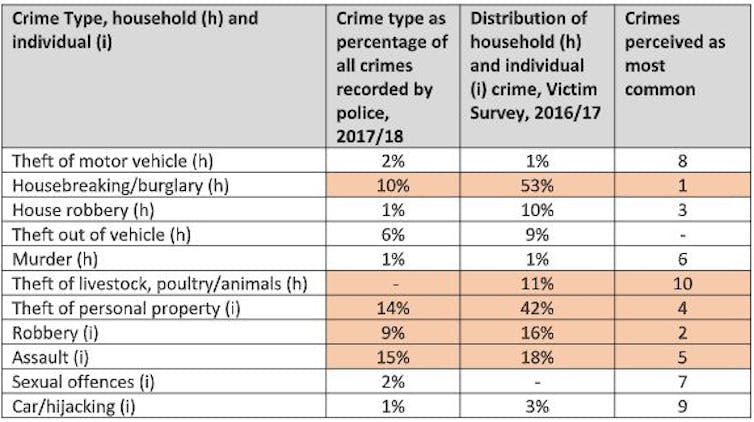
Victim surveys estimate the distribution of crime experienced by victims. The latest data suggests that most victims in 2016/17 experienced burglary (53%) and theft outside the home (42%). But, only 10% of crimes reported to police in 2017/18 were classified as burglary, and 14% as other theft. This suggests irregular victim engagement with police.
Fewer crime victims
Like police statistics, household victim surveys suggest that increasingly fewer people are falling victim to crime. In 1998, 25% of households reported experiencing a “household” crime (for example burglary, home robbery, car theft) while in 2016/17 just 7% did.
Similarly, 4.7% reported being victims of “individual” crimes (for example theft of personal property, robbery, assault) in 2013/14 compared to 3.5% in 2016/17. This suggests that despite widespread feelings of insecurity, fewer people may be victims of crime each year than is commonly thought.
For example, if burglary is the most common crime and half of burglaries aren’t reported to police, this still means that fewer than 1% of individuals or roughly 3% of households experienced burglary in 2017/18.
Despite what appears from both police and victim survey data to be a decline in general crime, in 2016/17 more people believed crime had increased in their area of residence than those who believed it had decreased or stayed the same. In contrast, in 2011 and 2012 more people believed crime had decreased.
Nevertheless, recent perceptions are better than they were in 2003 and 2007, when most people believed crime was increasing. People are also more positive when asked to reflect on long term trends.
How do these beliefs shape lives?
Fear of crime
In 2016/17, up to 32% of people reported being unable to carry out basic tasks for fear of crime. Although most people report feeling safe walking in their area of residence during the day, just 29% feel the same at night. This figure has declined consistently since 2011, suggesting that although general crime may be declining, public fear is increasing.
While national victims surveys give some cause for optimism, youth victim surveys – which can register harms not captured by national surveys – offer reason for serious concern. They show that 26-35% of young South Africans have experienced sexual abuse; 34% have been hit, beaten, kicked or physically hurt by an adult. Children exposed to violence are more likely to perpetrate and be victims of violence as adults.
South Africans should be very concerned about this. Without addressing violence against children – which is often coupled with violence against women – the country will struggle to reduce the violent crime that keeps so many gripped by fear.

Andrew Faull receives funding from the Hanns Seidel Foundation.
Source: The Conversation – Articles (AFRICA)
Read more on The Conversation.
Join the fun: Add Your event | Submit a Press Release | Add your listing.


