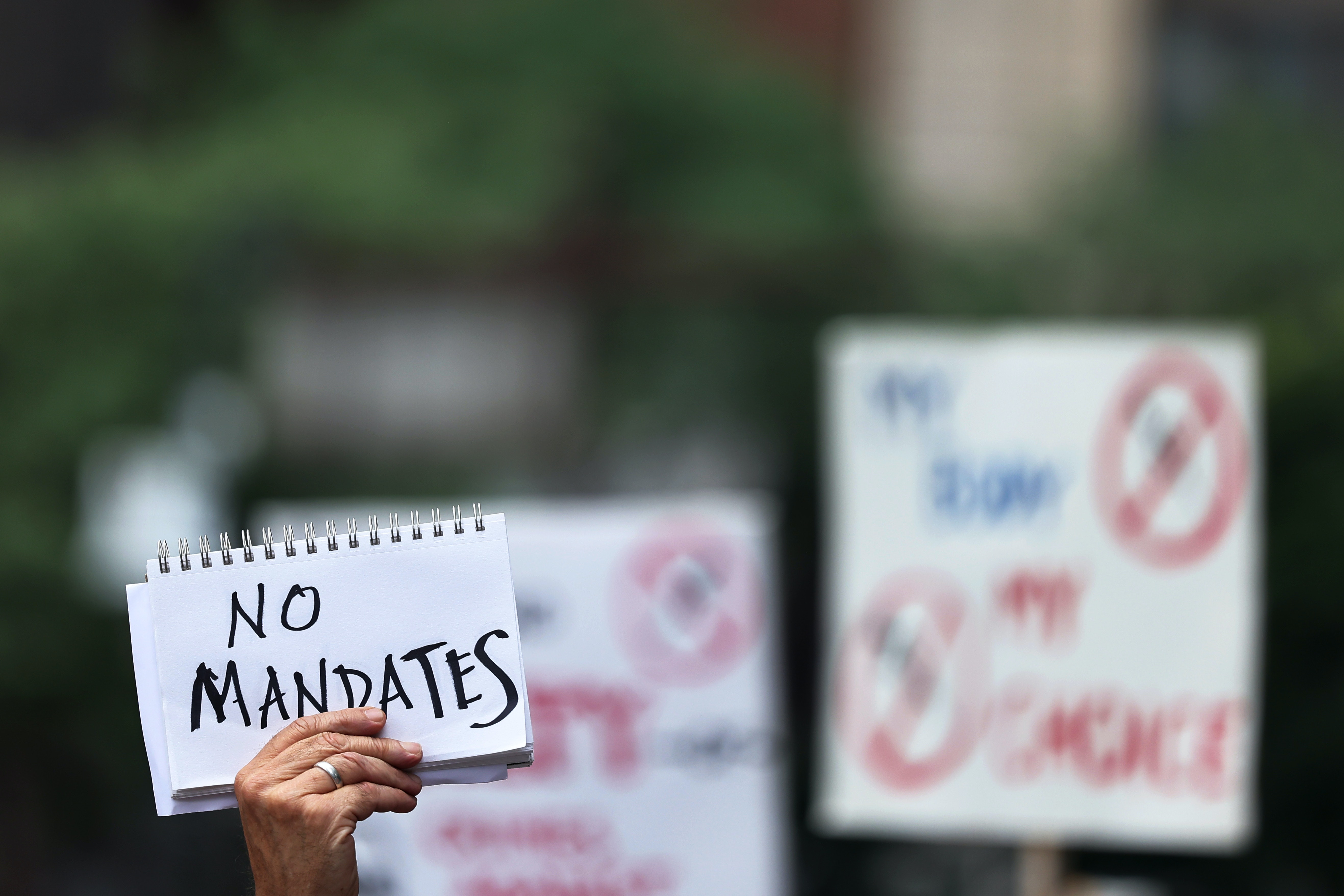
There is a global debate among bioethicists – and other experts – about whether vaccine mandates are ethically justified. The debate has, of course, extended to South Africa, where we conduct our research as human rights and constitutional law experts with an interest in bioethics.
The constitution is South Africa’s supreme law. At its core is a moral vision of people as autonomous moral agents, capable of rationally forming their own opinions. This vision, we argue, will be shattered by a vaccine mandate – at least at this stage.
In a recent article, bioethicist Keymanthri Moodley argued that South Africa’s constitution requires any limitation of rights – like a vaccine mandate – to be proportional to the purpose of the limitation – in this instance, protecting public health. The bigger the risk to public health, the larger the limitation may be on individual rights. Hence, so the argument goes, given the big risk to public health, a vaccine mandate is justified.
However, the constitution also requires that the least restrictive means must be employed when limiting rights. There is no doubt that COVID-19 poses a big threat to public health. But we suggest that a vaccine mandate is clearly not the least restrictive means to protect public health from COVID-19.
There are numerous other policy options, such as incentive schemes, that have not yet been implemented in South Africa. Research on vaccine incentives is still in its infancy, but preliminary data suggests that they may have a positive impact. A number of states have already offered a variety of incentives such as money awards, lotteries with monetary or other prizes, and free or discounted food.
Exploring these incentives, in conjunction with other strategies to promote vaccine uptake, must be earnestly explored before South Africa considers the route of a vaccine mandate.
Trust and uncertainty
It is important to consider the issue of public trust in the government and in the science of COVID-19 vaccines.
A vaccine mandate is a drastic policy measure that may have far-reaching consequences – in fact, it might even be counter-productive. Firstly, public trust in government is low as a result of its (mis)handling of the pandemic thus far. Secondly, there is a climate of vaccine hesitancy among many in South African society, seemingly influenced by the government’s failures in the vaccine rollout process.
Read more: South Africans are keener to get vaccinated. But many still need to be convinced
Thirdly, vaccine hesitancy worldwide seems to be motivated, in part, by conspiracy theories about vaccines as a means of acquiring authoritarian control. Those who hold these views would perceive themselves vindicated by a government-driven vaccine mandate. These three factors could result in widespread and organised pushback against vaccination by members of the public and healthcare professionals. We have seen this in France, where tens of thousands have taken to the streets in protests for weeks, and the US, where protests have recently turned violent.
A recent report by the National Income Dynamics Study Coronavirus Rapid Mobile Survey (NIDS-CRAM) found that vaccine hesitancy in South Africa was caused, to a significant degree, by concerns about the side effects of COVID-19 vaccines, which were linked to a lack of access to trustworthy information about them. Despite this, NIDS-CRAM data shows that openness to vaccination among South Africans is on the rise.
The solution, given that this is a moment in which trust in the safety of the vaccine appears to be rising, is clearly not to bring down the hammer. As we have discussed above, this could do more harm than good by causing people to push back against vaccines rather than embrace them. Instead, the government must address problems like a lack of access to trustworthy information about vaccines by further bolstering its efforts to make verified and scientifically sound information available to South Africans. Scientific research has shown that people who received information on COVID-19 through reliable information channels are more likely to be accepting of vaccines.
The constitution as a guide
Even in times of crisis, the South African government has a duty to honour its constitutional obligations. This has been codified in case law recently.
It is important that the South African government recognises this and treats citizens with respect by engaging with their concerns, making information about the vaccines more accessible, and exploring policy avenues such as incentivising vaccines, rather than using the law as an authoritarian hammer to batter them into compliance.
The constitution demands nothing less.


