Dr Emmett Brown, Dr Victor Frankenstein and Dr Henry Jekyll are just three of the “crazy” scientists who populate fiction. Their methods were controversial and revolutionary – and I have always been especially drawn to the character of Dr Frankenstein, who was created by the English novelist Mary Shelley in 1818. I am fascinated by how he used electricity to study and understand the living. Every movement, feeling or thought is the result of electrical current in our body.
As an electrophysiologist, I see myself as a modern, real version of Dr Frankenstein: I use electrodes to study and understand living organisms. Given the tragedy at the heart of Frankenstein, this may sound evil. But in fact, using ethical practices to insert electrodes into living creatures can help research in human health, agriculture and forestry and create the path to greener ecology and conservation.
This sort of work also has enormous economic value because it can help reduce the damage done by invasive insects. A recent study estimated the losses and negative effects of invasive insects at US$70 billion annually. Other research suggests that insects destroy one fifth of crops produced annually worldwide. The figure can be higher in developing countries.
How does inserting electrodes into insects tackle these problems? Simply, it helps scientists to understand, in the first instance, what attracts insects to different crops. It’s then possible to design ways to trap them. This is what I’m doing in my PhD research, focused on an invasive woodwasp, Sirex noctilio. It kills pine trees and does major damage in the forestry sector worldwide. But by testing what colours and smells attract the insect, I have developed compounds I hope will trap and divert the wasps from pine trees.
What attracts insects
Pheromones are odours released by an insect which have a strong attractive effect on another insect’s behaviour. For example, male insects can smell a female willing to mate and are strongly attracted.
Insects are also attracted to what they perceive as a “beautiful” colour. As humans, we possess three pigments that absorb light, in the red, green and blue part of the visible spectrum. Colour blind people usually have a defective red pigment and struggle to differentiate colours such as green, orange and red. Most insects in the Hymenoptera order – like wasps, bees and hornets – possess three photoreceptors (for detecting green, blue and ultraviolet) in their eyes. This means they are less good at distinguishing warm colours than us, but they are able to see ultraviolets.
So, to trap these insects and prevent them from targeting crops or forestry plantations, scientists copy the insects’ natural pheromones. From this, and sometimes also synthesising colours that are pleasing to the insects, lures can be created to draw them away from particular crops or plant species.
By putting electrodes in the Sirex noctilio’s antennae, I am able to record the electric current from those antennae to the brain and to visualise on a computer when the insect can smell a specific pheromone. This means I can see what the insect can smell. I can also insert very small electrodes into the insects’ eyes, testing which colours they can see.
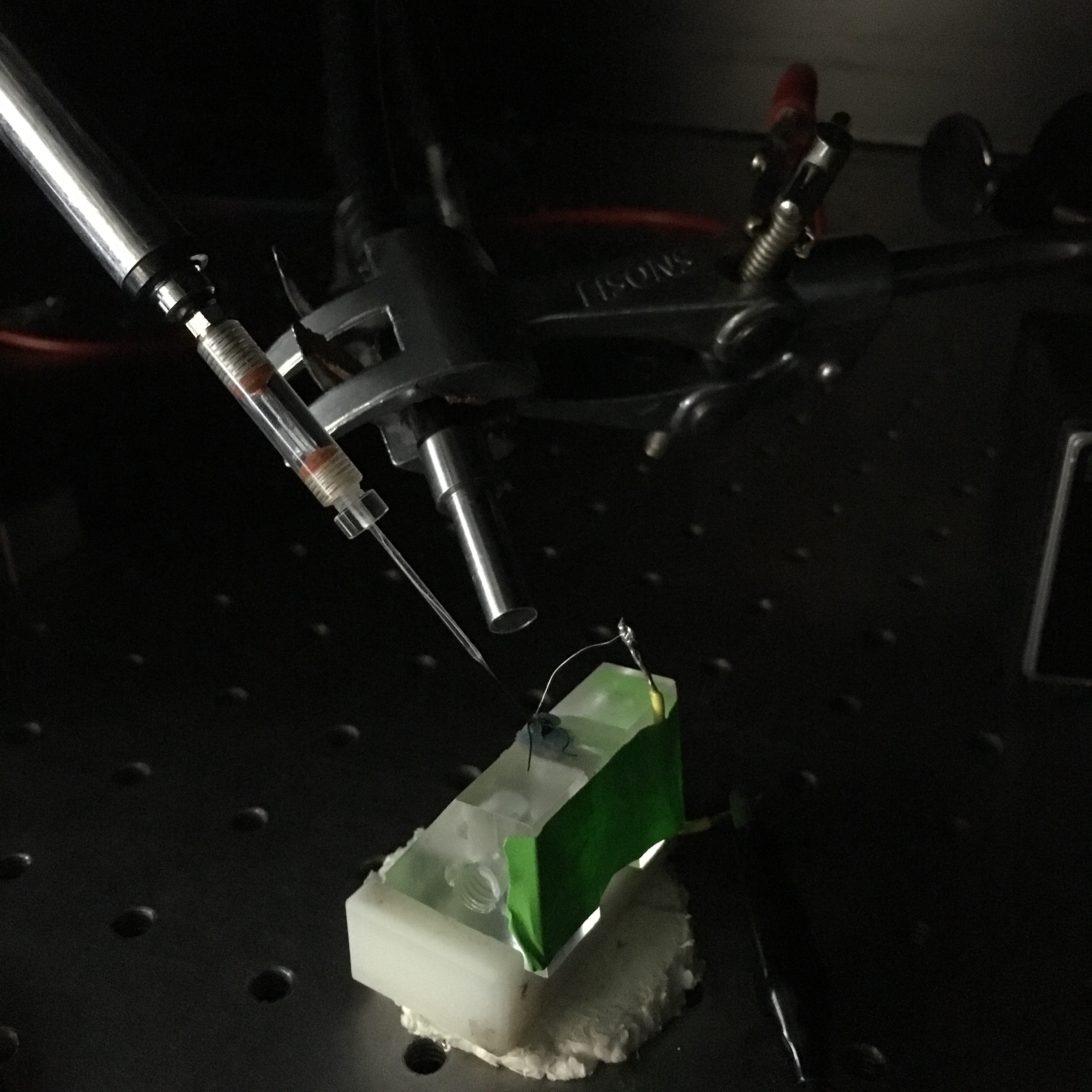
Armed with this information, we can now craft a selective “trap” – lures that keep the wasps away from the pine trees they usually target. These lures are a blend of a few pheromone compounds and the colours that are visible to the woodwasp. Once attracted in the trap, the invasive pest is killed and won’t do further damages to the area that needs to be protected.
Huge benefits
The next step will be to start field trials that put the compounds’ viability to the test.
Global research has already shown that pheromone traps of this nature, used in the field, can have tremendous positive effects. One study followed the efficiency of such traps in citrus plantations in Brazil for 12 years. The authors estimated that up to 50% crop loss was prevented. This represented a benefit of between $2,655 and $6,548 for each dollar spent on the pheromone research.
Of course, my research is just one piece of a large puzzle. Scientists are trying a number of approaches to save crops and plantations around the world from invasive insects. These range from transgenic crops to sterile insects; from introducing a new species as a biological control agent to creating new types of pesticides.
What’s especially promising about creating pheromone and colour traps, however, is that they can be extremely targeted. More traditional methods of pest control, like spraying pesticide, can harm other, non-invasive species. But if we find that our traps are negatively affecting such species, we’ll remove them and try a more specific blend of compounds that we hope will only eradicate the wasps from pine plantations.
This article won the Science Communication Award in a competition hosted by The Conversation Africa and the DST-NRF Centre Of Excellence In Tree Health Biotechnology.


