Why merely owning land isn’t enough to empower Africa’s women farmers:
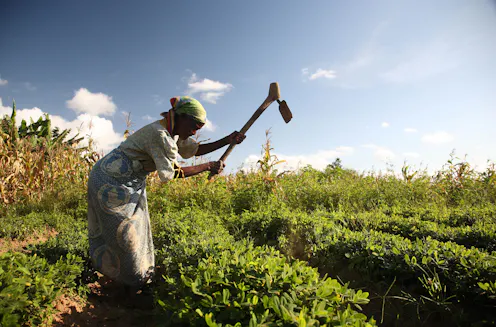
In the agricultural sector – the major employer for poor people in Africa – assets like land and livestock are owned and controlled mainly by men.
It makes sense, then, that many donors, national governments and civil society groups believe rebalancing asset and land ownership in favour of women will greatly empower women. The argument is that increasing women’s access, control and ownership of land will lead to stronger bargaining power and higher incomes. It is also posited as a way to strengthen women’s “voice” within households and communities.
But the reality in communities is very different. Our recent book, Agriculture, Diversification and Gender in Rural Africa, drew on a unique, longitudinal data set covering around 2000 households in 15 regions in six countries: Ghana, Kenya, Malawi, Mozambique, Tanzania and Zambia. This data, coupled with more detailed qualitative research carried out in three villages in Malawi, highlights the limitations of approaches that rely on gender based redistribution of land from men to women.
We found that even when women own land, their husbands are still perceived as household heads. As such, men have better access to public resources such as subsidised fertilisers and agricultural advisory services.
The findings suggest that genuinely empowering women and girls within agriculture requires interventions that go beyond the issue of land redistribution. Instead, policymakers and development agencies should adopt a multifaceted approach that includes aspects beyond agriculture. These include issues of sexual and reproductive rights, for instance, and freeing women from the heavy and time consuming drudgery of domestic work in poor, rural settings.
Ownership and demands on women’s time
Female landholders have less land than men in five of the six countries we studied. This means they have lower access to one of the most important resources in rural Africa.
The quantitative data we collected confirms the existence of gender based gaps in farm sizes – female landholders have smaller farms in all countries except Kenya. And the gaps have grown in most of the regions since 2002, when the study started. In countries where average farm sizes have increased – Ghana, Zambia and Tanzania – men have tended to benefit more from this growth than women.
In parts of Malawi and Zambia matrilineal systems mean that women control and inherit land. But this hasn’t made a real difference to women’s lives. This is because of their other responsibilities, as well as societal bias and pressures.
Then there’s the issue of the responsibilities that women bear which interfere with their ability to focus on the business of farming. Through qualitative interviews in the three Malawian communities, we discovered that there are many demands on women’s time and labour outside agriculture. Women are expected to care for ill relatives, especially children and infants. Other demands are the need to collect firewood and water.
A woman cannot juggle these demands with participating fully in agricultural production, even if she is the owner of the land. Gender norms around the division of labour enable men to avoid time consuming domestic work.
Women’s relative lack of empowerment is also related to their limited mobility, which makes it harder for them to reach markets. Women are fettered by their domestic responsibilities, controlling husbands and by the potential dangers of moving around on their own, especially at night.
This means that women don’t have the actual power to control the income from products sold in agricultural markets.
Men’s relative superiority within the household and local communities is compounded by government policies that strengthen the male household head norm. For instance, governments divert substantial public resources into subsidisation programmes that favour household heads.
These programmes also withdraw resources earmarked for agricultural extension services for women. This means that areas that lose funding are those that would empower women – not in terms of land ownership, but in terms of support.
Sustainable solutions
These findings suggest that empowering women farmers requires more than just ensuring they own land and assets. Women need support to deal with the many demands on their time. For example, addressing poor health among children might free up more time for women farmers who are also mothers. Improving women’s ability to get around easily is also important.

This article draws on work from rural Malawi by Agnes Andersson Djurfeldt, Ellen Hillbom, Wapulumuka Mulwafu, Peter Mvula and Göran Djurfeldt (https://www.sciencedirect.com/science/article/pii/S0264837717306683) and a book co-edited by Agnes Andersson Djurfeldt, Fred Mawunyo Dzanku and Aida Cuthbert Isinika. Both of these contributions are based on collaborative work in the context of the Afrint project, an African-Swedish research project that has been running since 2002 https://www.keg.lu.se/en/research/research-projects/current-research-projects/afrint Funding for the Afrint project has been awarded by Sida's research council, Vetenskapsrådet, and the UK's Economic and Social Research Council (ESRC) and UK aid from the UK government. The project is part of two grant schemes, DEGRP (DFID-ESRC Growth Research Programme) jointly funded by the UK's Department for International Development (DFID) and ESRC and APRA (Agricultural Policy Research in Africa) conducted with funding from UKAid from the UK Government. The findings and conclusions in this article are those of the author and do not necessarily reflect positions or policies of the UK Government, DFID, or ESRC, or the Swedish government, Vetenskapsrådet or Sida.
Source: The Conversation – Articles (AFRICA)
Read more on The Conversation.
Join the fun: Add Your event | Submit a Press Release | Add your listing.


