World Cup is reminding South Africans that sport is still divided:
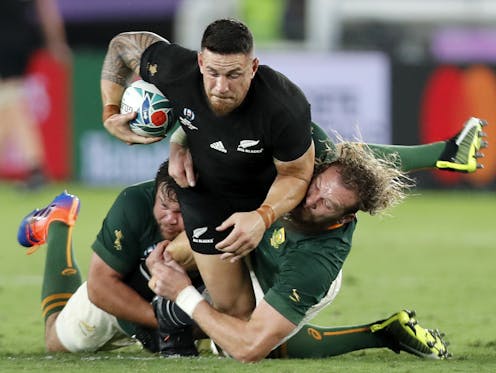
As South Africa’s Springbok rugby team vies for victory in the 2019 Rugby World Cup tournament, it is worthwhile to reflect on the historical substance of sports unity since 1994.
South Africa held its first democratic elections in 1994. In mainstream history and school textbooks this represented a turning point that brought unity to South African society. But the danger of honing in on a single event blurs the broader social and political landscape that led up to the 1994 moment and subsequent developments.
More directly, Walter Mignolo, a prominent scholar of decolonial theory, reminded his audience at a recent conference that when the colonised take over the state, past complexities can be reproduced without question. The result is that power relations that favour the privileged remain intact.
Since 1994 South Africans have been constantly bombarded with the much publicised words of Nelson Mandela:
Sport has the power to change the world; it has the power to inspire. It has the power to unite like little else does. It speaks to youth in a language they understand. Sport can create hope where once there only was despair.
But criticism against the notion that “sport has the power to unite like little else does” has become unpopular and has, to borrow from Neville Alexander,
scored a duck or very low innings in post-Apartheid society.
South Africans no longer, as they did prior to 1994, dare speak truth to power. Instead there is silence about racism and class divides in sport and almost a denial that there was vicious racism in sport prior to 1994.
This raises the question: Does the nature, basis and purpose of unity in the pre-1990 anti-apartheid sports movement correspond with developments after 1994?
To answer these questions it’s useful to consider two types of unity – principled and ad hoc. Principled unity endeavours to unite people around a common outlook and how they intend achieving their common goal. Clarity of ideas and practice is crucial. With ad hoc unity one may discard their allies once the short term goals have been achieved.
I argue that the sports unity that was achieved in South Africa during the last decade of the 20th century was an ad hoc or temporary tactical unity.
The history
After the unbanning of the anti-apartheid political organisations in 1990 a new sport political elite emerged. It was made up of the apartheid sport federations and individuals from within the sport liberation movement. Despite rhetoric to the contrary, the new elite favoured the establishment or apartheid sports federations. Lured by the prospects of jobs, and the high life, former outspoken anti-apartheid sports critics began promoting unity while side-lining the South African Council on Sport. This was the internal non-racial anti-Apartheid sports organisation.
And when some officials of the South African Non-Racial Olympic Committee returned to South Africa from exile, they sought the political support of the establishment sports federations, ignoring the South African Council on Sport. Not surprisingly, the sports moratorium was lifted without the South African Council on Sport’s consent.
What followed was a scenario of extraordinary unity sports ventures. For example, South Africa participated in the 1992 Olympic Games and organised a cricket tour to India with the Apartheid government still in power.
In this period (1992-1994), the country was represented solely by players from apartheid sport federations. National and provincial non-racial school sport federations were abandoned while white school sport derbies continued and thrived.
Although it was clear to many, nobody dared to state that the unified sports teams were nothing more than apartheid teams playing under the banner of a yet to be democratic sport structure.
Many South Africans were lulled into believing that white people, who had benefited from apartheid sport, would be willing to share their gains in meaningful ways with sports structures of the non-racial movement.
What the South African Council on Sport demanded was a moratorium on international sports contacts until development at grassroots level had reached a satisfactory level. But many activists capitulated and gave in to the demands of the new sport political elite for international participation under new unified sports federations.
Bitter fruit
South Africans are reaping the effects of this ad-hoc sports unity. School sports in the townships, the historically racially segregated areas of black working classes, are either non-existent or at an extremely low level, while middle to high fee-paying schools offer learners a variety of sports opportunities. For black students to achieve sport success, they have to attend middle to high fee-paying schools.
It is therefore not surprising that the vast majority of first team players (black and white) in the Protea cricket and netball teams come from these schools. The same applies to the Springbok rugby team.
There is no sports organisation outside government that speaks on behalf of the poor and marginalised communities and their sports structures and organisations.
The type of unity that was forged between sports organisations in the 1990’s has inevitably meant that there’s no urgency about addressing social inequality in society.
It is wasteful energy to seek out opportunistic racist culprits and collaborators to blame for the current state of inertia in sport within the country’s economically poor areas. What is needed now is a principled sports unity that is forged from grassroots upwards to national level. Sports clubs need to be formed for purposes of healthy participation, enjoyment and competition at all levels.
In addition, sports clubs need to become part of critically-minded social movements that deliberately downplay virtues of excessive monetary gain and the ‘win at all costs’ approach. This is nothing less than a call for a new progressive sports movement that works for equality and peace based on mass participation and social justice.
Otherwise, 25 years down the line South Africans will still be in search of a sports unity that is both principled and practical.

Francois Cleophas does not work for, consult, own shares in or receive funding from any company or organisation that would benefit from this article, and has disclosed no relevant affiliations beyond their academic appointment.
Source: The Conversation – Articles (AFRICA)
Read more on The Conversation.
Join the fun: Add Your event | Submit a Press Release | Add your listing.


