There’s a new way to “grow” bio-bricks using human urine. Here’s how it works.:
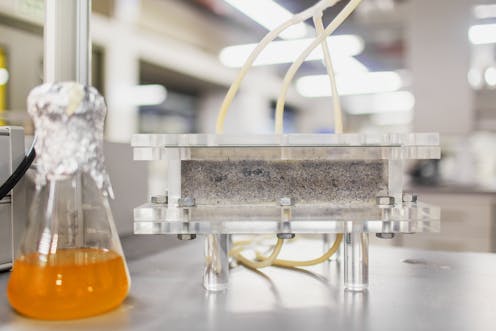
Recently, researchers from the University of Cape Town in South Africa have “grown” a bio-brick using bacteria and urea found in human urine. The Conversation Africa’s Natasha Joseph asked Dyllon Randall to explain the research and story behind the bio-bricks.
What prompted this project?
Initially, curiosity. Some years ago I read about a US based company called BioMASON that uses the same process we do to produce bio-bricks, but with synthetic urea rather than urine. I was working in the sanitation field and wondered whether real urine could be used instead. Thanks to a one-year feasibility grant from South Africa’s Water Research Commission in 2017, we were able to test the concept – successfully.
So you’re putting what we usually describe as “waste” to good use?
Yes. My research work focuses on rethinking wastewater as a resource. Some of the things we discard – like urine – can actually be converted into useful resources, as this work has shown. This is important if we’re going to achieve a truly sustainable future because we are running out of natural resources at an unprecedented rate.
It’s also about questioning the status quo and trying to improve processes.
Finally, it’s about using language differently when we describe “waste”. Language is important because it creates subtle paradigm shifts.
Where did you get the urine for this project from? How much does it take to form one bio-brick?
We collected the urine from men working in the New Engineering Building at the University of Cape Town using novel fertiliser-producing urinals. In future, we plan to collect urine from women, too.
We typically need between 20 and 30 litres of urine to make one bio-brick. This might sound like a lot, but remember that urine is more than 98% water: for the bio-brick making process we are only after carbonate ions and calcium ions which only accounts for about 1% (by mass) of the total urine.
How does the process work?
The bio-brick is made by a process called microbial induced calcium carbonate precipitation.
It’s partly a biological process, and a key part of the process is making sure the urea doesn’t quickly degrade, which is what usually happens. To do this, we increase the pH of the urine by adding calcium hydroxide (lime). If we didn’t do this, most of the urea would degrade during collection or storage.
This initial process also produces a solid fertiliser, calcium phosphate. This is removed from the liquid phase by filtration, and we’re left with a solution that’s rich in urea which can be used to make bio-bricks.
Certain bacteria produce an enzyme called urease which acts as a catalyst to breakdown urea into carbonate ions and ammonium ions.
With this in mind, we decrease the pH of our solution slightly so the bacteria which degrade the urea can survive, and add food for the bacteria along with extra calcium to make the whole process more efficient.
After this the carbonate ions combine with the calcium ions from the urine to form calcium carbonate – that is, a solid is formed. This solid is the cement that glues any lose material together into a shape of your choice – in this case, a bio-brick. This is also a natural process and occurs in many environments from coral reefs to caves. We merely imitate this in our bio-brick mould.
Do the bio-bricks smell of urine?
They’ll initially have a strong smell. This is the smell of ammonia, a pungent gas that is produced as a by-product when the bacteria degrades the urea.
We can recover this ammonia using a separate process and convert it into a nitrogen rich fertiliser.
Importantly, the bio-bricks lose their ammonia smell after drying at room temperature for a day or two and are safe to use and handle thereafter.
What about waste?
This is an integrated three phase process. Phase one produces the first (solid) fertiliser; phase two produces the bio-brick and phase three, which we haven’t tested yet, has the potential to produce a second (liquid or solid) fertiliser.
The entire process would theoretically produce no “waste”.
There’s also room to optimise the process and reduce the amount of urine required to make the bio-bricks.
Will this work at scale?
I think so. BioMASON has shown that this natural process is commercially viable, albeit not with urine. Back in 2016 they were in the process of upgrading their facilities to grow 2500 bricks per day.
We need to work on the integration of the urine collection to the large-scale bio-brick making process though. I’m confident we will be able to do this in the near future.

Dyllon Randall receives funding from South Africa's Water Research Commission (WRC K5/2734/3) for this work.
Source: The Conversation – Articles (AFRICA)
Read more on The Conversation.
Join the fun: Add Your event | Submit a Press Release | Add your listing.


